

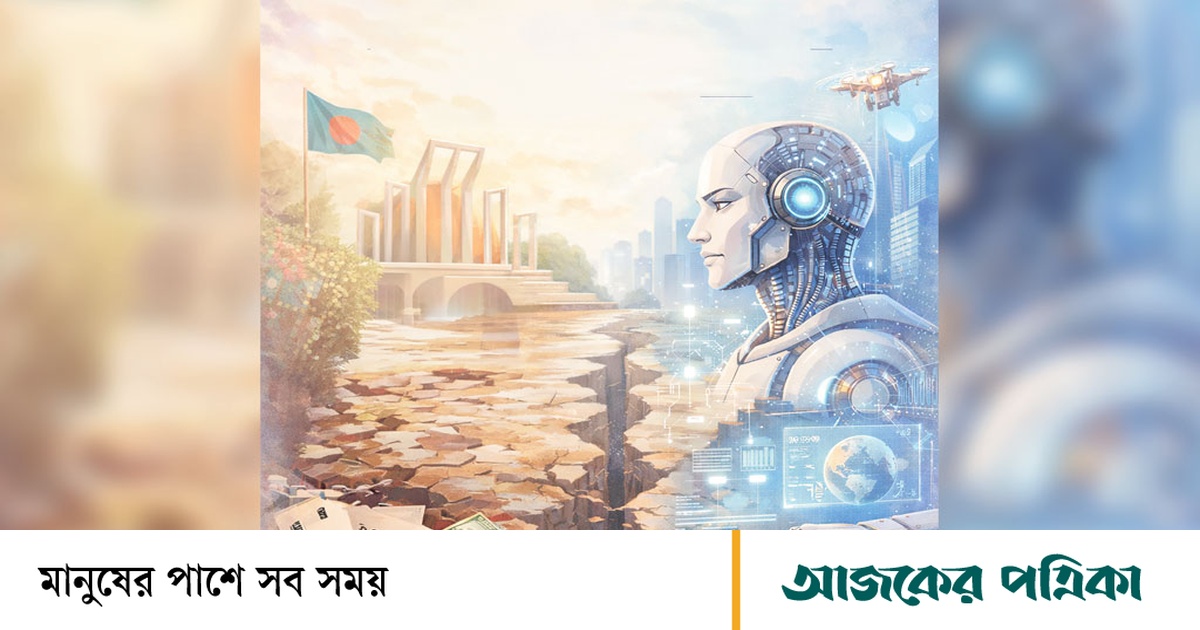
Our Bengali language is one of the richest and most vibrant in the world. Literature, music, drama, film, research – through everything, Bengali is not only a medium of communication; It is the foundation of our history, identity and creativity.
The power of language in the digital age is determined by its technological presence. Languages that are strong in artificial intelligence, search engines, voice assistants, data platforms and software economies will survive in the future.
In Bangladesh, the National Artificial Intelligence Strategy was formulated in 2020 under the slogan ‘AI for Innovative Bangladesh’. The draft National AI Policy of 2024 identifies AI as a central technology to implement Smart Bangladesh 2041. The ambitions in this policy are clear—data governance, ethics, intellectual property, research and innovation—are all there.
An important chapter in this journey was the ‘Bengali Language Enrichment Project in IT’ 2017. Inspired by personalities like Prof. Muhammad Zafar Iqbal, initiatives were taken to strengthen the foundation of Bengali corpus, speech recognition, text-to-speech and language technology. This project has benefited us in two ways. Firstly, this project first gave us confidence that we can develop new technologies using local resources. Second, many key contributors to the latest national AI policymaking have grown through this project.
Although this achievement does not represent much of the work of the Ministry of Information and Communication Technology; Rather, they have historically been vehemently accused of corruption and inefficiency. This is the biggest risk to our language in the AI age.
The world’s leading AI corporations; Examples include OpenAI, Anthropic, and Google’s Gemini—using massive amounts of online content to train their models. That content includes Bengali language literature, news, research, blogs, artworks, folk culture and motifs; Which is created by artists and writers of Bangladesh. The question is, what are they getting in return for this creative work?
If an AI model acquires linguistic skills by reading millions of Bengali texts, generating new texts, translating, analyzing or being used as a commercial product; So where is the recognition, permission or remuneration of the creators of the content used in that training?
The National AI Policy addresses intellectual property and data governance. But at the international level, have we visibly demanded that there should be a structure of transparency and compensation in the use of Bengali language content?
To clarify the matter, I have given the image of Jamdani saree made with Google’s Nano Banana and OpenAI. These two pictures had to be made by spending money. But did our jamdani artisans get a share of that money? I’m sure they didn’t.
Allegations of opacity surrounding Aspire to Innovate (A2I) among leading companies in our IT sector have been discussed in the media at various times. Determining the truth of the allegations is a matter of judicial process; But organizations leading the digital transformation must have maximum transparency and accountability.
Similarly, the rapid increase in wealth of former state minister Junaid Ahmed Palak has been discussed in the media, which has raised questions in the public mind. Wealth growth is not in itself evidence of corruption; But in a democratic system, transparent explanation and independent verification are essential for abnormal wealth growth.
Recently, the special assistant of the former chief adviser, Faiz Ahmad Tayyab, has also been criticized at various times. It is for the court to prove the complaint; But the behavior, transparency and policy integrity of those in positions of power are directly related to public trust.
Another long-standing public issue is government officials’ close ties to Silicon Valley tech giants, corporate-sponsored foreign trips or participation in conferences. International connections are essential; But the question is, are these relationships weakening policy strength? Is the state prioritizing the interests of citizens, or is it important to maintain good relations with multinational technology companies?
Today, author organizations in Europe are going to court over the use of copyright in AI training. Licensing agreements are being made by the media. But in Bangladesh, have we raised the demand, we must ensure fair compensation in the case of using Bengali language content?
Critics have been saying for a long time that the leadership of the previous Information Technology Ministry did not adequately protect our children and teenagers from the negative effects of social media. That experience is a warning to us. If we do not take a firm stand now on transparent policies, accountability and fair protections for creative labour, the same failure will be repeated; Especially when organizations like OpenAI, Anthropic and Google are using huge content for commercial gain, without proper policy protection, our cultural motifs including artists, creators, writers of Bangladesh may remain unsafe.
However, I am not sure if our Ministry of Science and Technology is ready for this new world, plagued by allegations of corruption and inefficiency!
Author: Theoretical quantum computer scientist, USA

