

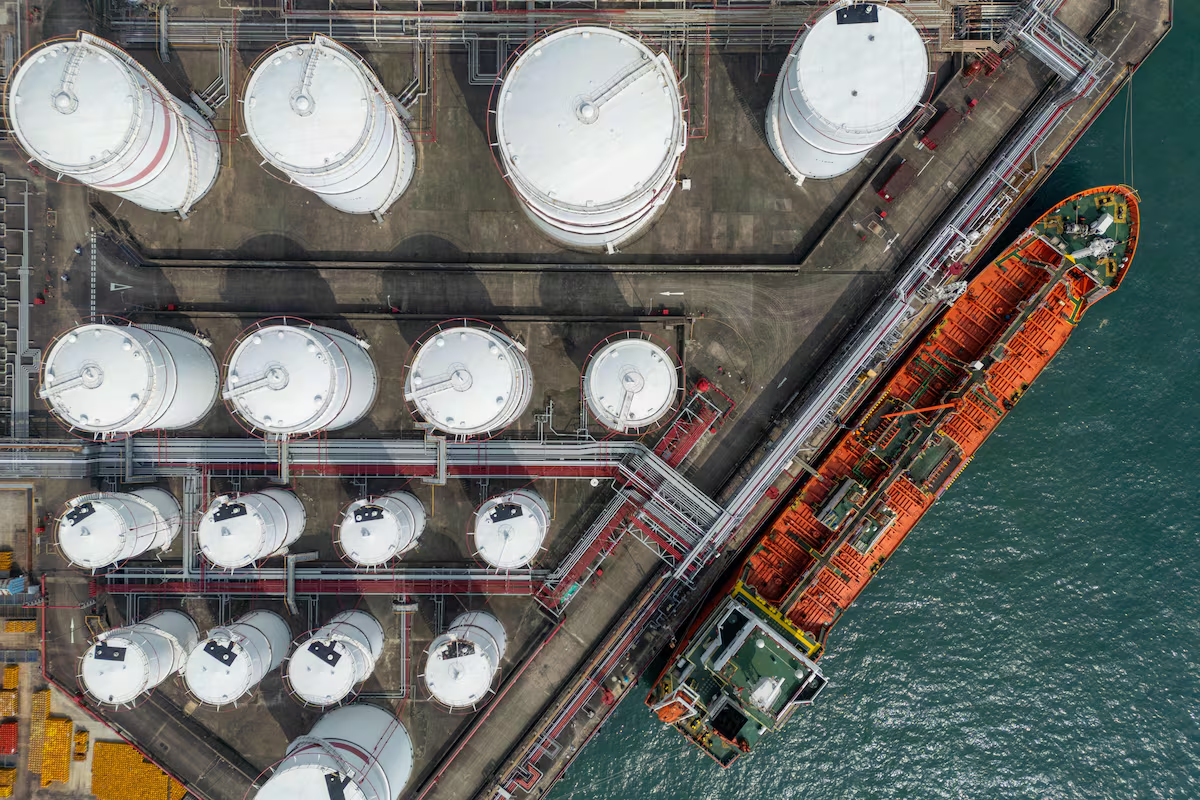
The world’s large economies are already contemplating the possibility of releasing more barrels of their strategic reserves, when they have not yet been deployed the 400 million announced just two weeks ago. The International Energy Agency (IEA), the body that coordinates the response of 32 countries to the energy crisis, is consulting with governments in Asia and Europe about the release of more stored oil after finding that more than 40 energy facilities have suffered “severe or very serious” damage in nine Middle Eastern countries since the start of the conflict. Repairing these infrastructures will take time, pointing to a prolonged disruption to energy flows.
“If necessary, of course we will do it. We analyze the conditions, we evaluate the markets and we discuss it with our member countries,” said Fatih Birol, the AIE executive director, in a meeting with the press in Canberra (Australia), where the director has begun a world tour.
On March 11, IEA member countries agreed to release 400 million barrels of oil from their strategic reserves, the largest coordinated operation of this type in the organization’s history. That amount is equivalent to around 20% of its emergency reserves. However, much of that volume has not yet reached the marketsince its deployment is being carried out gradually and coordinated between regions.
The possibility of a second move even before the first is completed reflects the magnitude of the energy crisis facing the world. The effective blockade of the Strait of Hormuz, a key passage for global energy trade through which around a fifth of the world’s oil and gas circulates under normal conditions, has set off all the alarms. And although the president of the United States, Donald Trump, has announced that it will postpone the attacks for five days to Iranian energy facilities, doubts about the scarcity of black gold remain, because even with the reopening of Hormuz, the flows would still take some time to recover.
The IEA has already described this situation as the largest supply interruption in the history of the oil market. As he explained, the current crisis has caused the loss of 11 million barrels of oil per day, a figure that exceeds the combined impact that the energy market already suffered in the seventies. “In the crises of 1973 and 1979, a total of 10 million barrels per day were lost. Today we are above that level,” Birol said last week.
The deterioration is not limited to crude oil. In the gas market, the disruption is also large-scale. The IEA estimates that 140 billion cubic meters of supply have been lost, between exports of liquefied natural gas from Qatar and the United Arab Emirates and regional consumption. It is a drop almost double that recorded after the Russian invasion of Ukraine, which already represented a historic shock to the global energy system.
The blockade of maritime transit through the Strait of Hormuz not only affects oil and gas, but also other strategic products. A third of the world’s fertilizer trade, nearly a quarter of petrochemicals, and approximately half of global sulfur travel through this route. Qatar also concentrates about a third of the world’s helium production, a key input for the technological and medical industry. The paralysis of these flows introduces additional risks, from higher food prices to tensions in industrial chains.
“Some of the vital arteries of the global economy, such as petrochemical products, fertilizers, sulfur and helium, see their trade interrupted, which would have serious consequences for the world economy,” Birol has warned.
In this context, to the strategy from AIE combines measures of supply and demand. On the one hand, the release of reserves seeks to provide liquidity to the market and contain the escalation of prices. On the other hand, the organization has urged governments, companies and citizens to reduce oil consumption through measures such as teleworking, reducing speed limits or cutting air travel.
However, the IEA itself recognizes the limits of these tools. “A release of reserves will help calm the markets, but this is not the solution. It will only help mitigate the impact on the economy,” Birol stressed. The director of the organization insists that the key remains geopolitics. The reopening of the Strait of Hormuz is “the most important solution” to restore the stability of energy flows.
Meanwhile, pressure is especially concentrated in Asia. Birol pointed out that the Asia-Pacific region It is “in the first place of the crisis”, due to its high dependence on imports of oil and other products that cross the strait. For this reason, the IEA is intensifying its contacts with governments in the area in search of a coordinated response. Birol even stated that the current situation is equivalent to the oil crises of the 1970s and the gas crisis of 2022 combined. A diagnosis that summarizes the dimension of an episode that is no longer perceived as transitory, but as a structural threat to global energy security.
In this scenario, the possibility of new crude oil releases before completion reflects that the IEA is preparing for a longer and deeper crisis than initially expected.

