

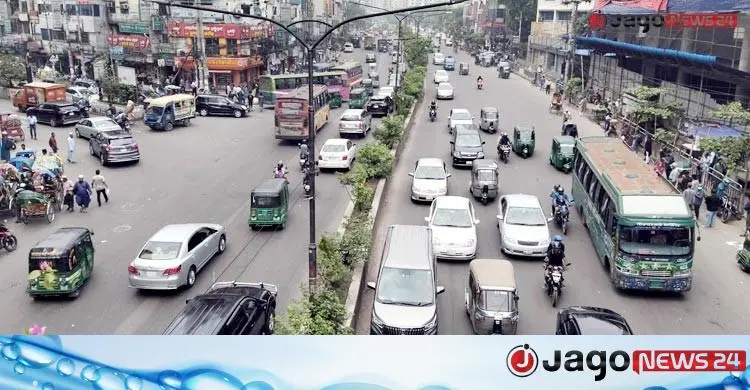
In the ongoing war situation in the Middle East, the whole world is in trouble with energy. The country’s energy sector has also been affected. Due to shortage of supply, there has been a deadlock in oil pumps across the country including the capital. Many pumps are closed, while drivers of various vehicles have to wait for hours to get fuel from the ones that are open.
The deadlock, which has been going on for almost a month, has had an adverse effect on the roads of the capital. Not getting the fuel supply as per the demand, the owners and workers have taken half of the public transport on the road. It has increased the pressure of passengers on the limited number of public transports. Especially during the beginning and end of the office, the extra pressure of passengers is being noticed. Waiting for the bus for a long time is not enough time. Again, even if you get a bus, you have to suffer a lot because the number of passengers is more than the number of seats.
The bus is really a race to see who gets on first/Photo: Jago News
On Wednesday (April 8), he was seen walking around different areas of the capital and talking to transport workers.
‘They are giving us only 20 liters of oil. Earlier, we used to have about 350 cars every day. Now due to oil crisis, there are 150 to 160 cars on the road. Earlier we could beat the fare by making six trips a day. Now I can make a trip all day long.’ —Ashiq, assistant driver of Savar Paribahan
Even after standing for a long time at the stop, the desired bus does not meet
The number of buses was relatively less on various roads of the capital on Wednesday during the closing hours of the office. As a result, homebound people have to suffer. The desired bus could not be seen even after standing for a long time at the stops. The buses that were running were packed with passengers. As a result, there is no opportunity to get new passengers. In spite of this, many people are seen hanging on the bus gate and leaving for their destination.
Read more
Bangladesh may be the first country to run out of fuel due to Iran war
Fuel crisis, cars that can reduce costs
In-principle approval for purchase of 3 lakh tonnes of diesel to meet emergency fuel demand
Motorcycle mechanics hit by fuel crisis, parts business stagnant
The number of buses and trips has decreased due to lack of sufficient fuel
Ashiq, the driver’s assistant of Savar Paribahan said, ‘They are giving us only 20 liters of oil. Earlier, we used to have about 350 cars every day. Now due to oil crisis, there are 150 to 160 cars on the road. Earlier we could beat the fare by making six trips a day. Now I can make a trip all day long.’
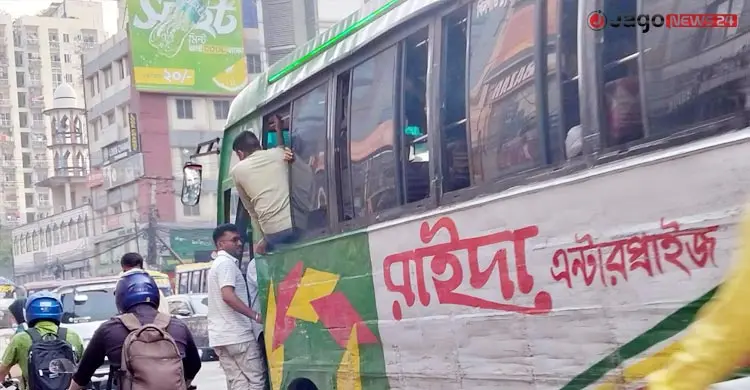 Many people are seen hanging on the bus gate going to their destination/Photo: Jago News
Robin, the driver’s assistant of Labbaik Paribahan, said that there is no oil at the pump. So the oil will not affect the movement of the car brother? Due to the oil, the owner is not even able to get all the cars out on the road. I can’t even pay the rent properly.
“Since the oil crisis, the traffic has increased. Earlier it was possible to travel by standing at the bus gate or inside. And the number of cars that are running now do not have the environment to stand at the gate. Due to the oil problem, there are fewer cars on the roads, more traffic problems for people.’—Shikdar Akash, a passenger waiting for a bus.
Samiul Alam Sabuj, the driver’s assistant of the address transport, said that if you want to bring oil to the pump, you have to be in the serial first. Secondly, we are not getting enough oil even after standing in the cereal all day. That’s why we can’t drive properly. We are suffering a lot.
He said the number of cars on the road has also decreased due to the oil crisis. As many cars as we used to come out, now half of them are coming out on the road.
Anwar, the driver’s assistant of Welcome Paribahan, said that the number of cars on the road has decreased due to the oil crisis. Earlier we used to have 60 to 70 cars per day. And now 40-45 cars are moving.
Sagar, assistant driver of Gabtali Link (No. 8) bus, said that many vehicles have reduced on the road due to the oil problem. During office hours the road is very crowded with cars but now there are less cars.
We have observed that since the energy crisis, the movement of private transport has decreased by about 50 to 60 percent. And the number of public transport has decreased by 20-25 percent. As a result of the decrease in the number of cars, passengers are suffering on the road. Mozammel Haque Chowdhury, General Secretary, Passenger Welfare Association
Pointing out that the pressure of the passenger increases during the beginning and end of the office, he said that there is a lot of pressure on the passenger at the time of the end and the beginning of the office. But due to the oil crisis, the number of cars on the road has decreased.
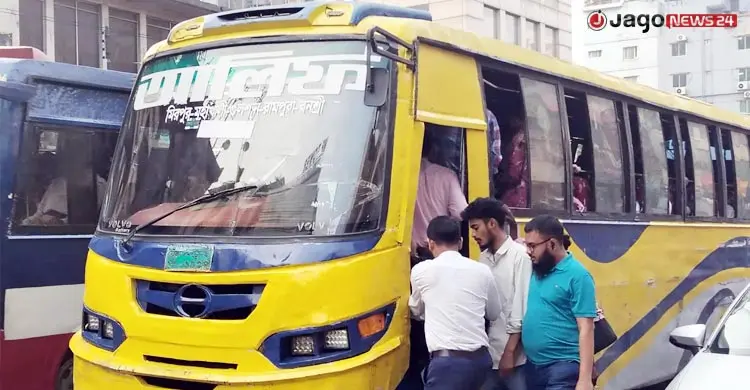 Commuter pressure is highest at the beginning and end of the office/Photo: Jago News
Sagar also said, “Earlier our company used to have about 200 vehicles. And now 100, at the highest (if more) 120 cars are running. No oil was given to the car yesterday. Later today only 20 liters of oil was given because of talking too much.’
Endless suffering of city dwellers due to public transport crisis
Meanwhile, commuters are suffering due to less traffic on roads than required. Many times we have to wait for hours for the bus. Many people have been seen traveling by rickshaws or autorickshaws with extra fare.
Read more
Energy crisis around the world, various measures in the country
Fuel Crisis: What Car-Bike to Use for Short Trips
The income of motorcyclists has dropped from 1500 to 300 taka
Shikdar Akash was standing at the Shyamoli bus point of the capital waiting for the car after finishing the office. He said to Jago News, “Since the oil crisis, the traffic has increased. Earlier it was possible to travel by standing at the bus gate or inside. And the number of cars that are running now do not have the environment to stand at the gate. Due to the problem of oil, the number of cars on the road has decreased, the traffic problems have increased for people.
Another passenger named Laizul Islam said, ‘What else can I say about suffering, brother. We are the middle class people living in Dhaka – they don’t have their own cars, they don’t have the money. So no matter how much suffering, public transport is our only hope. Since the onset of the oil crisis, travel has become more difficult than ever before. But we have endured, adapted everything.’
What the concerned say
General Secretary of Passenger Welfare Association. Mozammel Haque Chowdhury told Jago News, “We have noticed that since the energy crisis, the movement of private transport has decreased by about 50 to 60 percent.” And the number of public transport has decreased by 20-25 percent. Due to decrease in the number of vehicles, the commuters are suffering on the road.
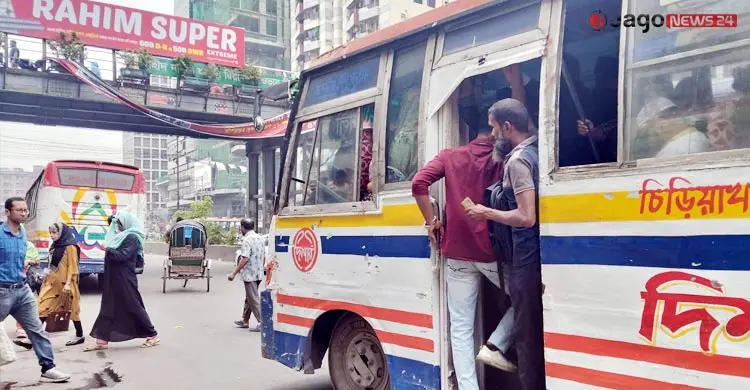 Waiting for long time at bus stops, not meeting the desired bus/Photo: Jago News
Citing the example of making public transport free for common people in Pakistan, Muzammel Haque further said that as a result of such initiatives private transport stops, everyone becomes dependent on public transport. Due to lack of private transport, demand for fuel is reduced. A public transport carrying 50 people is using the same amount of fuel as one person taking a private car on the road. Therefore, he also opined that the government can follow such policies to deal with the energy crisis.
KR/MMK
You can also write on JagoNews24.com, a popular online news portal. Writing topics feature, travel, lifestyle, career, IT, religion, agriculture and nature. Submit your essay today [email protected] at the address

