

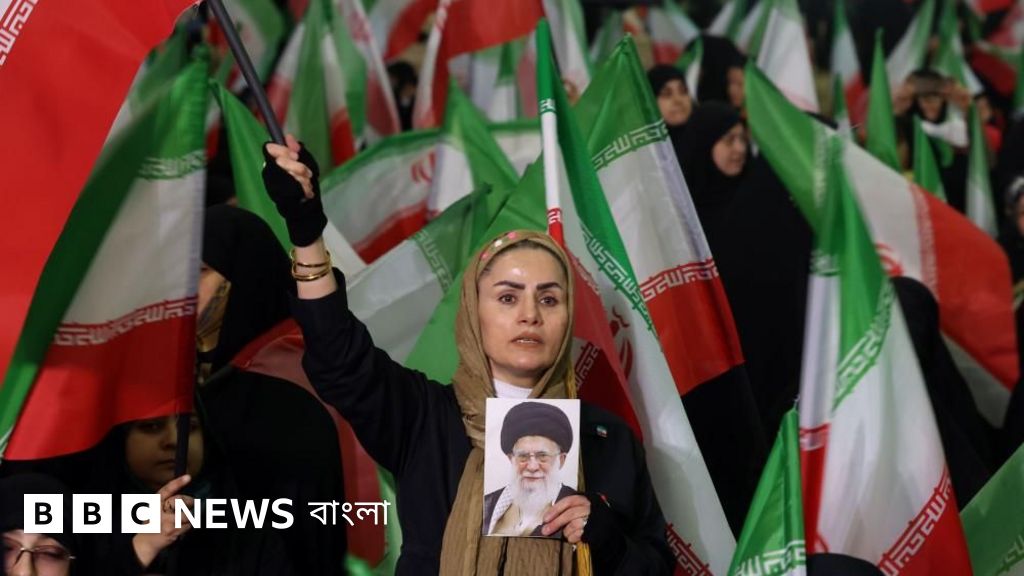
image source, EPA
In the history of the Islamic Republic of Iran, today can be said to be a crucial and decisive day.
When it became clear on Saturday morning that the residence of Supreme Leader Ayatollah Ali Khamenei had been targeted by US and Israeli strikes in the first round of strikes, news and rumors swirled about the possible consequences.
Satellite images showed his compound severely damaged.
The first response from Iran was that he had been evacuated to a safe place.
Then came news that the 86-year-old religious leader would address the country’s state television, though that ultimately did not materialize.
Israeli Prime Minister Benjamin Netanyahu said in a televised address shortly after dusk that “many signs indicate” that Iran’s supreme leader “is no longer alive”.
A series of reports published in the Israeli and US media, citing multiple officials on condition of anonymity, continue to say that there is credible evidence of the death of Iran’s supreme leader.
And all the while Iranian officials were denying it.

image source, Reuters
Preparation was Iran
But then, hours after US President Donald Trump announced the death of Ayatollah Ali Khamenei on his social media, Iranian state TV confirmed that the country’s supreme leader had been killed.
Such news is a defining moment in the tumultuous history of the Islamic Republic of Iran. However, the country’s powerful religious leaders and military commanders were already preparing for such a scenario.
Those preparations were accelerated by the 12-day war with Israel in June last year. Israel killed nine Iranian nuclear scientists and several security chiefs in the first round of strikes on the first night.
Several other senior scientists and at least 30 top military commanders were killed in Israeli strikes over the next few days.
It was also made clear at the time that the Ayatollah could also be among their targets.
According to various reports at the time, Ayatollah Ali Khamenei, who was stationed in a special bunker during the war, was preparing a list of security officials who could take over immediately if necessary to prevent a possible vacuum at the top level of power.
Even before last year’s conflict, Khamenei ordered the Assembly of Experts, a body of 88 senior religious leaders responsible for electing the supreme leader, to be prepared for all possible scenarios.

image source, Airbus
The New York Times reported at the time that Khamenei himself had selected “three senior religious leaders” as potential successors in the event he was assassinated.
There has been speculation for years about who might succeed him, with his son Mojtaba Khamenei being the most prominent.
Although Supreme Leader Ayatollah Ali Khamenei was killed in the first day of airstrikes and targeted strikes, those still in charge or who have risen to senior positions will now want to show that they are still in control and that the leadership transition will be seamless.
But the end of the Ayatollah’s 36-year rule is a major blow to his supporters, especially his close aides and allies.
A large portion of Khamenei’s close aides and allies are members of the elite Islamic Revolutionary Guards Corps (IRGC), whose responsibility it is to protect him and Iran’s Islamic Revolution – both at home and abroad.
But video verified by the BBC showed some people on the streets of Tehran and Karaj cheering Khamenei’s death.
Khamenei has ruled harshly with deep suspicion of the Western world, especially the United States, and hostility toward Israel.

image source, Getty Images
He harshly suppressed calls for reform and continued protests.
Khamenei has faced the biggest challenges in recent years.
Because Iran has a direct military conflict with Israel and the United States, and at the same time, Khamenei’s regime is facing increasing demands for change from the people of the country.
Iran seemed like a very different country when the BBC was in Tehran earlier this month.
The wounds and anger across the country were once fresh after the death of thousands of Iranians in the worst crackdown in the country’s history at the hands of security forces.
But on Saturday, the new conflict between the United States and Israel has turned the tables.
After the sudden departure of Khamenei, all eyes are now on his successor.
Besides, whether this change at the top of the power will lead to any change in the governance of the 47-year-old Islamic Republic is now a matter of question.
But whoever emerges, their main objective will remain the same – and that is – to ensure the survival of a system where religious leaders and their powerful security forces are at the center of power.
But the war, which is not yet over, has already begun to move down an uncertain and dangerous path.
https://www.bbc.com/bengali/articles/c70kr9znx19o?at_medium=RSS&at_campaign=rss

