

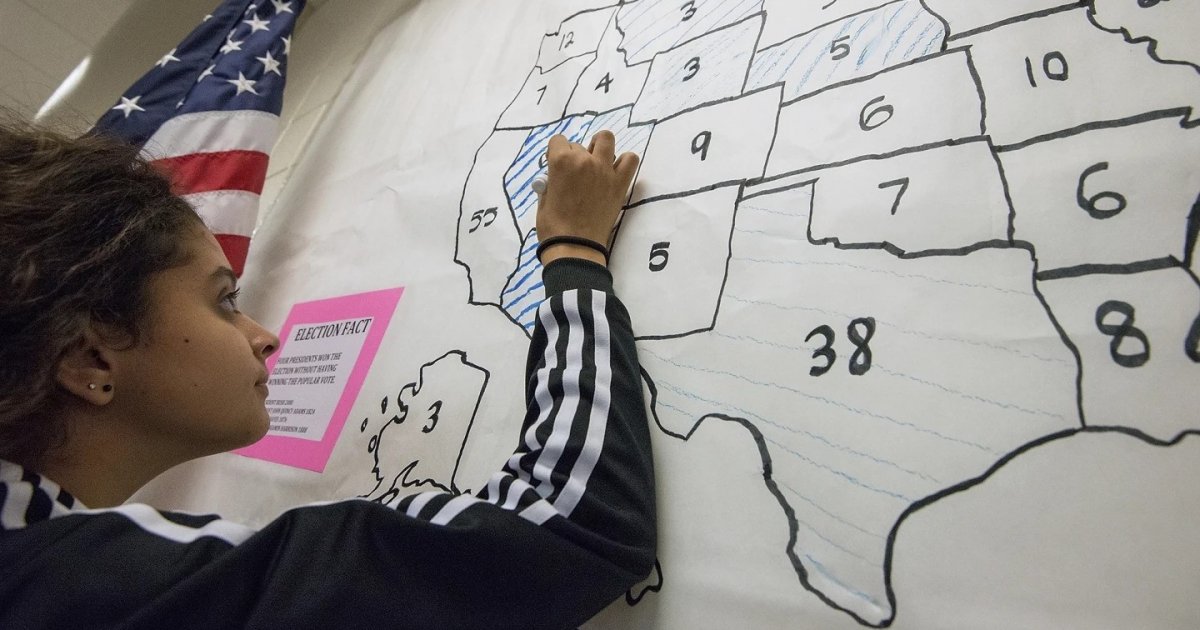
Even in ancient democracies like the United States, the people cannot directly elect a president. The election of the President is done through a special system called the Electoral College, which has been in place since the 18th century. There has been growing criticism of this system recently. Because in some cases the candidate who got the most popular vote was defeated. In particular, George W. Bush and Donald Trump were elected as US presidents in 2000 and 2016, respectively, despite losing the popular vote.
What is the Electoral College?
According to Article II of the US Constitution, the election of the President is done through a specific process. Each state in the United States determines the number of electors or election workers based on the number of delegates to Congress. A candidate needs at least 270 votes out of 538 electors to be elected. Most states follow a 'winner-takes-all' policy, where the candidate who wins the state's popular vote receives all the electoral votes. But Maine and Nebraska allocate electors differently. In these two states, the statewide winner receives some electoral votes, and the winner of each congressional district also receives electoral votes.
Introduction and Requirement of Electoral College
During the drafting of the Constitution in 1787, there was great controversy over the method of electing the chief executive of the United States. Initially, the proposal was made to elect the President through the Congress, but it is feared that the executive branch may come under the influence of the Congress. There was also a proposal to elect by direct vote. But it was canceled due to the objection of the southern states. They fear weakening the popular vote. Because at that time slaves were counted under the three-fifths compromise, but they did not have the right to vote. Finally a special committee proposed the Electoral College system. which is adopted on the basis of an agreement between different states.
What is 'swing state' or 'oscillating state'?
'Swing states' are states that both candidates have a chance of winning. Currently, such states are Pennsylvania, Wisconsin, Michigan, Georgia, North Carolina, Arizona and Nevada. These states will play an important role in the 2024 elections.
There have been five times in US history where a candidate who won the popular vote lost the electoral vote. It highlights the inconsistencies and flaws of the Electoral College system. The electoral college system determines the representation of the people based on the number of electors in each state. As a result, the votes of smaller states are weighted more. For example, one elector in California represents over 7 million people. Also in the state of Wyoming one elector represents about 200,000 people.
Are electors bound to vote for a particular candidate?
Each state appoints its own electors. who are generally considered loyal to the party. However, seven electors did not vote for their promised candidate in 2016. Most states have laws that require electors to vote for specific candidates. The US Supreme Court ruled in 2020 that states can compel electors to comply with requested instructions.
Efforts to abolish the Electoral College
Several attempts have been made to abolish the Electoral College. In 1968 there was a national debate on this issue. But the proposal did not pass in the US Senate due to the opposition of the southern states. Recently the National Popular Vote Interstate Compact initiative is gaining popularity. At least 270 electorally-voted states have united to award the electoral vote to the candidate who wins the national popular vote. So far 17 states and Washington DC have joined the initiative.
How likely is the abolition of the Electoral College?
There is an initiative called the Popular Vote Interstate Compact to abolish the Electoral College. However, the Republican ruling party in most of the states did not support this initiative. Besides, there are questions as to whether it is unconstitutional or not, and the issue may be raised in the US Supreme Court.
Source: The Guardian

