

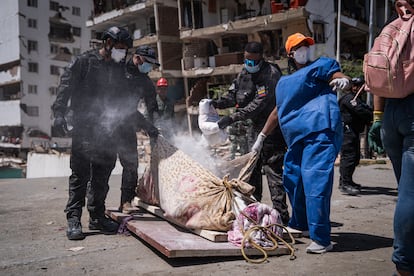
The thanatologist has two dead women at her feet and a daughter who screams, torn, for her mother. One of the bodies has been in the sun for more than an hour, covered with sheets and blankets. They have put lime on top to make it smell a little less. Finally they are going to take them away in a van, but you have to write their names and their ID number so that they are not just white bags. Others more. “Does anyone have a piece of paper? Something to write on? Anyone!?” she screams desperately. In Venezuela’s worst tragedy of the last century There are even labels and markers missing to name the dead.
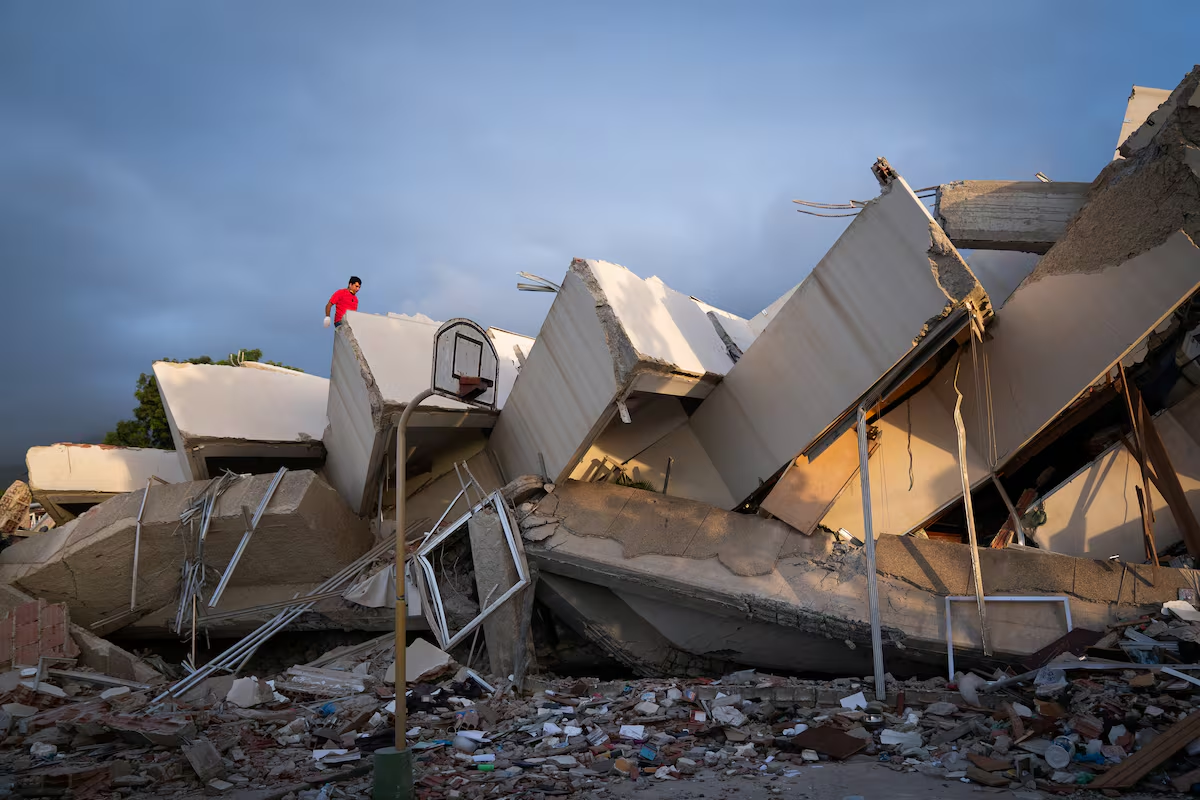
This Saturday, almost 72 hours after double earthquake that shook the north of the country, La Guaira, the most devastated areait smelled like death. The stench, increasingly stronger, enters through the nose, soaks into clothes, backpacks and masks and never leaves. After the announcement of 1,450 deaths, authorities spent Saturday collecting up to 20 deaths per hour, according to official sources. There is nowhere to put them. The Government of Delcy Rodriguez has improvised eight new morgues where corpses are piled up. There is less and less chance of finding people alive and what is under the rubble remains a mystery. It will take weeks, or even months, to remove the remains of the dozens of buildings reduced to rubble.
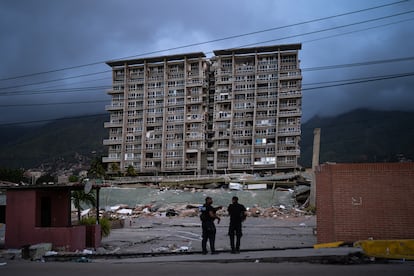
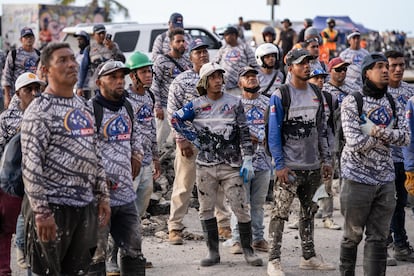
Arrival to the area from Caracas normally takes just over 40 minutes, but these days it has taken hours. Thousands of people they wanted to go help. The tour of the city shows green areas full of families who have improvised camps, huge towers as if they had melted, swimming pools hanging from cliffs, entire buildings folded in on themselves and many Venezuelans with their shovels on their shoulders. Also public officials, the same ones who sweep the streets or make the roads. Humble people. Exhausted. In shock. And, above all, sad. The dimension of the tragedy has overwhelmed everyone.
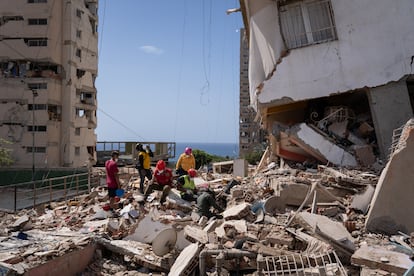
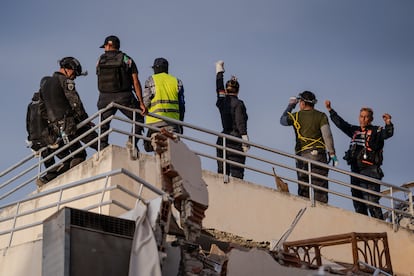
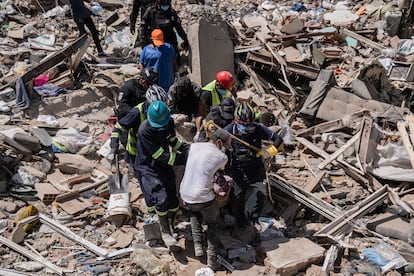
In La Guaira, a vacation spot facing the Caribbean Sea, there is a constant noise of motorcycles, trucks and backhoes, but from time to time there is almost total silence. When everyone shuts up and turns off their engines, there is hope. It’s because a moan was heard. A scream. And that’s when someone, with bare hands and a construction helmet, ends up getting into the rubble to look for the sob.
This Saturday it happened several times. Faced with the scream that came from a ten-story building, so inclined that it seemed like it was going to collapse at any moment, a young man without thinking got into the guts of the waste dump. People waited for him, holding their breath until he emerged with his legs shaking and covered in dust. Decomposed. Several of them had to assist him, clean his face with water, pour alcohol into his nose and hold him. “I can’t get rid of this smell,” he said. The boy did not find the cry: “Only blood and bodies”.
Precariousness reigns in the apocalypse. “Don’t go,” asks the thanatologist without a notebook. “You have to show how we are doing this with nothing. They say that a lot of international help has come, but I haven’t seen anything here. It’s a disaster and we can’t do this alone.”
In La Guaira there is still a lack of even alcohol to disinfect wounds. Thousands of neighbors are without electricity and water. They heat dishes with candles, they can’t flush the toilet. Here the stretchers are still wooden doors. The body bags, sheets and hearses, the vans that until now pursued environmental crimes and animal abuse. Or, really, any van that can fit a dead body. Where the refrigerators should be there is lime, thrown up by a truck that was passing by.
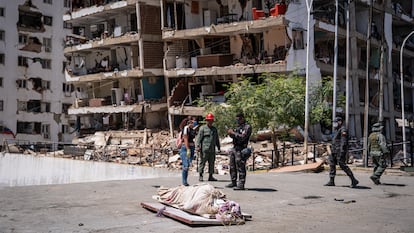
In the disaster area there are 25,000 Venezuelan officers and 2,741 international rescuers, and everything, authorities say, is coordinated. But on the street it’s hard to know who’s leading. In another rescue attempt, when everyone was silent, a police officer came out of the building in pieces, angry: “Bah! There are 300 damns in charge.”
The role of the military in this tragedy remains puzzling. There is someone in charge of the emergency and the uniformed men are everywhere, but they are not seen with shovels, but rather in the streets directing traffic, standing in groups talking or controlling some areas. Or, at least, trying.
This Saturday, a major from the Bolivarian militia—the reserve—appeared trembling with rage at the door of a housing development under his command. He stood small in front of the 20-story building, looked up and shouted: “We are not responsible if something happens to you!” His men had been sneaked in by several people who were looking for their things even at the risk of collapse. “We already said that they could not enter until they come to inspect; the aftershock is being very constant, slight but constant,” explains the major. They warned them, but no one paid them attention, the uniformed men justify themselves. And it doesn’t seem like they imposed much either. The world seems upside down: the military that has instilled so much fear in Venezuela for years today cannot even prevent some neighbors from passing through the door that they themselves guard.
In the remains of another building, facing the sea, two Navy officers confessed their exhaustion. “We’re going for four days without sleep,” says one, warning that he’s going to get in trouble if he talks too much. He admits to having cried these days when meeting his family. The other says he hasn’t even had time. “We were not prepared for this. We do not have the means,” he acknowledges. “And we were coming from the bombing of January 3,” he points out, in reference to the early morning in which the United States passed over them to take Nicolás Maduro.
Alvear Rodríguez, 78 years old, appears with his right arm bandaged, where a huge bruise and a nail are visible through the bone. He walks tiredly with two plastic bags of groceries and asks to be taken to the house where a neighbor is hosting him. He tells his story in the car, along a road full of blocked streets and chaotic traffic. On the Wednesday of the earthquake, a woman had told him that her apartment had burned down, it was not known if her people were inside. “I’m diabetic and this drives me crazy,” he says. The old man walked out, went through all the apartments asking questions, and no one knew anything. “I already wanted to start crying,” he says as he passes by that group of humble, standing but burned-out houses where his daughter lived with her family. found them alive.
At the end of the route is Juan Manuel Chirino, a thin and humble man who has not moved from the sidewalk for three days, in front of the building that swallowed his people: his son —Juan Manuel, like him—, his daughter-in-law, Jemily Hernández, and two grandchildren, ages 6 and 10. He says that they were taken out hugging. He says he saw them. And he is there disoriented, not knowing where to go, asking for them to be handed over to him. They send him from one hospital to another, they tell him to come back tomorrow, that there is no vehicle to transport the bodies. People from the neighborhood took her family out with their hands, when no one with the authority to decide who entered and who did not had yet arrived. And when they found them, there probably wasn’t a pen or paper to write down their names. Chirino goes from crying to indignation: “The earthquake did not kill these people. The Government killed her”.
https://elpais.com/internacional/2026-06-28/venezuela-se-salva-con-sus-propias-manos.html

