

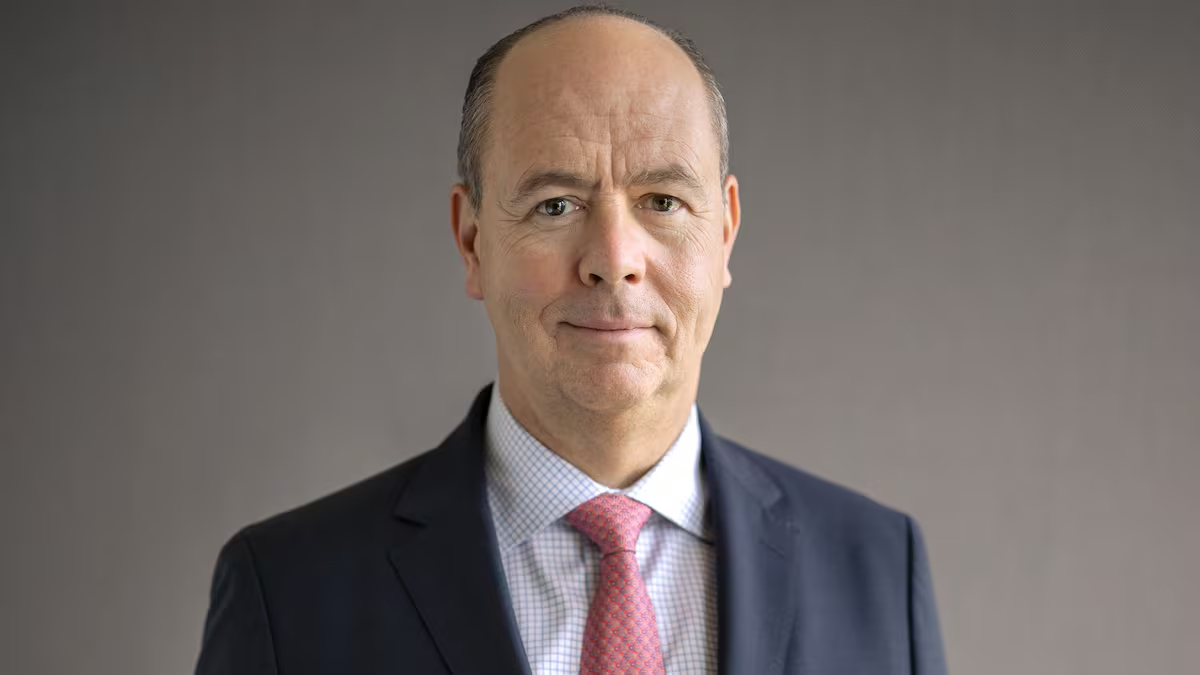
The world economy has avoided the most adverse scenario, that of a serious energy shortage that persistently drives inflation and limits growth. Gaston Gelos (Montevideo, 57 years old), deputy director of the Monetary and Economic Department of the Bank for International Settlements (BIS)—the entity that brings together banking supervisors from around the world, the bank of central banks—acknowledges that the agreement between the United States and Iran to stop the war and reopen the Strait of Hormuz removes the worst of the assumptions, although he insists that “there are still risks.” Not only in relation to the recovery of oil supply from the Persian Gulf but also in the multiple challenges that the economy faces in the medium term. From the sustainability of AI investments, through the weakening of fiscal positions and the reinforcement of financial vulnerabilities, in a market in which sovereign bonds are increasingly closely connected to non-bank financial intermediaries, especially hedge funds.
“The high leverage of these funds can turn small adjustments into large tensions. This vulnerability is important. Liquidity can evaporate quickly when there is a shock,” says Gelos in an interview online with this diary. His warning is very present in the annual economic report published this Sunday by the BIS and in which he also alludes to very burning threats. In a world that is beginning to recover from the energy shock caused by the Hormuz blockade, the great unknown remains as to how much the magnitude of the blow will be, that is, how long it will take for inflation to recover.
The ball is now in the court of the central banks, which the BIS warns in its report. “With the rebound in post-pandemic inflation still fresh in our minds, the risks that even temporary supply shocks will trigger second-round effects and persistent inflation should not be ruled out,” the BIS annual report states. The ECB raised rates in June, in a decision that Christine Lagarde has defended it as justified and not preventivey the Fed could raise them before the end of the year.
-What should be the role of central banks now?
-The task of central banks is to keep inflation expectations anchored in the medium term, but at the same time avoiding an exaggerated reaction to its initial effects. It’s like walking along a ledge, anchoring expectations without overreacting. If inflation expectations increased, if the dynamics of prices and wages changed, and if demand pressures intensified, they would have to react. “The risks have decreased, but have not yet been completely eliminated.”
The resumption of the flow of oil is not going to be a bed of roses and the return to some normality is going to take weeks, if not months. What’s more, the oil market is hardly going to be the same again after Iran has shown that it does not hesitate to close Hormuz – it has the most persuasive weapon in its resistance against the United States – and the world has discovered its vulnerability to the lack of energy supply from the Persian Gulf.
For the BIS, according to the report, it is possible that the macroeconomic repercussions of the interruption of traffic in the Strait of Hormuz have not yet come to an end, while there are already clear signs of an increase in inflationary pressures. Achieving price stability will obviously depend on the price of energy stabilizing, without causing second-round effects on wages, and on the expertise of central banks. But the risks do not end there.
-Do you see the investment fever in artificial intelligence as a danger to financial stability?
-A disappointment in artificial intelligence could trigger an abrupt and strong correction in financial markets. The race for leadership in artificial intelligence can fuel overinvestment, as we have seen in previous waves of innovation.
Gelos does not distrust the benefits of AI and believes in its ability to improve productivity, although the BIS also warns against excesses. For the institution, the magnitude and pace of the current boom in investment in artificial intelligence, accompanied by expectations of significant benefits in terms of productivity, bears similarities to precedents such as the railway fever in the United Kingdom in 1840, the electricity boom in the 20s of the last century or the dotcom bubble of the late 90s. The BIS also warns of the risks of its implementation. Not only because of the avalanche of investment that it monopolizes, capable of unbalancing the financial market, but because of the bottleneck that it can create in the enormous supply of electricity necessary for its development and because of the effects on employment. “It remains uncertain whether advances in AI will create new jobs, or expand demand for existing ones, sufficiently to offset such displacements. Unlike general-purpose technologies of the past, AI competes directly with human cognitive abilities,” the institution notes.
The BIS also points out how the AI fever has permeated the entire plumbing of the financial system, which represents an added risk in an environment of higher inflation. “A tightening of official interest rates, necessary to contain inflation, could precipitate a sharp decline in asset prices after a prolonged period of exuberant risk-taking, triggering disturbing macro-financial vicious circles,” warns the BIS. What’s more, a major stock market correction could have a greater impact on the economy than in the past, due to the greater investment in the stock market by households, which would cause a greater decrease in wealth and consumption.
Despite the resistance that the global economy has shown in recent years, the risks extend in a financial ecosystem with more and more powerful actors, and a geopolitical scenario “more volatile and precarious than in the past,” recognizes the BIS, which never loses sight of the mountain of public and private debt that the large Western economies bear and to which private credit is also contributing.
-In addition to the avalanche of investment towards AI, what other risks do you see for financial stability?
-The growing and opaque interconnections between private credit and non-bank financial institutions and banks. We see fragilities in the financial structure of the bond market. And that is very relevant because the sovereign debt of several countries is at very high levels. We have a combination of high public debt with greater intermediation by non-banking actors, and particularly a greater role for hedge funds.
The closure of the Strait of Hormuz for more than three months has kept the world economy in suspense, but the BIS, in its task of financial supervision, points to the pending, and well-known, challenges for the medium term. “It is important for central banks to safeguard price stability and strengthen macro supervision beyond the banks. We must also promote structural reforms that strengthen productivity and fiscal policies that improve the fiscal trajectory, but at the same time minimize the damage to the economy, prioritizing spending that promotes productivity and growth,” concludes Gelos.

