

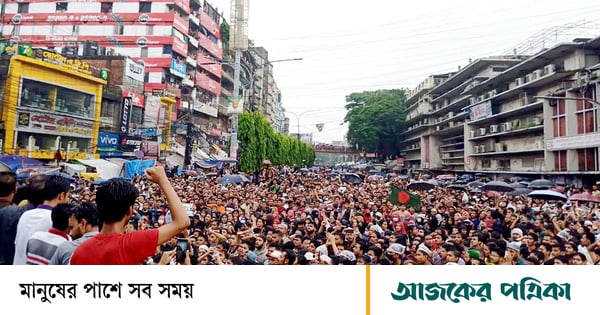
Through the movement, the resignation of Sheikh Hasina and the abolition of the 'fascist system' developed during her tenure, almost all the political student organizations of the country formed a unity. After 4 months of the fall of the Awami League government, the tone of disunity is playing among them. After emerging as an anti-discrimination student movement organization that led from the front in the July-August mass movement, most student organizations are apparently looking at the issue negatively. They accused the anti-discrimination student movement of getting priority from the interim government and the lack of coordination of anti-discrimination leaders with other student organizations.
Talking to the leaders and workers of various student organizations including anti-discrimination student movement, Nationalist Chhatra Dal, Bangladesh Student Union, Islami Chhatra Shibir, it is known that the student organizations have practically divided into two groups on the question of student politics. Among them, sections led by the anti-discrimination student movement and the Islami Chhatra Shibir have been campaigning for the banning of political parties' 'lazy' student politics on campus since the July-August coup. Although identified with different suffixes like 'Anga', 'Sahyogi', 'Bhratripratim' etc., all mainstream students, workers and professional organizations of the country are directly associated with some political party. This politics of student organizations has been criticized as 'Lejurvritti' since quite some time due to unquestioning adherence to the main political ideals, programs and activities of the political parties. However, student organizations are not liking the recent campaign to stop alleged 'lazing' activities in this particular political climate. Because they consider it a part of depoliticization process. According to the majority of organizations, this process is harmful for the overall politics of the country including student politics.
At the end of last month, an initiative was taken to form a 'National Student Council' by combining all student organizations, but significant student organizations including the Chhatra Dal did not respond to it. Their leaders say that although students are supposed to be involved in various initiatives of the interim government, only the anti-discrimination student movement and those associated with them are being taken into it. Leaders of student organizations affiliated to political parties did not receive invitations to the last meeting of student representatives with the chief advisor. They complained that the anti-discrimination and related parties are trying to continue by taking their own decision and calling it the decision of all student organizations.
In this regard, Jatiyatabadi Chhatra Dal General Secretary Nashir Uddin Nashir told Ajker newspaper that the chief advisor only discussed with a few coordinators in the name of discussion with student leaders. In this, the inclusive national unity that was promised in the wake of the July-August mass uprising has now been confined to the narrow confines of one party.
Samajtantrik Chhatra Front central president Salman Siddiqui told Ajker Patrika that the anti-discrimination student movement is taking decisions in an undemocratic way by excluding all organizations. National unity is being destroyed through this.
Saikat Arif, General Secretary of the Student Federation (Mass Solidarity) said that the anti-discrimination student movement has pushed other student organizations away by giving priority to their own group interests in all cases.
In such a situation, the political party-centered student organizations are conducting discussions to build a counter-unity by excluding the anti-discriminators. 28 student organizations including Jatiyatabadi Chhatra Dal, Student Federation (Mass Solidarity), Student Union, Student Rights Parishad, Islami Chhatra Andolan held a meeting online on Wednesday and Thursday at a restaurant in Kantaban of the capital. The representatives of anti-discrimination student movement and Islamic student camp were not invited in this meeting. Several sources present said that, apart from the anti-discrimination student movement and the Islamic student camp, other student organizations are trying to create unity. In the future, these organizations can continue programs on various national issues through 'simultaneous' or 'unified platforms'. The student organizations are scheduled to meet again this week.
Meanwhile, in such a context, the anti-discrimination student movement has demanded the election of the student parliament in the educational institutions from the last week of January. Hasnat Abdullah, convener of anti-discrimination student movement, made this demand after discussion with some organizations on Wednesday. At this time, he said that the student organizations present in the exchange of views want the election of all students including Daksu to begin at the end of January or the beginning of February.
Mainstream student organizations say they were not represented at Wednesday's exchange. Talking to some of the organizations present, it is known that there was no mainstream student organization other than the student camp. Abdul Hannan Masud, chief organizer of anti-discrimination student movement, said that 30 organizations were present at the meeting. However, others claim that there were not so many representatives of organizations in the exchange of views. Most of the organizations represented were formed after the coup.
When asked about this, Hasnat Abdullah told Ajkar newspaper, “We want student politics centered on the student parliament. We do not want any lame student politics of the “mother party” (main political party). Because then the power structure cannot be questioned. Student politics should be such that it can question the power structure. If the politics of implementing the agenda of the mother party, politics based on guest rooms and public rooms will be launched.'
Chibgatullah, literary editor of Islami Chhatrashibir and former president of Dhaka University, told Ajker newspaper, 'In the coming days, student politics is not based on party agenda; Rather, it should be governed by the rights of the students. Student politics will be for the welfare of common students. Student politics should not harm their academic subjects.
In the context of this division among the student leaders, the political analysts urged unity and said that the student organizations should stay united on important public issues such as India, Awami League, reforms, avoiding issues related to their own interests at the time of the nation's crisis. Political analyst and professor of government and politics department of Jahangirnagar University. Md. Shamsul Alam told Ajker newspaper, 'If unity is not maintained among the students, we will suffer. Various parties will take advantage. There will be differences of opinion on various issues, but it is necessary to be united now without making it big.'

