

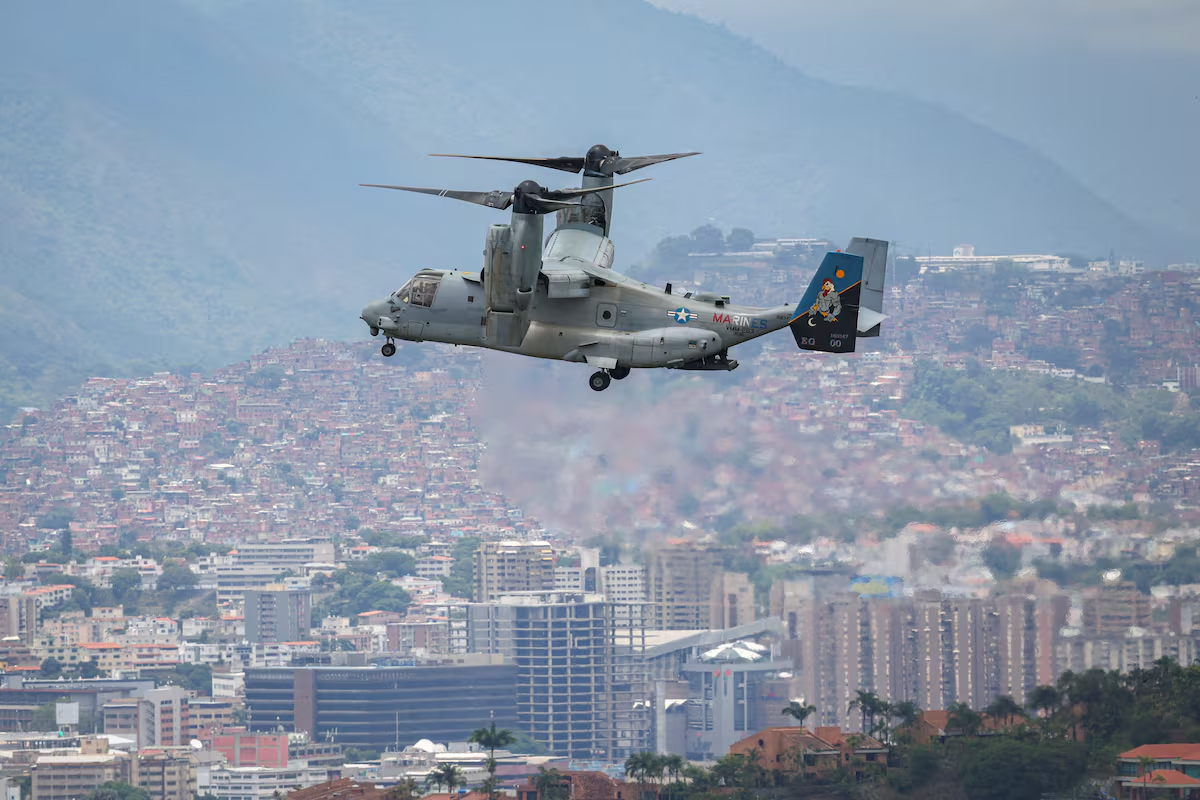
When the United States Army’s Osprey planes crossed the sky over Caracas on May 23 in a —perhaps unnecessary— military drill, something that had been silently fermenting for months finally came to light. The Chavista bases who supported the Bolivarian revolution for 27 years—the collectives, the party cadres, the popular movements—are revolting against the new order that Washington has imposed in Venezuela. The complaints and warnings from Chavista allies are increasingly open and harsh, although it remains unclear whether they are enough to put Delcy Rodríguez in trouble.
The reactions to the United States’ tutelage over the country since the military intervention of January 3, in which They captured Nicolás Maduro and his wife Cilia Flores, have gone from bewilderment to indignation. The former enemy of Chavismo, US imperialism, is now an ally that sets the rhythms of the country, carries out military maneuvers and even announces the international trips of the president in charge. And the bases that for decades shouted “Yankee go home“They don’t really know what to do with it.”
The unrest has been brewing in silence since January 3, but a few weeks ago, a guerrilla of chavista influencers began to raise the flag of betrayal. Two staunch propagandists of Chavismo, Mario Silva, host of the program The Bladeand the Argentine Diego Suárez, known as Michelo, turned up the volume on the complaint: those in power today, they said, cooperated with the imprisonment of Maduro and Flores in New York. They raised doubts about the toad that Chavismo is having the hardest time swallowing after the fall of its leader: the American baton.
When the noise on networks seemed to have subsided, The Venezuelan government itself handed over Alex Saab —Maduro’s closest collaborator, converted into a hero and martyr of anti-imperialism after years of campaigning in his favor— to American justice. The Colombian businessman is now a piece in the hands of Washington that could be key in the process opened against Maduro. Given the enormous controversy that the delivery aroused, the president in charge settled with a single defense: that every decision made since January 3 has been for “the interest of the nation.”
Last weekend, the malaise found its image. Two U.S. military planes landed in Caracas—the same city they had bombed five months earlier—in what Foreign Minister Yvan Gil presented as an “emergency evacuation drill.” On board was the head of the Southern Command, General Francis Donovan, followed by about twenty marines dressed in camouflage. In the streets, some banners could be seen with the old cry of “Yankee go home” and there were three small, but significant protests: for many Chavistas, seeing those planes in the sky of Caracas with the permission of the government itself was an obscenity.
One of Saturday’s protests, called by Comunes, a movement of left-wing grassroots organizations, led to a collection of signatures against the drill that in a few days had more than 5,000 supporters. “The majority have been grassroots Chavistas, from the structures of Chavismo,” says Antonio González, sociologist and part of this front. For him, what is at stake is the central nerve of the revolution: “There is a nationalist sentiment that was the great coordinate of Chavismo and that its leadership is no longer responding.”
González adds to this grievance the reform of the hydrocarbons law, negotiated to suit the interests of Donald Trump. For the sociologist, a government that has not been elected by the people does not have the strength to stand before Washington. “The loss of popular sovereignty has led us to the loss of national sovereignty.” The way out, he says, is free elections. “Maduro’s extraction lasted 40 minutes and the simulation planes spent about four hours in the country, but it will take us decades to get the United States out.”
Nobody in the National Assembly wanted to give explanations. The journalist and former Chavista official Mary Pili Hernández demanded that Parliament – led by Jorge Rodríguez, brother of the president in charge – clarify why the deputies had not authorized the maneuver, as the Constitution requires for any foreign military mission in the country. “At what point did the AN authorize the US military exercise in Caracas, in which even the head of the Southern Command was present?” he wrote on his networks. Nobody responded. Neither the bench of the United Socialist Party of Venezuela (PSUV) nor the opposition. Everyone was silent.
Criticism also came from the most ideological sectors of Chavismo. Elías Jaua, who was Hugo Chávez’s vice president and Maduro’s minister, thanked in a statement for the gestures of rejection on the day of the drill and predicted the beginning of a “civic resistance.” Perhaps May 23, he wrote, will go down in history “not as the day the foreign occupier dared to carry out military exercises on homeland soil, but as the day the civic resistance that will lead us to recover our national independence began.” It was the second time in a few days that Jaua was linked to criticism of the Chavista leadership.
Even within Chavismo in power, the hints of protest after the drill crept in, although quietly. Deputy Jorge Arreaza – former minister of Chávez and Maduro – did not make statements or sign statements. He limited himself to publishing an image of the Venezuelan flag on his networks, the same gesture he had used when Trump threatened to turn Venezuela into the 51st state of the Union. It was enough for others to read it as taking a stand.
Fury is growing among grassroots groups and organizations, the same ones that Maduro called last year to take up arms if the United States dared enter Venezuela. Now with them inside, a leader of these organizations who prefers not to be identified, vents every day through WhatsApp and threatens mobilizations. “You can imagine the outrage,” he says. “This was not a drill, it was an invasion, a demonstration of force and intimidation towards a rival with his hands tied and a rifle to his head,” he claims. The groups you are a part of are full of posts in which Delcy Rodriguez appears as a traitor. “The leaders who should be the first to prevent this are the first to lend themselves to the fact,” he denounces. “The people of Bolívar and Chávez are being vilely trampled in their face.”
https://elpais.com/america/2026-05-30/las-bases-del-chavismo-se-revuelven-contra-la-tutela-de-estados-unidos.html

