

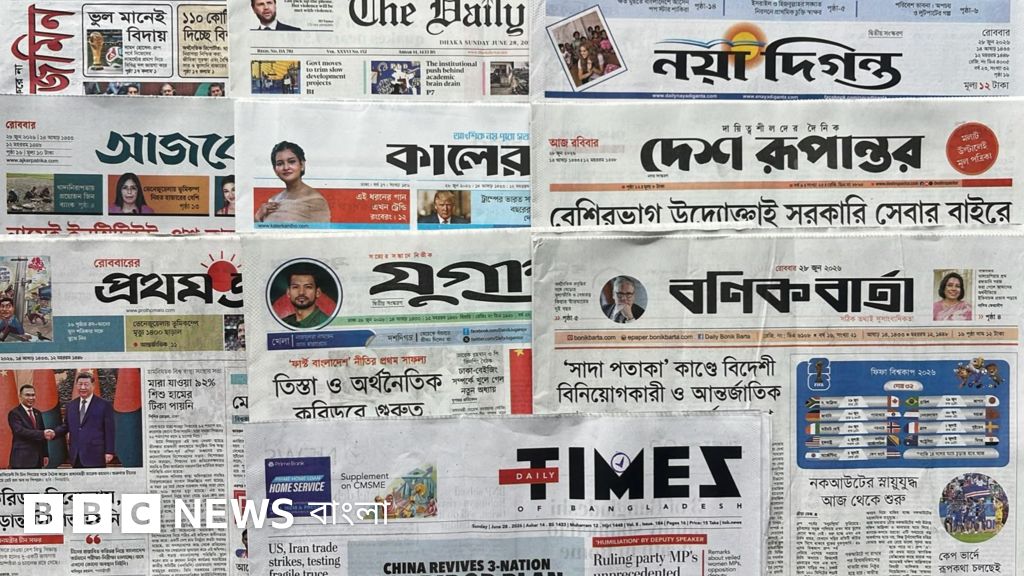
Published
Reading Time: 7 minutes
When the World Cup comes, there is a scene of hanging the flags of different teams in the country, but this time, a different trend is seen in different areas of the country, including the capital. Over the past few weeks, specially designed white flags, with Kalima written in Arabic script, have been hoisted on various roads and residential areas, and processions have also taken place in some places. The issue has sparked discussions and debates on social media.
Those involved in the hanging of the flag claim that it is not the flag of any political or extremist group, but a religious sign with the kalimas of Islam. However, a section of experts related to security, international relations, labor market and business think that such design in the international arena may be seen as a symbol used by some extremist groups. This may have a negative impact on the country’s image, foreign investment and expatriate labor market.


After six months, 13 donation boxes of Kishoreganj’s historic Pagla Mosque have been opened. Under the supervision of the district administration, opening the donation box from Saturday morning, this time a maximum of 43 sacks of Tk. Later, hundreds of people started counting money together.
According to the information of the district administration, 11 crore 78 lakh 48 thousand 538 taka was obtained by opening the donation box last time. Besides cash, foreign currency, gold ornaments and diamonds were also found earlier.
Currently, Pagla Masjid’s direct donation of Tk 114 crore and online donation of Tk 24 lakh 76 thousand 882 is deposited in the bank. The dividend of this money is used to support mosques, madrasas, orphanages and helpless and critically ill people in the district.

Both countries noted that Bangladesh and China have entered a new era in bilateral relations with Prime Minister Tariq Rahman’s four-day visit to China. The visit laid the foundation for a long-term strategic partnership and the relationship has expanded beyond economic cooperation to regional diplomacy, enhanced connectivity, defense dialogue and geopolitical coordination.
During the visit, the two countries signed three agreements, a framework agreement, a protocol, a joint action plan, nine memorandums of understanding and a 15-point joint declaration outlining future cooperation. Of these, 13 were at the ministry level, three were with business organizations and one was between the Bangladesh Nationalist Party and the Chinese Communist Party.
In the joint statement, the two countries agreed to further promote the existing integrated strategic cooperative partnership to build a common future Bangladesh China community in the new era, so that the people of the two countries will benefit more.
During the visit, Prime Minister Tariq Rahman met with Xi Jinping, Li Qiang and Zhao Leji. He also participated in World Economic Forum’s New Champions Annual Conference and Bangladesh Investment Forum. Officials in Dhaka and Beijing hailed the visit as one of the most important diplomatic initiatives in recent years.

Times of Bangladesh news- China revives 3-nation corridor plan without India In other words, China is advancing the economic corridor plan of three countries except India
Beijing has proposed to form a new economic corridor with Bangladesh, China and Myanmar. It aims to facilitate regional communication and trade. At the same time, Bangladesh and China have agreed to work on a two plus two dialogue framework to enhance strategic cooperation.
Foreign Minister Khalilur Rahman said that an important part of the plan is to create a multi-modal transport connection between Kunming in China’s Yunnan Province and the ports of Bangladesh. The idea is to use Myanmar ports that are already connected to China’s supply chain to bring in goods directly on small Bangladeshi vessels. It is expected to reduce time and cost.
However, the implementation of the new land link will largely depend on peace and stability in Myanmar’s Rakhine region.
According to analysts, this initiative could be geopolitically important. Because it may create a new opportunity for China to reach Chittagong port and the matter may be seen sensitively in the eyes of the United States and India. Earlier, the Bangladesh China India Myanmar Economic Corridor plan was stalled, but now China wants to move forward with a new structure without India.

On holidays, as offices, courts, industries and educational institutions are usually closed, demand for electricity is reduced and load shedding is also expected to be reduced. But this time the situation is different. For the last three weeks, there has been an average load shedding of more than 2000 MW on Fridays and Saturdays. If there is no rain, the power demand may increase further and load shedding is also likely to increase.
Currently, the power generation capacity in the country is more than 28 thousand megawatts, but due to energy crisis, only 13 to 14 thousand megawatts are being produced. On the other hand, the demand is exceeding 16,500 megawatts. As a result load shedding of two to three thousand megawatts per day has to be done.
Most of the load shedding is being done outside Dhaka and especially in rural areas to meet this shortfall. Many areas do not have electricity for more than five to six hours a day. Load shedding increases after 10 pm and the situation is worst from 12 pm to 4 am. About 1,700 MW of loadshedding took place during the day on Saturday as well.

Prime Minister Tariq Rahman has returned home after a six-day visit to China and Malaysia. During this visit, the head of the government of Bangladesh met with the top leadership of China.
The meeting emphasized increasing cooperation in economic corridors, trade, investment, industry, education, health, culture and military sectors. Beijing proposes to establish Bangladesh-Myanmar-China trade corridor. China has also promised cooperation in solving the Rohingya crisis. All in all, the issue of relations between the two countries was at the center of the discussion.
Dhaka-Beijing has expressed its desire to enter a new era of relations by expanding existing cooperation by signing memorandums of understanding on 17 issues.
Both countries have talked about a number of cooperations. The proposal includes – construction of Bangladesh-China Economic Corridor through Myanmar and creation of management at the level of Foreign Minister and Defense Minister with a new dimension in strategic cooperation. Again, 11 leading Chinese companies have offered to invest a total of 9.21 million US dollars in various sectors of Bangladesh.

The World Bank has approved two projects for emergency assistance of USD 1.1 billion or USD 1.1 billion to maintain food security, sustain agricultural production and deal with emergencies in Bangladesh. Its amount in Bangladeshi currency is about 1 thousand 353 crore taka.
According to the World Bank, increasing prices of fertilizers and fuel in the global market and instability in the supply system have put pressure on Bangladesh’s economy. Small farmers and poor and vulnerable communities are particularly affected.
According to the World Bank, the aid will be used to ensure the supply of fertilizer for rice production, help secure employment and livelihoods for ordinary people, and keep emergency services running.

To reduce the pressure of inflation on the common man, the tax-free income limit of individual tax payers is being increased from Tk 3 lakh 75 thousand to Tk 4 lakh. As a result, if the annual salary is less than 6 lakh rupees, no tax will be paid, as one third of the salary will be under tax exemption.
However, despite the increase in tax-free life span, the total tax burden is not expected to reduce much due to the reduction of the concession limit and the treatment of tax at source on savings bonds, government securities and interest on FDR as advance tax instead of final tax.
Apart from this, the opportunity to show the real value of land and flats through regular tax is being canceled in the proposed budget. The decision to make Taxpayer Identification Number or TIN mandatory for opening bank accounts is also being withdrawn. On the other hand, the tax rate on share market dividend income will remain the same as before. These changes are being brought to the National Parliament for approval through the Finance Bill.

Two leaders and activists have died in the center of a naval procession of Awami League in Turag river. After the incident, claims were spread on social media that seven people were killed and several others were missing, but the police headquarters termed these reports as rumors and baseless. Preliminary investigation revealed that two people died after jumping into the river in the face of a rush.
According to the investigation, before the founding anniversary of Awami League, about 25 to 30 leaders and activists left Rustampur Ghat in Ashulia with a procession by boat. After reaching Ashulia Bazar Ghat, local BNP activists and police chased them and they quickly tried to escape back to the boat. But unable to lift the anchor of the boat, some jumped into the river. At this time, seven people were arrested.
Later from Turag river. The bodies of Suman and Ariful Islam Rakib were recovered. The DB investigation initially suggested that they drowned in the strong current of the river and the bodies were recovered later.
https://www.bbc.com/bengali/articles/c5yzqzq6v3qo?at_medium=RSS&at_campaign=rss

