

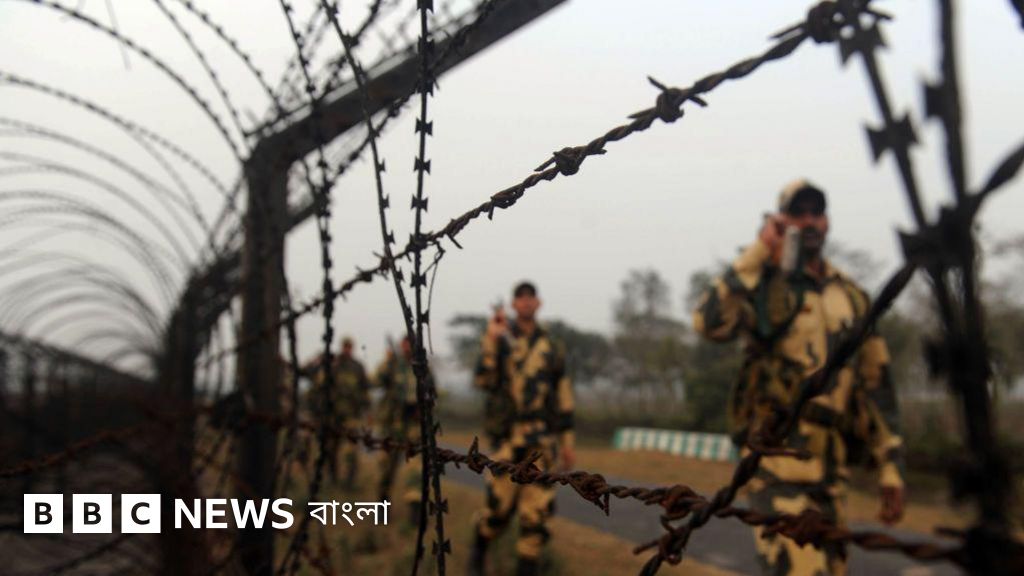
image source, DIPTENDU DUTTA/AFP via Getty Images
The West Bengal government has ordered the creation of ‘holding centers’ or detention camps in every district of West Bengal to detain alleged ‘Bangladeshi and Rohingya’ infiltrators. Such holding centers have been set up in other Indian states over the past year, but this initiative is the first in West Bengal.
Foreign nationals who have been released from jail and are awaiting extradition to their home countries will also be held in those holding centers.
An official note sent to the state police at the end of last week directed that holding centers for detained foreigners should be set up in every district following the guidelines given by the Union Home Ministry last year regarding the ‘extradition of Bangladeshis and Rohingyas living in the country illegally’.
Holding centers have been set up in many other states of India following the instructions of the Union Home Ministry.
Many Bangladeshis and Rohingyas, who are suspected of living in India illegally, are detained there. However, many of those arrested were residents of West Bengal and bona fide Indian citizens.
A large part of them were Bengali speaking Muslim migrant workers who went to work in those states from West Bengal.
After 26 civilians were killed by gunmen in Pahalgam in Indian-administered Kashmir on April 22 last year, a massive search operation was launched in many Indian states for alleged Bangladeshi and Rohingya infiltrators.
Hundreds of thousands of people, including many children and women, were detained in various states including Gujarat, Maharashtra, Haryana, Delhi, Odisha.
Some of these thousands of people were detained for six, seven days or more for identity verification.
Several families have been ‘pushed-out’ to Bangladesh, as many have been released after identity verification.
BBC Bangla reported several such incidents. It has been pushed to Bangladesh from the holding center India has brought some back।

What is this ‘holding center’?
BBC Bangla has spoken to many of those detained in raids to track down alleged Bangladeshi and Rohingya infiltrators in various Indian states since May last year, who, after identity verification, have been found to be genuine Indian citizens and released from their holding centres.
They were mainly arrested for speaking in Bengali. At the same time, many detained men and women told the BBC that their religious identity was a major reason for their detention.
After talking to them, it is known that those holding centers are not actually prisons. A temporary auditorium or large office premises were used for the holding center.
Many people were detained there at once.
After arresting those people, the police would initially verify their identity. After being sent to the holding center, they used to verify their identity by asking the district police of the area where they claimed their home in West Bengal.
It often took six-seven days or more. During this whole time the detainees were not allowed to leave the holding center, police guarded outside.
Many also complained that even if food was provided, it was often insufficient.
Many reported that those released from holding centers after proving genuine Indian citizenship were not allowed to keep their mobile phones.
There are also cases where some have taken pictures or videos of their detention in the holding center and sent them to their families.
Asif Farooq, State General Secretary of Pariyayi Sramik Manch, said, “Many Indian Bengali-speaking Muslim migrant workers and children, as well as ordinary people, were detained in such holding centers in various states on suspicion of being Bangladeshi. There were also incidents of harassment, torture and human rights violations. Later, it was found that many of those detained were actually Indian citizens.”

image source, Getty Images
The first step of ‘push-back’ is ‘holding centre’?
After initially being detained as alleged Bangladeshi or Rohingya infiltrators, those who have been able to prove their Indian citizenship or whose proof is satisfied by the local police in those states, have been released.
However, after being released, many said that many genuine Bangladeshis were also caught with them.
Again, the identity of Indian citizenship has been verified by the West Bengal police, but after that they have been identified as Bangladeshis and sent to the other side of the border, many such cases have come to the fore.
After six members of her family, including Sonali Khatun, were sent to Bangladesh when she was pregnant, the Indian government brought back only the pregnant Mrs. Khatun.
One such person who was sent back to Bangladesh was Mehbub Sheikh of Murshidabad. After he was brought back to India, BBC Bangla visited his home and spoke to him. At that time, Mustafa Kamal Sheikh, a native of East Burdwan district, was arrested from Mumbai. He was also brought back by the Government of India.
According to the existing laws of India, foreign nationals caught illegally entering or residing in India are detained by the police and tried in courts according to foreign laws.
If the court decides, he is kept in prison to serve that sentence. At the end of the period, the identity and address are confirmed by contacting the embassy of the country concerned and finally extradited.
However, the central directive says that each state should form a special task force to identify and extradite Bangladeshis or Rohingyas living illegally inside India.
Police-supervised ‘holding centres’ should be set up in each district and the state governments themselves should conduct investigations. The police of the state where the concerned person claims to be a resident should verify the identity and send a report within 30 days.
If the report is not received within 30 days, the concerned Foreigners Regional Registration Officer or FRR will take necessary steps to extradite the ‘suspect person’.

image source, Getty Images
‘Why is the holding center necessary?’
The alleged infiltrator identification drives that began last year were mainly carried out in various states of northern and western India, where arrested suspects were initially held in ‘holding centres’.
But what is the meaning of setting up such a holding center in West Bengal now that the alleged infiltrator identification operation will start in this state as well?
After becoming the Chief Minister, Subvendu Adhikari announced that alleged infiltrators would be ‘detected, deleted and deported’ in this state as well.
The state home department is believed to have issued the weekend guidelines as per the signed declaration.
Prasenjit Basu, an economist and activist on citizenship rights, now the leader of the National Congress, said, “Why is there a need to build such a holding center? How many Bangladeshi immigrants or Rohingyas are there in West Bengal? The state government should provide that information first!
“In August last year, according to the Right to Information Act, I asked the Union Ministry of Home Affairs to know how many illegal immigrants have been detained or arrested in West Bengal from 2000 to August last year. I also had a question about the religious identity of the immigrants from Bangladesh. How many Bangladeshi ‘immigrants’ are now in prisons or detention centers in West Bengal and other states – I also had this question,” said Mr. sit down
He also asked the Home Ministry how many alleged infiltrators from Bangladesh have been ‘pushed back’ in the country and who have not been caught – what is the approximate number of alleged Bangladeshi infiltrators?
Mr. Basu says he has not yet received a reply to any query – his application has only been sent to one department after another.
According to him, this initiative can be discussed only after these facts are known.
https://www.bbc.com/bengali/articles/cx21ryjdvx0o?at_medium=RSS&at_campaign=rss

