

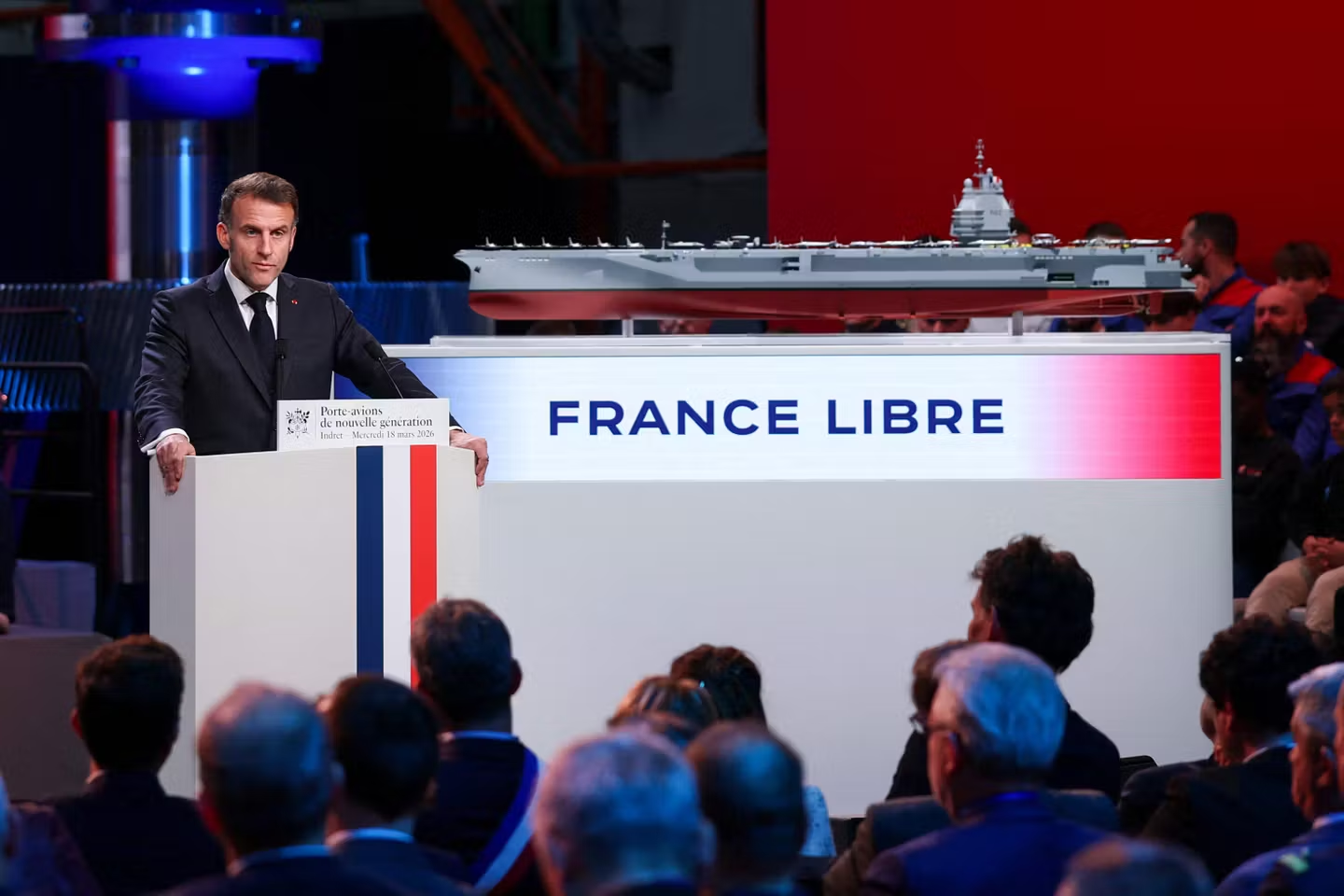
SDo we realize the extent of the historical shift? Europe is in the process of carrying out a rearmament effort such as we have not seen since the 1950s. In 2023, the EU would spend on average 1.6% of its GDP on defense. In the summer of 2025, it committed to rising to 3.5% by 2035. This is a doubling in a decade, a consequence of the Russian attack on Ukraine on the one hand, and the American abandonment of Donald Trump on the other.
A fascinating study published in February by the Kiel Institute, a German research center, gives the measure of the change underway. Economists Johannes Marzian and Christoph Trebesch reviewed the defense budgets of 20 countries since 1870 (Western Europe, United States, Canada, Australia, Russia, India and Turkey). They find 114 episodes of sharp increases in military spending. Unsurprisingly, these took place mainly around the two world wars, and during the “hottest” period of the Cold War, that is to say the 1950s (and to a lesser extent the 1960s). Since then, almost no country has experienced such a jump in military spending, with the notable exception of the United States during the 2000s (wars in Iraq and Afghanistan). In France, the last major episode dates back to 1951-1953, during the Indochina War. Hardly anyone remembers such a rearmament.
Germany, which barely dared to talk about its army a decade earlier, is now fully embracing the great return of the Bundeswehr. This will become “the strongest conventional army in Europe”asserts loud and clear the German Chancellor, Friedrich Merz. Until 2022, Germany spent less than France on defense. Today, its budget is 50% higher.
How to finance this considerable effort? The risk is to oppose “butter” and the “canons”as summarized by the American economist Paul Samuelson after the Second World War. Social versus defense. The first signals point in this direction. To finance his military effort, Friedrich Merz made a profound change in economic doctrine, agreeing to go into massive debt. But this conservative has not completely thrown away his orthodoxy: he agrees to use the debt for the army and major projects, but no question of doing so for social welfare. It has already significantly tightened the conditions of access to unemployment insurance.
You have 38.53% of this article left to read. The rest is reserved for subscribers.
https://www.lemonde.fr/idees/article/2026/03/23/depuis-cent-cinquante-ans-les-gouvernements-n-ont-generalement-pas-choisi-entre-les-depenses-sociales-et-l-effort-de-defense_6673935_3232.html

