

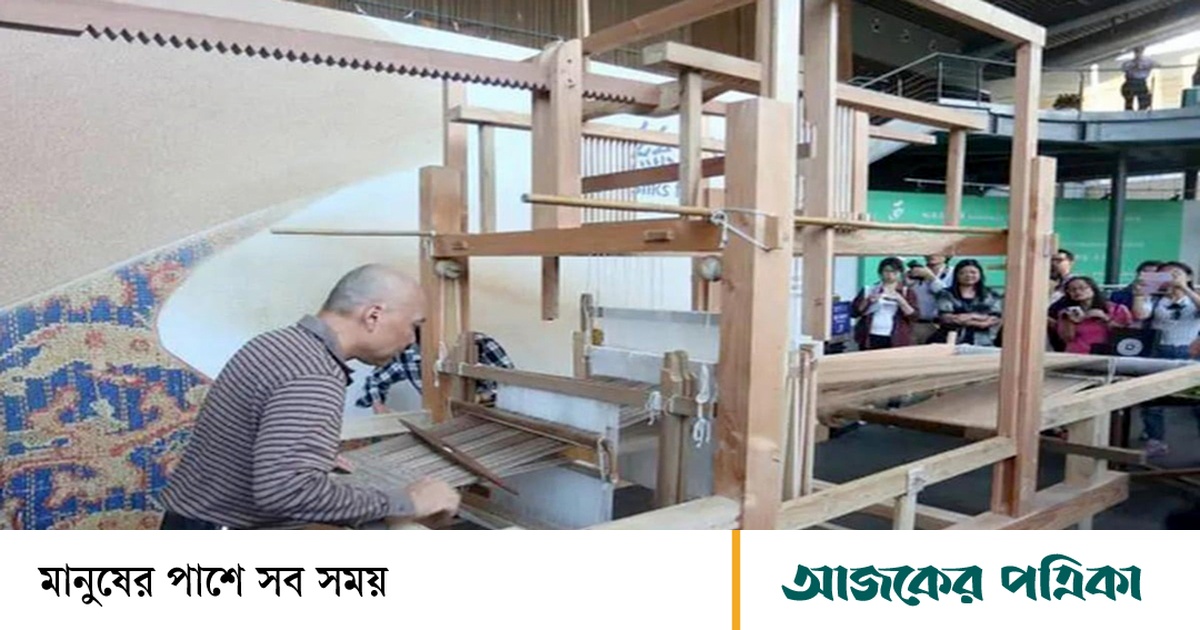
Does the computer only mean electronic chips and electricity? A new discovery by scientists could change this idea. An astonishing 2,000-year-old device has been discovered in an ancient tomb in western China, which Chinese scientists claim could be the earliest form of the modern computer. Named ‘Ti Hua Ji’ or Ornamental Loom, this machine originally worked in the ‘binary’ or binary system, which is the basis of today’s digital technology.
According to scientists from the China Association for Science and Technology (CAST), the machine operated on the same ‘input-output’ and ‘programming’ principles as today’s computers. In 2012, four loom models were unearthed from a Western Han Dynasty (150 BC) tomb during the construction of the Chengdu Metro Line. After much research, the scientists said, the device was fully ‘programmable’.
Just like modern computers have software, these looms used ‘pattern cards’ to design the yarn. These cards would tell the machine which yarn would go up and which would go down.
The language of modern computers is 0 and 1. In this ancient machine, when a thread goes up, it is counted as ‘1’ and when it goes down, it is counted as ‘0’. In this way complex designs were created by controlling the intersection of 96 million threads, which is the early version of today’s binary calculation.
For a long time, science and computing were thought to have originated in Europe. Eniac, developed at the University of Pennsylvania in 1946, is said to be the world’s first electronic computer. But CAST says Chinese craftsmen mastered automation and information encoding or data storage 2,000 years ago.
History says that this Chinese technology reached Europe through Persia along the Silk Road. This technology was first used in looms in Venice, Italy in the 12th century. In 1805, French craftsman Joseph Marie Jacquard invented the ‘punch card’ controlled automatic loom from this idea. This ‘punch card’ method was later used for programming computers in the early 19th century. Karl Marx in his book ‘Capital’ described the jacquard loom as the ‘most complex machine’ in the world before the steam engine.
Interestingly, in 1946, the Chinese scientist Zhu Chuanju was one of the key members of the team to create the first modern computer ‘Eniac’. Many researchers believe that Zhu drew inspiration from this ancient Chinese weaving technique and the binary theory of the ‘I Ching’ philosophy in his logical structure design.
Wang Yusheng, the former director of the Science Museum of China, said that this loom is not only a textile tool, but also a unique artifact of ancient programming thought and mechanical intelligence. It is behind the scenes in creating the basic principles of modern information technology.
Source: South China Morning Post

