

image source, Getty Images
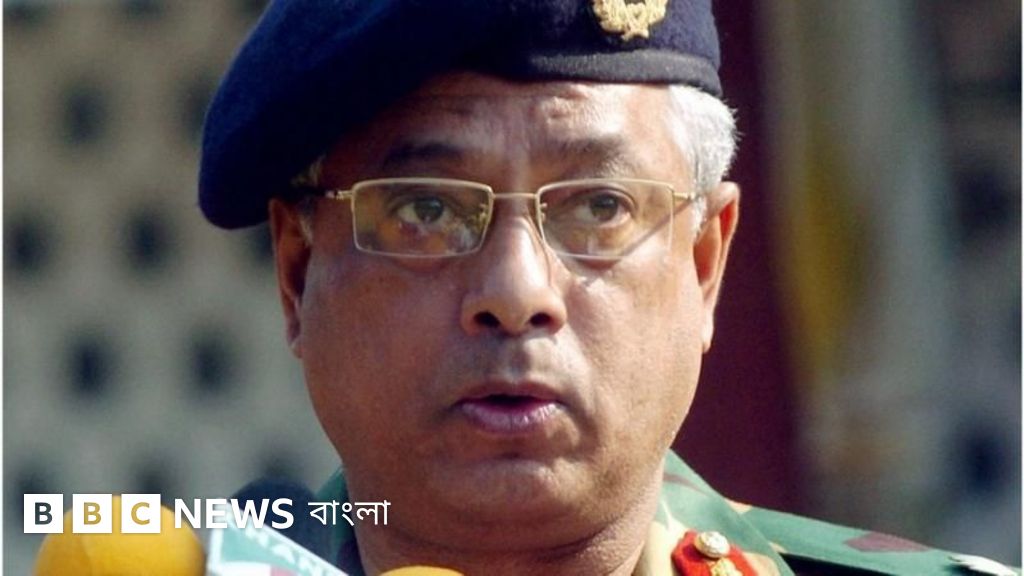
The court has granted a five-day remand to retired Lt. Gen. Masud Uddin Chowdhury, who was widely discussed as an influential army officer during the much-discussed ‘One Eleven’ in Bangladesh about 19 years ago.
DB Additional Commissioner Md Shafiqul Islam said that after he was arrested from his house in Baridhara on Monday night, he was arrested in a human trafficking case at Dhaka’s Paltan police station and presented to the court.
“I have received information about six cases against him in Feni and five in Dhaka. Among them, three cases are under trial in Feni. As he is absconding, the court has issued an arrest warrant against him there. We are also investigating the other cases,” said Mr. Islam
Meanwhile, Mr. Ever since Chowdhury’s arrest, many leaders and supporters of the ruling BNP have taken to social media to bring up the ‘One Eleven’ issue.
Many of them accused the current Prime Minister Tariq Rahman of arrest and torture at that time, that’s why Mr. Chowdhury is responsible.
As a result, the question is now being raised in the political arena that through this arrest, BNP started to take ‘revenge’ against those associated with One Eleven or not.
Incidentally, the formation of caretaker government supported by the army in Bangladesh on January 11, 2007 is known as ‘One Eleven’.

image source, Getty Images
Why is this arrest important?
Political analyst and author of the book ‘Ek-Eleven’ on One-Eleven, Mohiuddin Ahmad says that one of the most important players of One-Eleven was Masud Uddin Chowdhury.
He was one of the few military officers who became very influential at that time.
“And BNP considers itself a victim of One Eleven. That’s why many may consider the arrest of Masud Chowdhury as revenge. But there are many more charges against him. As a result, we have to see what kind of charges are actually brought against him,” Mr. said to BBC Bangla. Ahmad
In the context of widespread violence due to the political crisis on the issue of who will be the head of the caretaker government in Bangladesh, the former governor of Bangladesh Bank Dr. A caretaker government was formed on 11 January 2007 under the leadership of Fakhruddin Ahmad.
At that time, as the last retired Chief Justice, KM Hasan was supposed to be the head of the caretaker government, but a political crisis was created around him.
At one point Mr. President Yazuddin Ahmed himself was sworn in as the chief advisor of the caretaker government amid the opposition of some political parties including the Awami League after Hasan himself declared his inability to take responsibility.
After that, when the opposition parties announced one political program after another in protest, violence broke out in different parts of the country.
At one point, Yazuddin Ahmed resigned and declared emergency due to the intervention of the armed forces. Fakhruddin Ahmed’s government took responsibility.
After nearly two years in power, the government held general elections in December 2008 and Sheikh Hasina’s Awami League came to power with a huge majority in those elections.
However, in January 2007, then Army Chief Moin U Ahmed played a key role in the resignation of the then President Yazuddin Ahmed’s chief advisor post and his advisory council members.
At that time, three more army officers came for extensive discussion.
They are – the then GOC of the ninth division Major General Masud Uddin Chowdhury, the then Acting DG of DGFI Fazlul Bari and another officer of the then DGFI Major General ATM Amin who later retired.
Among them, none other than Masud Uddin Chowdhury has been in the country for a long time.
Although Fakhruddin Ahmed’s caretaker government was in power in June 2008, Mr. Chowdhury was removed from the army and sent to Australia as the High Commissioner of Bangladesh.
Then the Awami League government came to power and extended his term twice.
Although Mr. Chowdhury was appointed as High Commissioner and before leaving the country, he played a role in arresting the top politicians and businessmen of the country and came into wide discussions.

image source, Getty Images
Formation of National Coordinating Committee on Serious Crime Suppression Campaign
On January 11, 2007, Dr. Fakhruddin Ahmad’s government formed the National Coordination Committee on Serious Crime Suppression Operations on March 8 of that year with the then advisor MA Mateen as the chairman and General Masud Chowdhury as the chief coordinator.
Almost all the important politicians including Sheikh Hasina and Khaleda Zia were arrested on the decision of this committee. Even then, the activities of the joint forces across the country were also conducted under the guidance of this committee.
However, before that Mr. Fakhruddin Ahmed led the formation of the advisory council Masud’s role was mentioned by the then army chief Moin U Ahmed in his book ‘Dream of Peace’.
In a part of the book, he wrote that they initially proposed Professor Muhammad Yunus to be the chief advisor, but he did not agree.
“After Dr. Yunus refused, Dr. Fakhruddin’s name came up. Major General Masud Uddin Chowdhury went to Dr. Fakhruddin’s house and requested him to take over the position of Chief Adviser on behalf of the President. It was late at night. I called Dr. Fakhruddin’s house. He was probably asleep. I also invited him to take the position of Chief Adviser”.
In this article, Moin U Ahmed himself stated that January 11, 2007 ended an eventful day of drama, uncertainty and busyness.
“Which I named One Eleven after Nine Eleven,” wrote Mr. Ahmed. Incidentally, 9/11 was a major terrorist attack in the United States, which shook the entire world.
Regarding Masud Uddin Chowdhury’s role in the formation of the Advisory Council in this book, the then Army Chief wrote, “..at that time, Major General Masud Uddin Chowdhury, the GOC of the country’s Intelligence Department and Savar Division, came forward with all his support in the formation of the Advisory Council. The GOC of the Savar Division, having worked in DGFI for a long time, played an important role in the formation of this council”.

image source, Getty Images
Then Fakhruddin Ahmed’s government was formed by forcing the resignation of the caretaker government of the president elected during the BNP government, and during that government, many leaders of BNP including Khaleda Zia and Tariq Rahman were arrested and above all, BNP suffered a miserable defeat in the elections held during that government.
The leaders and activists of the party think that the election of 22 January 2007 which Yazuddin Ahmed’s government wanted to hold with the support of BNP was canceled because of this One Eleven.
After 19 years, BNP was able to return to power through the February elections this year. However, Awami League could not participate in this election as the activities were prohibited.
Mr. After Chowdhury’s arrest, BNP Vice Chairman Shamsuzzaman Dudu wrote on his verified Facebook page on Tuesday, “Thanks to Prime Minister Mr. Tarek Rahman for starting the arrest of democracy killers on 1/11”.
“In addition to the arrest of the BNP leader, Tariq Rahman was tortured. The party’s leaders and activists think Masud Uddin Chowdhury’s role was behind it. That is why BNP people are demanding his trial or supporting his arrest. All in all, his arrest is very important,” said writer Mohiuddin Ahmad.
From army officer to high commissioner, then businessman
After his term as High Commissioner in December 2012, he returned to Dhaka and started restaurant and manpower export business. Chowdhury At the same time, he gradually got involved with the then ruling Awami League.
However, in 2018 he joined the Jatiya Party led by late HM Ershad.
He was elected Member of Parliament from Feni-3 constituency in the disputed 11th National Parliament election on the party’s nomination.
Later, he was elected as a Member of Parliament on the nomination of the Jatiya Party in the one-sided election of January 2024.
After the fall of the Awami League government in March 2025, in a case of the Anti-Corruption Commission, Masud Uddin Chowdhury along with the wife and daughter of Awami League’s former Finance Minister AHM Mustafa Kamal were also accused.
He was also accused of embezzlement and money laundering in that case.

image source, FARJANA K. GODHULY
‘Then I am calling Masud’
Masud Uddin Chowdhury’s name came into discussion in many ways during the ‘One Eleven government’ apart from being the chief coordinator of the National Coordination Committee for Suppression of Serious Crimes.
Even apart from Moin U Ahmed, the name of Masood Chowdhury has come up in the mouths of other officers of the armed forces who played a role in the formation of that government.
The then Acting Director General of DGFI, Chowdhury Fazlul Bari Mohiuddin Ahmed, gave an interview in book 1-11, Mr. Chowdhury mentioned.
Chowdhury Fazlul Bari said, “..in a word, the country has become unstable. Even if there is an election, it is unstable, but it is unstable. What should be done now? I don’t want to speak against anyone. Why would the army come outside of normal? Everyone is getting their salaries and allowances! Let’s attack the country, your child is studying inside the cantonment. What else do you need?”
I insisted again and again. Then I knocked the army chief. I knocked General Masud. Why did I knock General Masud? Because, he is a relative of Begum Zia. Let’s see what his attitude is.”
At one point, Mr. Bari said, “Brigadier Amin was replaced by General Masood. Nine Div (Army’s Nine Division) worked with him, Amin was the artillery commander of the 9 Div”.
In that book, the name of General Masood also appeared in the description of then Air Force Chief Air Vice Marshal Fakhrul Azam. Mr. Fakhrul said that he and three army chiefs were called by the President on January 11 (2007).
There, at one stage of the discussion with the President, when the President was proposed to issue a state of emergency, the President said that he would sit down with his colleagues and take a decision.
Then Moin U Ahmed said “No, your colleagues have nothing to do here. Decision is yours. Decision you take or not. And if you don’t take, then I am calling Masud”.

image source, FARJANA K. GODHULY
Mr. Fakhrul described it like this – “Straight way he went to the mobile (phone). He rang up. I don’t know, where he rang up Masud. Press the phone, Masud, you take the tank and come away”.
He then said that at one point General Masood came and sat next to him. Later in another part of the interview, he said, “Masud-Tasud had all the pistols and thistles”.
Again, the issue of the psychological battle between Moin U Ahmed and Masud Uddin Chowdhury came up in the cable sent by the US Ambassador to Washington from Dhaka regarding the flow of events of 1-11.
Quoting that cable, Mohiuddin Ahmad wrote in his book, “There was personal or group conflict at the highest levels of the army from the beginning. It was not suppressed at one-eleven times. The closeness of DGFI director Amin with army chief Moin can be seen.
On the other hand, Army PSO Lt. J. Fazlul Bari, another director of DGFI, had a good relationship with Masud Uddin Chowdhury. This creates a kind of polarization. Bari had already fallen from the ring of power. Amin’s prestige in DGFI increased. Some saw Masud as Moin’s rival. Moin was able to consolidate his position at one stage in this power struggle. He practically clipped Masud’s wings”.
But now the question has arisen, even if the police talk about money and human trafficking cases, for political reasons or for the role of the One Eleven government. Chowdhury was arrested or not.
Additional Commissioner of Intelligence Police, Shafiqul Islam, was asked such a question at a press conference, but he only said, “They are investigating only the cases that are there and their aim is to continue the democratic process and ensure the right of everyone to get justice.”
Mohiuddin Ahmad says, Sheikh Hasina’s government rewarded Masud Uddin Chowdhury in various ways after the eleventh, but now the time has not come to say whether his detention is retaliatory or not.
“However, there may be an inquiry into one-eleven. There are allegations of irregularities against him. If the government investigates properly, many things may be known,” said Mr. Ahmad
https://www.bbc.com/bengali/articles/c995re5lny7o?at_medium=RSS&at_campaign=rss

