

Bangladesh's leather sector, once known as the main pillar of the country's economy, is currently in deep crisis. Compliance issues and non-availability of international quality certification, especially LWG certification, are the main obstacles to the export of leather and leather products. This certificate can open the door to the sustainable development of leather industry in Bangladesh and access to the global market.
Leather sector is considered as the second major foreign exchange earning sector, but the export earnings of leather and leather products are quite low as compared to apparel exports. Although the export income is 46 billion dollars every year, only 122 million dollars are earned from the leather sector. With proper planning and ensuring international standards, the leather sector can also reach a competitive position in the global market like the apparel industry.
In 2017 leather industry shifted from Hazaribagh to Harindhara leather industry city in Savar. But that initiative was not successful. Compliance standards have not improved due to government apathy, bureaucratic complications and funding problems. As a result, land pollution and other environmental problems have not been solved. Non-operational CETP (Central Effluent Treatment Plant) of the industrial city has not been able to reduce the pollution in Savar and is also hindering the acquisition of LWG certificate.
According to a survey by the Department of Environment, the liquid waste released from the CETP is still higher than the actual environmental standards. Because of that LWG certificate is not available. The leather industry is currently in turmoil, incurring losses and leather prices are low during the sacrificial season. Debt problems and labor problems add to the danger.
These problems have become a major obstacle in exporting to European and American markets. As a result, leather traders are forced to export to China at only 90 cents to 1.2 dollars, while the actual price in the international market is 2 to 2.5 dollars. However, after obtaining the environmental certificate, it will be possible to sell the leather at the real price in the European and American markets.
Exporters hope that Bangladesh's leather export revenue will exceed $5 billion in the next 4-5 years if the government takes the right steps.
Private research institute Research and Policy Integration for Development (RAPID) executive director. Abu Yusuf told Ajker newspaper that the main problem in the leather sector is the lack of implementation. He said, if the compliance is not ensured by repairing the CETP, it will not be possible to get benefits from the leather sector. For this he advised the government to separate the leather sector from the purview of BCCI and bring it under a development authority or BEPAZA. He also recommended giving special loan facility to 15-20 good entrepreneurs.
What is LWG certificate?
In 2005, several international brands including Nike, Adidas, Timberland jointly established the Leather Working Group (LWG). Its main objective is to ensure the production of leather and leather products with environmental protection. Currently more than 1000 brands and suppliers are members.
According to criteria developed by LWG, they audit factories and categorize them into four categories—gold, silver, bronze and normal—according to environmental criteria. In terms of testing, they look at environmental management, proper management of harmful chemicals and waste, efficient use of energy and water, sources of raw materials, etc. LWG's certification provides proof of a factory's environmentally friendly production capabilities and makes factories more competitive in the international market.
how far behind
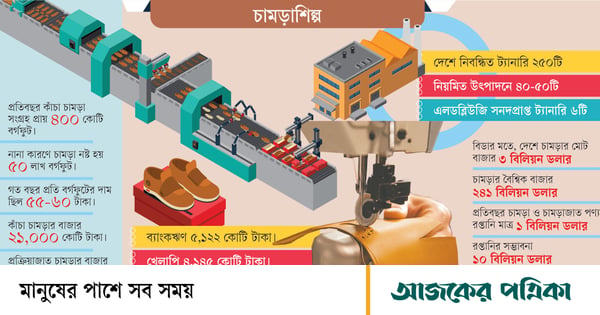
In terms of compliance, the position of leather industry in Bangladesh is almost at the bottom of the world. Its precedent can be seen in the given data. There are currently 250 registered tanneries in Bangladesh. Out of these, 149 went to Savar leather industry city. Out of this only 40-50 tanneries are in regular production, rest of the tanneries are closed or producing irregularly. On the other hand, there are 3 thousand 590 companies for the production of leather and leather products, 90 of them are large companies. There are currently only 6 LWG certified tanneries in Bangladesh; Out of which three use domestic raw materials and the remaining three use imported raw materials. Number of certified tanneries of LWG is 139 in India, 103 in China, 68 in Italy, 60 in Brazil and other countries also have more certified tanneries than Bangladesh. However, the government has set a target of earning 1,250 million dollars from the export of leather and leather products by 2030, which has nothing to do with reality.
Versatile use of leather
Due to the flexibility, durability and durability of leather, it is widely used in the manufacture of furniture, clothing, bags, belts, gloves, watch belts, car interiors, horse harnesses, upholstery and various fashion accessories in addition to shoes. Recently, the use of leather in the manufacture of sports equipment and clothing has increased significantly. Global brands like Nike, Adidas and Puma are focusing on manufacturing leather athletic goods considering the growing demand.
global market
The global leather market size is around $241 billion. Of this, the rawhide export market is about $11 billion, which is mainly controlled by a few large countries. According to data from World Integrated Trade Solutions (WITS), the US tops this market. It is followed by China, Switzerland, Hong Kong, Japan, South Korea, Italy, France, Germany and Vietnam. These countries are playing an important role in the global market in leather exports and processing. On the other hand, European Union countries are the largest importers of leather. Next is China. These countries import raw leather from various developing countries to meet the demand for high quality leather.
This competition in the global leather market can create great opportunities for Bangladesh, but ensuring proper standards and achieving international certification will open the way to enter this market.
Image of the country's market
25 percent of the leather produced in the country is used in the local market, while the remaining 75 percent can be exported. According to Bangladesh Tanners Association (BTA) data, 4 billion square feet of raw leather is harvested in the country every year. But about 50 lakh square feet is wasted. The remaining 350 million square feet is processed leather. As the government last year fixed the price of raw hide at Tk 55-60 per square foot, its market value stands at around Tk 21 thousand crore ($1.75 billion). According to tannery owners, the market value of processed leather is about 37,800 crores ($3.78 billion). According to the Investment Development Authority (BIDA), the total leather market in the country is $3 billion, which is growing at a rate of 5 percent every year. However, according to the people involved in the sector, this market could be up to 10 billion dollars if the finished leather is exported after ensuring compliance.
Export figure of the country
In the fiscal year 2023-24, the export of leather and leather products from Bangladesh earned 1.03 billion dollars. Out of this, 544 million dollars of leather shoes, 352 million dollars of leather products, 143 million dollars of finished and crust leather were exported. In the first four months of the current fiscal year (July-October), the export revenue was 372 million dollars, which is 10 percent more than the same period last year. The main reason for the growth is the export of leather shoes, which increased by 26 percent over last year. During this period, the export of leather shoes earned 228.47 million dollars, which is the highest in five years. Most of the exports were to the US, Japan and the European Union.
There are import obligations
Export of leather goods including shoes to various countries including Europe requires the use of leather from LWG certified factories. As a result, the country's exporting companies are forced to import leather worth about 150 million dollars a year. Sakhawat Ullah, general secretary of BTA, said that if the country's tanneries got the LWG certificate, this import would not have been necessary. This would save the country's foreign exchange on the one hand, and on the other hand, the competition in the export sector would increase.
What are entrepreneurs saying?
Bangladesh Finished Leather, Leather Goods and Footwear Exporters Association (BFLLFEA) President Md. Mohiuddin Ahmed Mahin said that the leather sector is currently in crisis. The main reason for this is lack of environmental compliance. The sector is selling leather at a 20 percent loss in China due to lack of LWG certification. As a result, many entrepreneurs became insolvent. He thinks that revival of the sector is possible; This requires CETP reforms and long-term credit facilities.
President of Bangladesh Tanners Association (BTA) Shahin Ahmed told Ajker newspaper, 'In order to exploit the potential of the global market, the various problems of the CETP of the industrial city must be quickly overcome. But we are not prepared for it.'
Government statement
Ministry of Industry says that it will not be possible to get LWG certificate only by reforming CETP. Tannery owners will have to meet many other types of compliance, which they do not currently meet. 1700 marks are required to obtain International Environmental Certificate, out of which only 300 marks are required for CETP. Rest of the marks have to be accepted by the entrepreneurs. However, CETP being an important part of environmental protection, it is being gradually renovated and almost 100% water treatment is being done from CETP except during Qorbani season.
Industries Secretary Zakia Sultana told Ajker newspaper that when the Chinese company handed over the CETP, it was an incomplete plant. Solid waste management was not being done properly. But now it is slowly being renovated and most of the works have been completed. However, tanneries are still not going into production properly and have faced various problems since shifting from Hazaribagh. Now they are talking about economic problems, especially capital problems. As a result, along with the CETP reforms, the entrepreneurs have to produce according to the compliance.
The Industries Secretary also said that the European Union has expressed interest in investing in this sector and they want to start a new project. Because, it is not possible to treat all leather waste in the country with only CETP. So another project will be taken up. They will give the evaluation report next January.

