


- Hindi News
- Business
- Reliance Industries Sees Biggest Valuation Fall; Top Firms Lose ₹2.51 Lakh Crore
Mumbai8 hours ago
- copy link
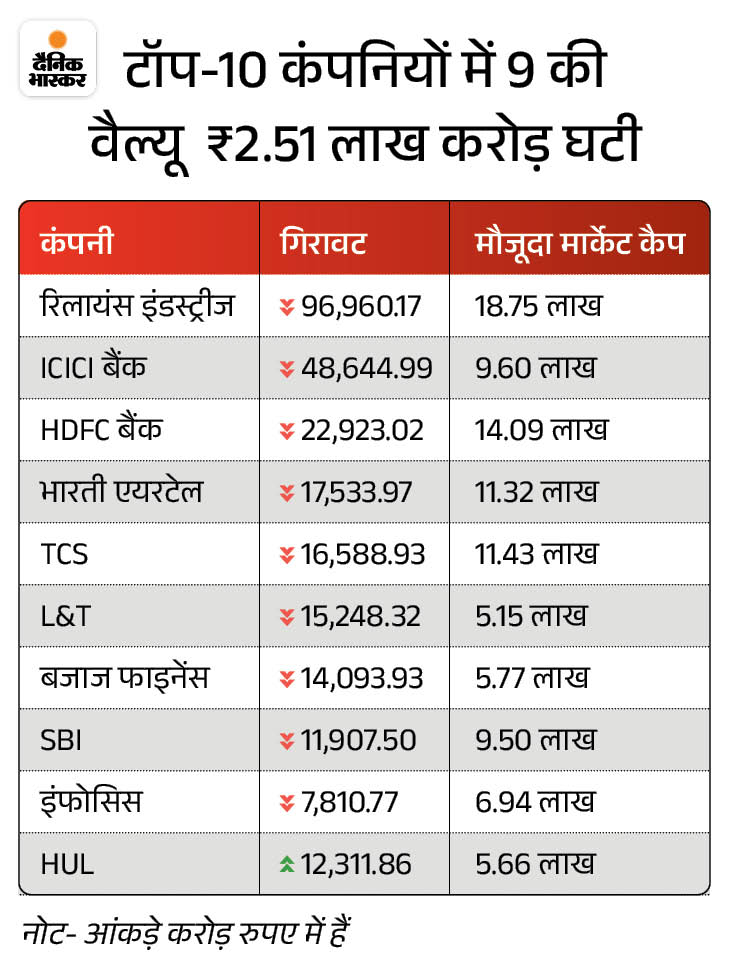
Due to the fall in the market last week, the market valuation of 9 of the top 10 most valuable companies decreased by Rs 2.51 lakh crore. Of these, Reliance Industries suffered the most loss. The valuation of Reliance Industries fell by Rs 96,960.17 crore to Rs 18.75 lakh crore.
In the last 5 trading days, BSE Sensex fell by 2,032.65 points or 2.43%. Experts believe that global tension, selling by foreign investors, weak rupee and weak corporate earnings have created pressure in the market.
Biggest decline in Reliance and ICICI Bank
Reliance Industries’ valuation decreased by Rs 96,960. ICICI Bank lost Rs 48,644.99 crore, which became Rs 9.60 lakh crore. HDFC Bank’s worth Rs 22,923.02 crore reduced to Rs 14,09 lakh crore. Whereas the valuation of Bharti Airtel decreased by Rs 17,533.97 crore, which became Rs 11,32 lakh crore.
The market value of TCS decreased by Rs 16,588.93 crore to Rs 11.43 lakh crore. L&T’s Rs 15,248.32 crore fell to Rs 5.15 lakh crore. Bajaj Finance lost Rs 14,093.93 crore, which remained at Rs 5.77 lakh crore. SBI’s valuation reduced by Rs 11,907.5 crore to Rs 9.50 lakh crore. Infosys’s Rs 7,810.77 crore fell to Rs 6.94 lakh crore. Hindustan Unilever’s valuation increased by Rs 12,311.86 crore to Rs 5.66 lakh crore.
What is market capitalization?
Market cap is the value of the total outstanding shares of any company, i.e. all those shares which are currently held by its shareholders. It is calculated by multiplying the total number of issued shares of the company by their price.
Understand this with an example…
Suppose… people have bought 1 crore shares of company ‘A’ in the market. If the price of a share is Rs 20, then the market value of the company will be Rs 1 crore x 20 i.e. Rs 20 crore.
The market value of companies increases or decreases due to increase or decrease in share prices. There are many other reasons for this…
| what does it mean to grow | what does decrease mean |
| increase in share price | decline in share price |
| strong financial performance | bad results |
| positive news or event | Negative news or event |
| positive market sentiment | Economy or market decline |
| Issuing shares at high price | Share buyback or delisting |
What effect do market cap fluctuations have on the company and investors?
Impact on the company: A large market cap helps the company to raise funds from the market, take loans or acquire other companies. At the same time, small or low market cap reduces the ability of the company to take financial decisions.
Impact on investors: Investors directly benefit from increasing market cap. Because the price of their shares increases. At the same time, the fall may cause losses, due to which investors may decide to sell shares.
Example: If TCS’s market cap grows by ₹12.43 lakh crore, investors’ wealth will increase, and the company may get more capital for future investments. But if the market cap falls then it may incur losses.

