

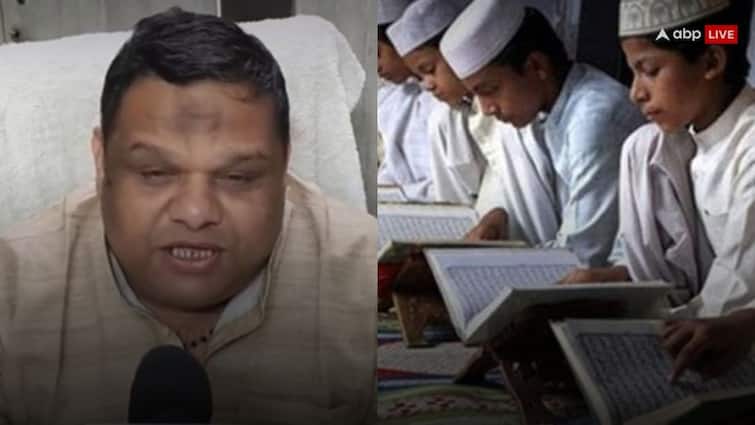
Priyank Kanungo, former chairperson of the National Commission for Protection of Child Rights (NCPCR), has said that he is pained by the Supreme Court's decision on the Madrasa Act. He said that the Supreme Court remained silent on the constitutional rights of children studying in madrassas, which has caused great sadness. However, he has expressed great happiness over the court's decision to ban the awarding of Kamil and Fazil degrees by madrassas.
Speaking to news agency ANI, Priyank Kanungo said that the court gave such a long verdict on the right to run a madrassa, but remained silent on the constitutional rights of the children studying there. He said, 'The case of Pramati Education Society and Others vs Central Government has been mentioned in para 76 of the Supreme Court's decision. When the Pramati case has been mentioned here, our expectation was that the Honorable Supreme Court will transfer the case to a larger bench. When earlier a Constitution Bench had given a decision in which it had said that the Right to Education Act (RTA) would not apply to minority schools and it was only about schools. However, this decision is on the Madrasa and the Madrasa is outside the RTA.
He further said that the primary reading of the Supreme Court decision which we have done has remained silent on the constitutional rights of the children studying in madrassas, which is very sad. You have given a long decision to protect the right of minorities to run madrassas, but the silence on the matter of children getting their right to education is painful.
Priyank Kanungo again said that secondly, our big fight was that Islamic religious education should not be given to Hindu children in madrassas through government funding. We used to talk about Article 28(3) of the Constitution here, the Supreme Court has accepted it, we are very grateful to them.
He said, 'The court has established this by mentioning this very specifically in para 86. It is a matter of great satisfaction that the business of these madrassa people, who were misleading the youth in the name of selling Kalim-Fazil degrees, has been stopped. So the Supreme Court said that it is not the job of madrassas to produce Kalim-Fazil and it was stopped. I am very happy about this because children will not spoil their future by believing that they will acquire great education by becoming Kalim-Fazil.
He said that the court has also stated very clearly in its conclusion that religious education will be given in accordance with the Right to Education Act, which is given to children through Article 21 (A) of the Constitution. Now it is the government's job to ensure that children go to school. Children should study for 4 hours in school and after that they can take religious education anywhere, but it is the job of the government to decide whether children go to school.
Priyank Kanungo also said, 'Now the UP government will have to make a fresh law. The law will have to be amended to remove what the Supreme Court has declared unconstitutional. When the amendment will be written and brought in the UP Assembly, I am confident that Yogi Adityanath The government will impose strict restrictions on imparting religious education to Hindu children. Children should get fundamental education, this should be ensured in the new amendment.

