

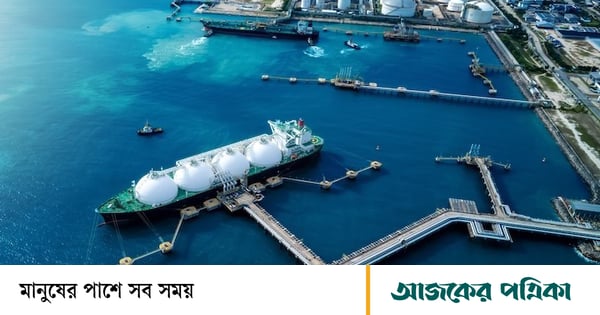
To implement the previous government's Integrated Energy and Power Master Plan (IEPMP), the country will need to spend about $50 billion on new liquefied natural gas (LNG) projects and terminals. A joint research report has revealed that the economy will face a major loss as a result. Market Forces, Waterkeepers Bangladesh and Dharitri Raksha Amara (Dhara) published this report.
A research report titled 'Cost of $50 billion LNG project for Bangladesh and a sustainable future' has raised fears that the country's economy will be threatened by LNG-dependent projects and millions of people will face health risks due to adverse effects of pollution and climate change. The report was released in a press conference at the Tafazzal Hossain Manik Mia Auditorium of the National Press Club today, Saturday.
Quoting the report, it was said in the press conference that currently the people of Bangladesh are under the pressure of huge cost of electricity. The situation could worsen if reliance on LNG, supplied through expensive imports, continues.
Instead of investing in planned LNG projects to fund renewable energy and grid infrastructure development, the research report suggested.
Under the Master Plan, $14 billion will be spent on LNG imports. Another $36 billion will be spent on the construction of LNG power plants, which, if invested in the renewable energy sector, could achieve 62 gigawatts of generating capacity, double the country's current power generation capacity, the report said.
According to the report, the proposed 41 new gas-fired power plants will emit toxic gases, increase the prevalence of respiratory problems and further worsen the situation in Bangladesh, which ranks among the world's worst in terms of air pollution.
In the press conference, former professor of Jahangirnagar University, Anu Mohammad said, LNG is causing financial burden on one hand and environmental disaster on the other. Bangladesh must move away from imported LNG and power plans dominated by foreign interests and follow the path of transition to domestic renewable energy. This will protect livelihoods in the country, improve healthcare and ensure energy security, while also avoiding the high cost of energy imports. Apart from this, he urged that the energy policy should be in the public interest and not in the interest of any individual or organization.
He said, 'Multinational companies are sold to developing countries in the context of development plans through organizations like ADB. Instead of adopting LNG, coal, nuclear systems, they could have switched to renewable generation systems. As a result of adopting these methods/measures, Bangladesh may face major natural disasters in the future. The previous government's LNG, Coal, Nuclear Energy Master Plans should be scrapped.
Moshahida Sultana, Associate Professor of Accountancy Department of Dhaka University said, 'The rule is that if we want to plan something, then we will do it with money from people from other countries. But in our country it has been reversed. Other countries have paid for the plan themselves. It must be understood that they have some other purpose. He said, we are victims of the interests of different countries. Taking the projects in the trap of global cycle instead of people oriented.
Dr. Center for Policy Dialogue (CPD). Khandkar Golam Moazzem said that the government does not need more than 27 thousand megawatts of electricity in 2041. But the previous government took more. At present 16 thousand megawatts are produced. We do not have the ability to use it. Artificial demand for fuel has been created by production and import.
The former chairman of the National River Conservation Commission (NRCC). Sharif Jamil, Coordinator of Waterkeepers, presented the press conference held under the chairmanship of Mujibur Rahman Howladar. Apart from this, Asia Energy Analyst Munira Chowdhury, IEEFA Lead Analyst Shafiqul Alam and ThreeFifty's Amanullah Parag participated in the event.

