

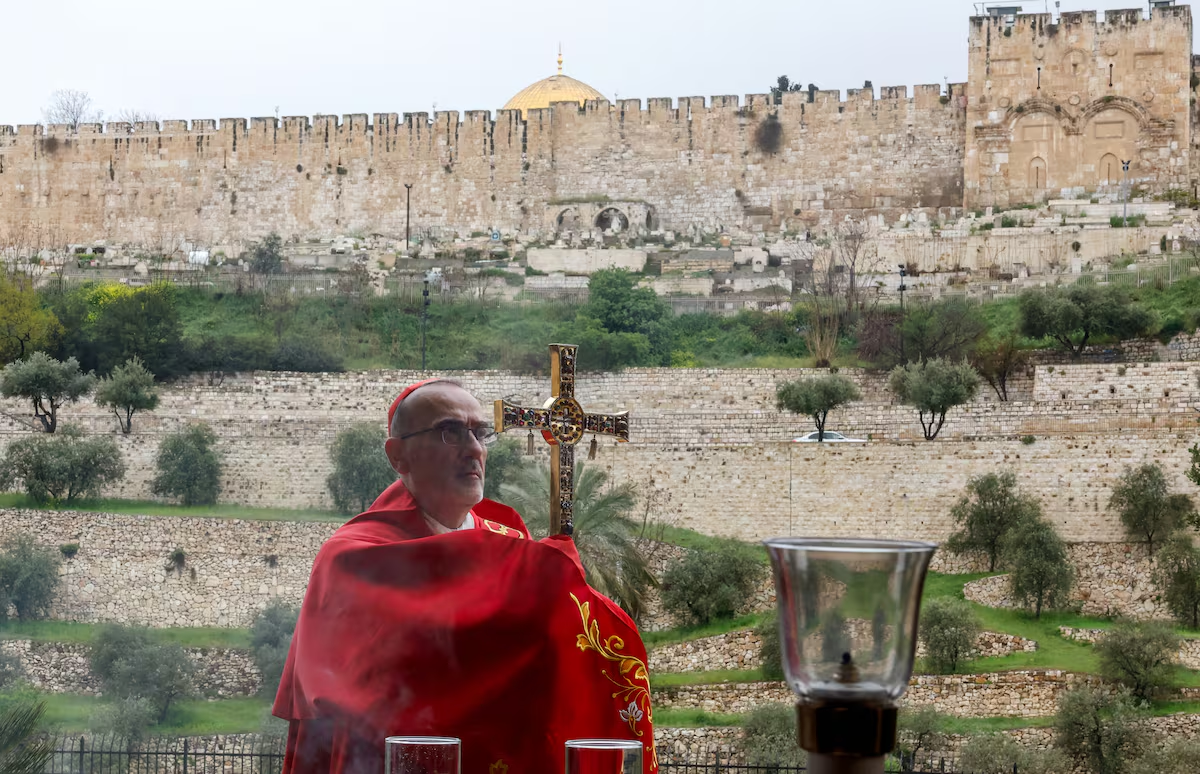
Israel has prevented entry to one of the most important places in Christianity, the Holy Sepulcher in Jerusalem, where tradition places the death and resurrection of Jesus, the highest Catholic authority in the Holy LandPierbattista Pizzaballa, and three other officials, to pray on the occasion of Palm Sunday. The decision has led to a controversy of international dimensions, with condemnations from the President of the Government, Pedro Sánchez; the top leaders of France and Italy, Emmanuel Macron and Giorgia Meloni; and even the US ambassador and ardent defender of Israel, Mike Huckabee. Israeli Prime Minister Benjamin Netanyahu has responded by defending the police action.
The Easter celebrations had been canceled for days, in a situation only comparable to 2020, during the covid pandemic. The traditionally festive Palm Sunday procession, in which thousands of people descend from the Mount of Olives amidst palms and songs, had already been suspended, and replaced by a mass, finally celebrated in the Church of Gethsemane with barely thirty attendees.
Before, however, as has been a tradition for centuries, four senior Catholic officials (including Pizzaballa) went to pray at the Holy Sepulcher, which has remained closed since Israel and the United States launched the war against Iran, a month ago, just like the Esplanade of the Mosques (in the middle of the month of Ramadan) and the Western Wall, the most emblematic places of worship of the other two main monotheistic religions, Islam and Judaism. The three places are located within the old walled citadel, where the Israeli authorities apply stricter regulations, due to the lack of air-raid shelters and the difficulties of treating any injured people in its pedestrian alleys.
The four leaders (among them Pizzaballa, Latin Patriarch in Jerusalem, and Francesco Ielpo, Custos of the Holy Land) were heading to the Holy Sepulcher in the morning, “privately and without any type of procession or ceremonial act,” when the police “intercepted them on the way,” so “they were forced to return,” the Patriarchate says in a statement. It is, he emphasizes, “the first time in centuries” that “the heads of the Church were not able to celebrate the Palm Sunday Mass at the Holy Sepulchre”, which “constitutes a manifestly unreasonable and disproportionate measure”, sets “a serious precedent and attacks the sensibilities of billions of people around the world who, during this week, have their eyes set on Jerusalem.”
Thousands of faithful
The Patriarchate recalls that those responsible for the churches “have acted with full responsibility since the beginning of the war,” abiding by the restrictions and canceling public meetings, at a time that not only affects the thousands of Catholics in the city (especially Palestinians), but also those who live in the West Bank and do not have permission to cross military checkpoints and all the pilgrims who have not been able to come because commercial flights to Tel Aviv airport remain minimal due to the war. The old city is in the part of the city that Israel has occupied militarily since the 1967 Six-Day War, with an annexation in 1980 that the international community rejects.
Netanyahu has justified the actions of the police, which remain under the umbrella of one of his most ultra-nationalist coalition partners, the Minister of National Security, Itamar Ben Gvir. The agents, he said, prevented him from passing “without bad intentions”, only “especially concerned about his safety.” The president, Isaac Herzog, has been more conciliatory, calling Pizzaballa to express his “deep regret over the incident.”
The police have issued a statement in which they ignore the specific case (with four participants) to emphasize that they prohibit “mass gatherings” to “protect the lives of Christian believers” and other religions. And he insists that the old city – today with almost all businesses and accesses closed – is a “complex area” due to the impossibility of introducing large rescue vehicles if A missile causes a large number of victims.
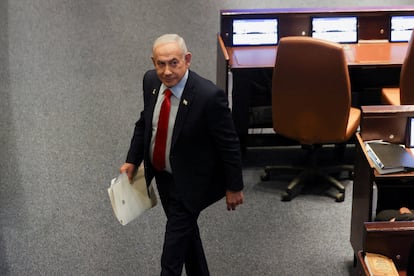
As the hours have passed, reactions have arrived from different capitals, turning the matter into something that the police who prevented the mass probably did not imagine.
The first, from Rome, by Meloni. He considers it “an offense not only for believers, but for every community that recognizes religious freedom.” Sánchez used a similar tone, but quoting the prime minister: “Netanyahu has prevented Catholics from celebrating Palm Sunday in the Holy Places of Jerusalem.” “Without any explanation. Without reasons or motives. From the Government of Spain we condemn this unjustified attack on religious freedom and we demand that Israel respect the diversity of faiths and international law. Because without tolerance it is impossible to live together,” he added.
Macron has not singled out Netanyahu, but has condemned “the police decision.” “It adds,” he continued, “to the worrying increase in violations of the status of the Holy Places in Jerusalem.” The president of France has also asked for guarantees for “freedom of worship in Jerusalem for all religions.”
Even Huckabee, the ambassador to Jerusalem appointed by Donald Trump and known for his close postulates to the most radical Israeli righthas lamented the “unfortunate excess”, with “important repercussions worldwide”. “It is difficult to understand or justify preventing the Patriarch from entering the church on Palm Sunday for a private ceremony,” he added in a message on the X social network.
Israel’s Foreign Minister, Gideon Saar, has only responded to Sánchez’s reaction. In a message on the social network “Israel is committed to freedom of religion and worship, and will continue to defend it, unlike the Iranian regime, which openly supports Sánchez,” he added in reference. to the previous controversy, for a video in which a member of the Revolutionary Guard attached a sticker with the president’s face to a missile aimed at Israel.
The incident adds to the feeling of grievance deepened for years, with desecrations, attacks on churches and spitting on priests and pilgrims.
On the other hand, it delves into the double standards in the application of the rules by the Israeli authorities. The same police that prevented a mass this Sunday, on an important date and in a key place, is the same one that, at the beginning of the war, turned a blind eye to different mass celebrations (which far exceeded the maximum of 50 people) in different parts of the country during the Purim holiday, a kind of Jewish carnival. There are videos of up to hundreds of people celebrating outdoors. In the Jewish neighborhoods of Jerusalem, concentrations can also be seen these days that exceed the limit set by the Armed Forces.
https://elpais.com/internacional/2026-03-29/israel-impide-a-la-maxima-autoridad-catolica-oficiar-la-misa-de-domingo-de-ramos-en-el-santo-sepulcro-de-jerusalen.html

