

The BNP government is deceiving the people about reforms. The promises they made to the people before the election, now they have moved away from that place.
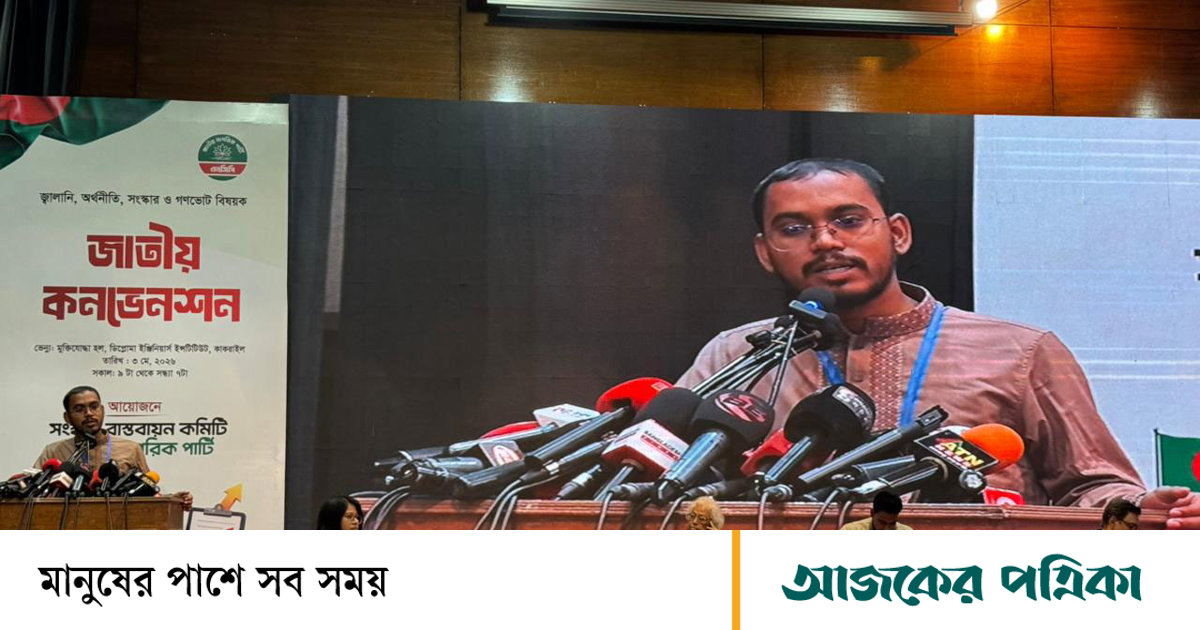
Speakers said these things at the National Convention on ‘Fuel, Economy, Human Rights, Reforms and Referendum’ held at Mukti Jodha Hall of the Institution of Diploma Engineers in Kakrail, capital, on Sunday. The convention was organized by the National Citizen Party (NCP) Reform Implementation Committee.
NCP member secretary Akhtar Hossain presided over the opening session of the program. Sarwar Tushar, Joint Convener of NCP and Deputy Head of Reforms Implementation Committee gave the welcome speech.
NCP Senior Joint Chief Coordinator and Member of Parliament Abdul Hannan Masood, Political Scientist Dilara Chowdhury and Sociologist Mirza Hasan discussed as panelists.
Abdul Hannan Masoud said, ‘I said after the first session of the parliament, it is a parliament of fraud and deception. Why did I come to this parliament and what did I get? Ordinances which would increase the power of the government, they passed into law. But those that will ensure the accountability of the government, they have lapsed and canceled them.
Hannan Masood said, ‘The interim government issued an ordinance at a special moment to remove various local representatives elected by stealing votes during the Awami League, the elected government came and made it a law. Through which they can remove local government representatives without explanation. As a result, if they dislike someone from the opposition party, they can remove him and install an administrator of their choice.
Hannan Masood said that despite some disagreements of the NCP, the police commission was done according to the BNP’s proposal, but it is not liked by the BNP when it goes to the government. They canceled the missing commission. Supreme Court Secretariat wanted BNPE. But the government canceled it. The BNP has moved away from the talk of reforming the constitution. We will also return to the demand for a new constitution.’
Political scientist Dilara Chowdhury said, ‘In 1991, BNP did not implement any of the reforms proposed collectively by the political parties. What happened after the coup of twenty-four? We are dealing with a fraudulent team. Those who have meticulously planned from the beginning that the dream we had after the coup, is destroyed. Bangladesh’s elite, civil-military-bureaucracy does not want to relinquish power. That is why they have corrupted Sanskar.’
He mentioned that Home Minister Salahuddin Ahmed had given a statement in Parliament that if any minister in Canada had told such a lie, he would have had to resign that day.
Dilara Chowdhury said, ‘Not even two months have passed since the election. In between we have to discuss. The government is canceling a number of institutional reforms including the missing persons, human rights, ACC, judiciary left in the July Charter and Ordinance. The Council was supposed to form and appoint the constitutional institutions. As a result, the organization will be able to work independently from the executive department. But that didn’t happen either. Without these, the Prime Minister will become authoritarian. As a result, the government will have to accept the July charter and referendum. If not, they will turn to Hasina’s government.’
Sociologist Mirza Hasan said, ‘July Sanade is a unique issue in the political history of Bangladesh. The main point of which is to keep the balance of power between the three main organs of the state namely the judiciary, the administrative department and the executive department. Much of the early talk of the Constitutional Reform Committee was radical. In particular, the same person cannot be the head of the government and the head of the party. There BNP has been compromised due to creating pressure. What survived, however, was also a great achievement. If we could implement that too!’
Criticizing a section of civil society, Mirza Hasan said, ‘Civil society has said that people have nothing to do with this charter. But this is a misconception. Because, the opinion of the people coming to the Consensus Commission has been taken, surveyed. There are criticisms that people voted without understanding the referendum. But you see, when Brexit happened, there was a complicated political environment. A line was lifted from the Constitution in the 1991 referendum; For which you need to know about the constitution. As a result, people can understand in their own way. They should be respected. They understand as they do. Another thing is said, there is no use in making laws, people should be good. This is a misleading statement. Because people are not angels. As a result, his hands and feet should be tied. This is the essence of the charter.’
Sarwar Tushar said, ‘BNP government does not want to reform. Many wanted to give them a “benefit of doubt” for so long. But after the Home Minister’s speech in the first session, it was clear that the BNP government would not do any more reforms. Not only that, it is not possible for BNP to go back to the reforms they have mentioned in the party and election manifesto. The promise they have made, they have already broken it by canceling the Supreme Court Secretariat Ordinance and partisanship in the constitutional institutions.
Sarwar Tushar said, ‘Many people give an argument that our government, so we will put our people everywhere. But you cannot install party people in constitutional institutions. Even though BNP appoints party people everywhere, there is no one person who can be made president in BNP. But the people of BNP are saying that the corruption allegations against him have been proven and he has already violated the constitution. It is our responsibility to implement the reforms and if the BNP does not implement the reforms, we have to build a mass movement.’
President of the session Akhtar Hossain said, ‘BNP government does not want to reform under the pretext of power. They want to enjoy absolute power BNP is repeatedly talking about the Note of Dissent. But the matter has come to the Consensus Commission in such a way that everyone agrees on the main issue. If anyone has a different opinion, it will be mentioned next. That is, note of descent is not important. Apart from that, after the referendum, BNP’s agree-disagreement is no longer an important issue.
Akhtar Hossain said, ‘BNP has said that they have objections to half of the four questions. You have to clarify which part of the referendum you object to. Because the referendum questions were very clear that there would be an upper house according to the voting PR, a caretaker government according to a new formula and appointments to constitutional institutions through an impartial board. There were 30 such points on which we all agreed. There were other issues which the political parties could have implemented as per their manifestos.’
Akhtar Hossain also said, ‘The constitutional reforms we talked about violate the basic structure. Then came the question, is it possible to make the matter sustainable by simply modifying it? At that time, we agreed on an idea between the amendment through the Parliament and the new constitution through the Constituent Assembly, that was the Constitution Reform Council. But BNP has moved away from that now.’
Akhtar Hossain urged not to disrespect the verdict of the people of the referendum. The session was moderated by Monira Sharmin, convener of National Women’s Shakti.

