

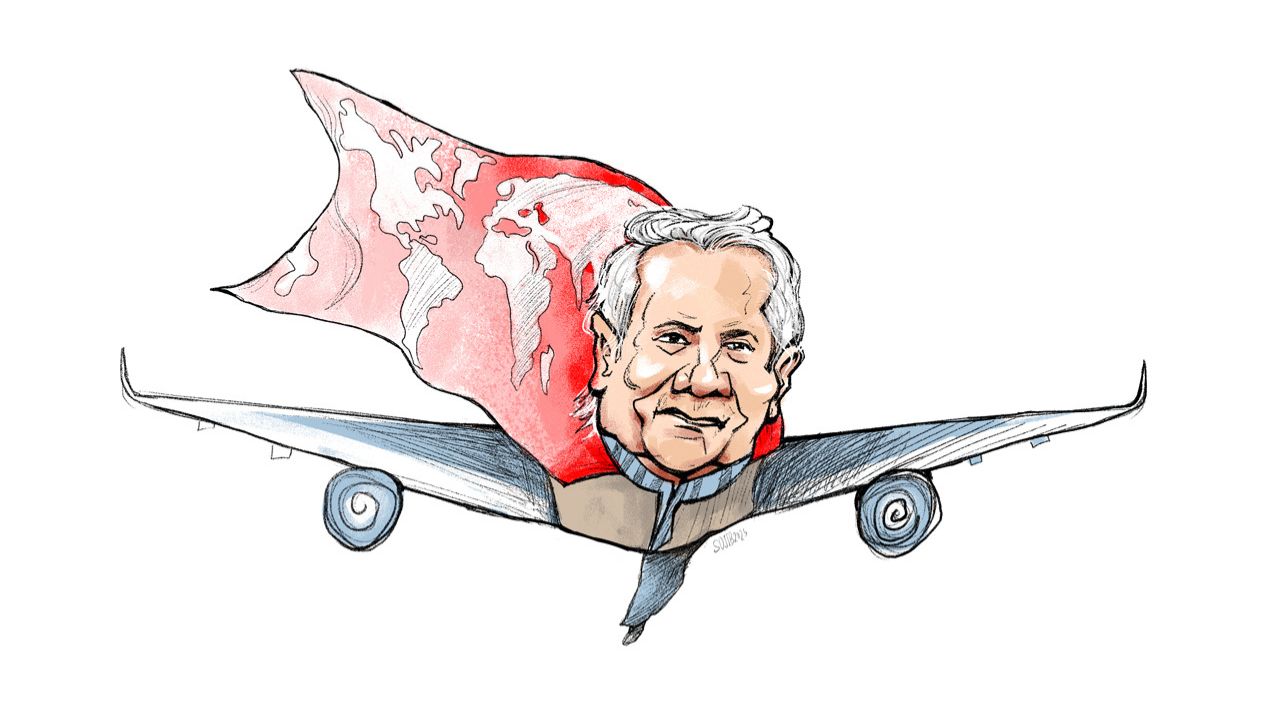
Nobel Peace Prize laureate Dr Muhammad Yunus is widely known for his vision of sending poverty to a museum.
After assuming office as chief adviser of Bangladesh’s interim government, he had what many viewed as a major opportunity to advance poverty alleviation. The reality, however, is that he was unable to capitalize on that opportunity. During his tenure, an estimated three million more people fell into poverty.
Following the mass uprising that emerged from the anti discrimination student movement and led to the fall of the Awami League government, Dr Yunus took oath as chief adviser of the interim government on August 8, 2024. He appointed advisers and special assistants of his choice and enjoyed broad support from political and student forces aligned with the uprising, including BNP, Jamaat, and the National Citizen Party.
This environment created significant scope for structural reforms in a decaying state apparatus, with opportunities to tackle poverty, curb corruption, stabilize business and financial sectors, and build institutional capacity. According to critics, Dr Yunus failed to seize that opportunity.
Distinguished economist and former vice chancellor of Jahangirnagar University Professor Abdul Bayes said expectations were high when Dr Yunus, an economist, took charge. Many hoped the battered economy would recover. Instead, he said, the economy stumbled further. Aside from growth in remittance inflows and foreign exchange reserves, most economic indicators declined. Business confidence weakened, industrial production slowed, no major new initiatives were launched, and domestic and foreign investment failed to materialize. Unemployment and the number of poor people increased. According to World Bank estimates, around three million people newly fell into poverty during his tenure.
Private sector investment at a four decade low
As of June 2024, average private sector investment stood at 24 percent of GDP. By June 2025, it had fallen to 22.48 percent. The nearly 1.5 percentage point drop within a year was unprecedented in the past four decades.
Lowest annual development spending in ten years
Not only did private investment decline, but public investment also dropped to its lowest level in a decade. According to a report by the Centre for Policy Dialogue, implementation of the Annual Development Programme was the lowest in ten years. From July to November, implementation stood at around 11.5 percent, a figure unmatched in its weakness over the past decade.
Non performing loans among the highest in the world
By the end of the September quarter of 2025, non performing loans in the banking sector had reached 6.44 trillion taka, accounting for 35.73 percent of total disbursed loans. At the end of December the previous year, the figure was 20.2 percent. The surge within a short span was unprecedented. Reviews of research data indicate that Bangladesh’s banking sector now has one of the highest non performing loan ratios in the world.
Debt burden of 23 trillion taka
Dr Yunus left office with the elected government inheriting a debt burden of 23 trillion taka. According to Bangladesh Bank data, total public debt from domestic and foreign sources stood at 22.50 trillion taka at the end of the 2024 to 25 fiscal year. During the July to December period of the current fiscal year, the interim government borrowed 611.48 billion taka from banking sources and nearly 130 billion taka in foreign loans.
Inflation outpaces wage growth
In December, inflation stood at 8.5 percent, while wage growth was below 8.1 percent. This means inflation continued to outpace income growth, eroding purchasing power. Despite this, the government kept policy interest rates high in an effort to curb inflation. As a result, lending rates rose, private sector credit declined to its lowest levels, and business operating costs increased.
While most economic indicators deteriorated, foreign exchange reserves rose. In his farewell address, Dr Yunus highlighted the increase in reserves as a point of pride. He said the country was leaving behind a stabilized situation, with reserves at 34 billion dollars, supported by remittances. He also claimed food inflation had declined significantly.
Criticizing what she termed reserve politics, United Kingdom based academic and researcher Dr Lubna Tureen wrote on social media that reserves are not an end in themselves but a tool. She argued that the real goals should be production capacity, employment, food and energy security, and policy autonomy. According to her, the more pressing question is at what cost reserves are built, whose losses finance them, and what structural constraints are imposed on the future state. She contended that reserves were boosted by curbing imports, reducing electricity production, squeezing industry, and raising the cost of living.
Promises, accountability, and benefits
In his first address to the nation, Dr Yunus pledged to strengthen local government institutions, ensure decentralization of power, and carry out reforms in administration, the judiciary, the election commission, law enforcement, and information flow in order to hold a free, fair, and participatory election. Critics say that aside from overseeing a peaceful election, he failed to fulfill many of his promises.
Allegations of corruption surfaced against officials appointed during his tenure. One personal staff member of an adviser was suspended amid allegations, and the Anti Corruption Commission launched investigations. Questions were also raised about asset declarations by advisers. Dr Yunus himself faced allegations of granting tax exemptions and other benefits to institutions linked to his interests while serving as chief adviser. Cases against him related to labor law violations and money laundering were dismissed swiftly, prompting questions about transparency.
During his tenure, Grameen Bank received tax waivers and the government’s shareholding in the bank was reduced from 25 percent to 10 percent. Several Grameen affiliated entities secured rapid government approvals and special privileges, including approval for Grameen University in Dhaka, a manpower export license for Grameen Employment Services, and permission for Grameen Telecom to launch a digital wallet.
Observers note that although Dr Yunus highlighted ordinances and measures taken during his farewell speech, he did not address these allegations of preferential benefits. Over 18 months in office, he did not hold a full press conference with the national media, speaking instead with selected journalists. Eleven reform commissions produced extensive reports funded by public money, yet effective implementation was lacking.
During his tenure, two major media outlets were attacked and set ablaze by mobs, and law enforcement agencies were seen as failing to respond decisively. Several journalists were jailed. Incidents of religious hatred, vandalism of shrines and temples, extrajudicial killings, and mob violence occurred. Historical monuments and records linked to the Liberation War were damaged or destroyed, while the government remained largely silent.
Dr Yunus has long promoted the concept of three zeros, zero poverty, zero unemployment, and zero carbon emissions. Critics argue that even while serving as head of government, he failed to advance those goals. Instead, poverty and unemployment rose during his tenure. As he returns to his previous global advocacy roles, observers now question whether he can continue to speak with conviction about achieving the three zeros.

