

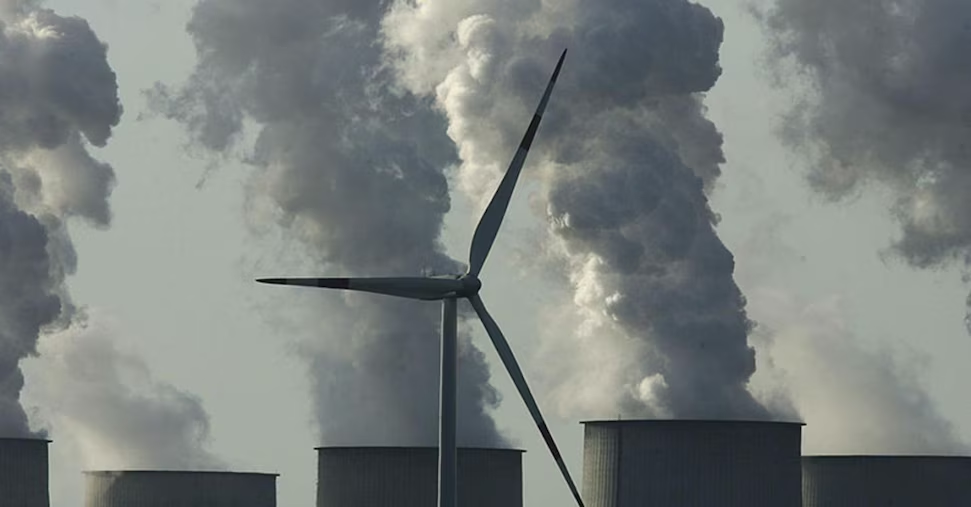
Ets, in the next European Council on 19 and 20 March we will talk about the reform of the EU emissions trading system aimed at the decarbonisation of the most energy-intensive sectors (such as electricity, cement, steel, aluminium, ceramics, glass, chemistry, then also aviation).
Italy is among the most active governments in calling for a suspension, as well as a broader review. And the Bills decree provides for its sterilization on the price of energy produced by thermoelectric power (if Brussels gives the green light). The impact on businesses is in fact both direct, represented by the permits that each plant must purchase depending on how much CO2 it produces, and indirect, i.e. incorporated in the cost of the electricity used (whose production from gas requires the purchase of permits), for which forms of compensation already exist. But how much does this mechanism weigh on the Italian industry? And how has it changed over time?
Price growth
The price of Ets permits has increased in recent years: equal to an average of 5.4 euros per ton of CO2 in 2015, it gradually rose (16 euros in 2018, 25 in 2020, 81 in 2022) until reaching an average of 84 in 2023 (with daily peaks in the 100 area) and then falling to almost 65 in 2024 and stabilizing at 74 euros in 2025. According to Confindustria, in 2025 the weight of the ETS on the electricity exchange was estimated at 29.5 euros per MWh, up from 26 in 2024. As the GSE certifies in the latest report (the next one is expected shortly) in 2024 the proceeds of the ETS in Italy were 2.6 billion euros: from November 2012 (the start of the emission quota auctions, then to fully operational from 2013) to 2024, the GSE has placed 768.2 million EUAs (European Union Allowances), obtaining 18 billion euros.
«The ETS system was created with the aim of supporting the decarbonisation of European industry but it is proving to be a source of financial speculation and extra costs on electricity», explains Aurelio Regina, delegate of the president of Confindustria for Energy. «All the efforts that the industry could make to decarbonize – he continues – have been made in these twenty-three years of existence of the mechanism. In the coming years there will be no mature and available technologies, so the ETS only risks fueling production delocalisation. The application of the ETS is now anachronistic compared to the geopolitical evolution we are experiencing, resulting in fact a threat to European competitiveness and security. For these reasons we strongly support its immediate suspension.”
Ceramics
«In the five-year period 2026-2030, the estimated cost of CO2 is equivalent to approximately half of the annual investments of the ceramic sector», adds Augusto Ciarrocchi, president of Confindustria Ceramica. «The tile sector – he underlines – in the last ten years has invested on average 400 million euros per year, around 4 billion in total, equal to 6.9% of the average annual turnover». Nomisma Energia (in a study prior to the war in Iran) estimated the average annual costs of ceramics for the ETS at around 130 million euros in the period 2021-2025, expected at 190 in 2026-2030 and 225 in 2031-2035. The current extreme volatility makes estimates difficult to substantiate.

