

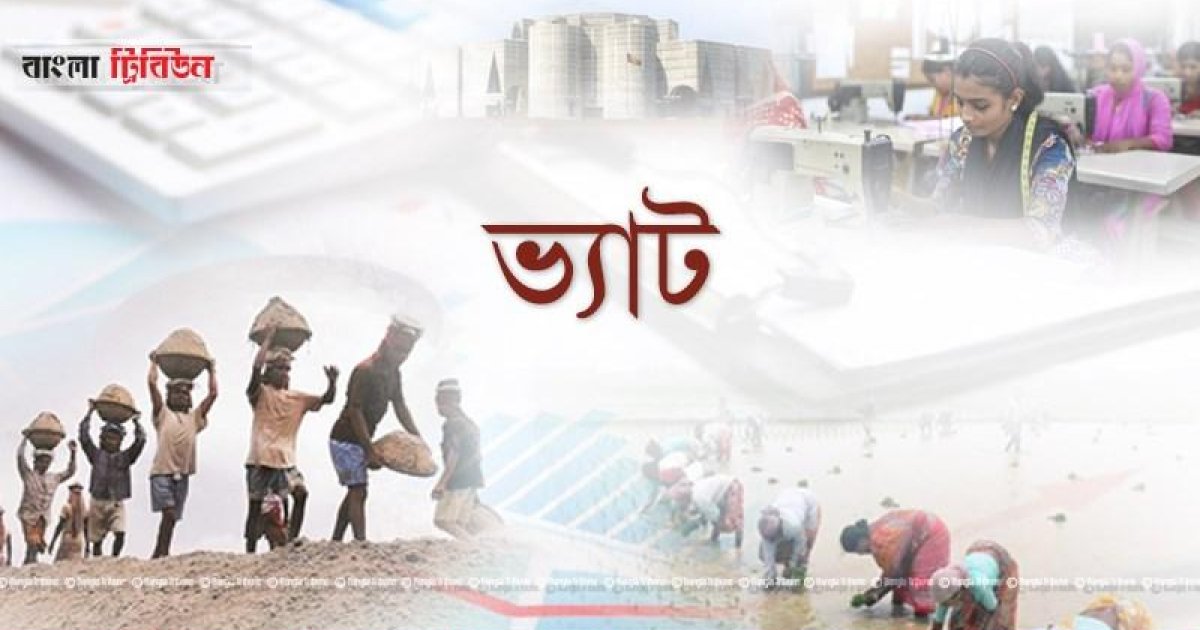
The interim government suddenly decided to increase the value added tax (MUSAC) or VAT. According to the related sources, the government is going to bring some amendments in the VAT and supplementary duty law mainly under the pressure of the International Monetary Fund (IMF). VAT may increase to 15 percent on 43 types of goods and services, including ready-made garments, air-conditioned restaurants, sweets, biscuits, pickles, coils and tissue paper, non-AC hotels. There is a risk that the price of these products and services will increase if VAT increases. As a result, the prices of these goods and services may increase before the budget. This will reduce the purchasing power of the common people. Business will be in crisis again. Economists and businessmen have already started criticizing this decision of the government. They say that it would be best to increase revenue collection by increasing direct taxes.
The draft Value Added Tax and Supplementary Duties (Amendment) Ordinance, 2025 was given in-principle approval at a meeting of the Advisory Council on Wednesday. Although the approval of the revised draft ordinance was announced at the end of the meeting, it was not officially announced what changes are being made regarding VAT.
However, the interim government's finance advisor. Salehuddin Ahmed said, even if VAT increases, the price of goods will not be affected. Because, duty on all essential products has been reduced to zero. On Thursday (January 2), after the meeting of the cabinet committee on government procurement, the finance adviser told reporters, 'The main weight indicators of our inflation are rice and pulses. And the things we're raising taxes on are far less important in driving inflation.'
In response to the question whether this decision of the government will cause hardship to the common people, he said, 'I don't think there will be any hardship.'
However, the businessmen say that increasing the VAT rate at this moment is a suicidal decision. Many people in the business community say that the government's decision may reduce revenue instead of increasing it. They say, already the rising trend of inflation is causing common people to sigh. There, the increase in VAT rate on life-saving medicines, LP gas, milk powder, biscuits, pickles, tomato ketchup or sauce, juice, tissue paper, fruits, soap-detergent powder, sweets, slippers will put more pressure on people.
Business leaders of various sectors say that the business sector has suffered a major shock after the political change in the student uprising. The losses have not yet been overcome. In such a situation, the decision to increase the VAT is a blow.
It is known that recently the International Monetary Fund (IMF) has given a condition of VAT rate of 15 percent as a loan condition. An IMF delegation visited Bangladesh last December before disbursing the fourth tranche of the ongoing loan program of USD 4.7 billion to Bangladesh. Bangladesh then requested to increase the size of the ongoing loan program by another 750 million dollars. IMF has also agreed to pay this amount. For this, the IMF has given some strict conditions to increase revenue collection including tax collection and separation of policy-making agencies. Economists believe that this initiative to increase VAT has been taken to fulfill that condition. According to them, the government needs money. Therefore, initiatives have been taken to increase the revenue by increasing the VAT and duty on various products and services. As a result, the cost pressure on the middle class and upper middle class will increase slightly. Some of the economists even think that the risk may be created in the economy.
In this context, the executive director of the private research organization Policy Exchange. Mashroor Riaz said, if the VAT rate is increased in this situation, inflation will definitely increase. He thinks that, in the current context, if the VAT rate is increased without proper research and well thought out analysis, it may not bring benefits to the economy. Even this decision may create risks to the economy.
In this context, Vice President of Consumers Association of Bangladesh (CAB) Central Committee, SM Najer Hossain said that every product except cigarettes is essential for the quality of life. In that case, if their prices increase, the cost of people's living standards will increase. Then inflation will increase.
Incidentally, VAT is the major means of government revenue collection. Currently, the number of VAT registered establishments is 5 lakh 25 thousand. Out of this, an average of 350,000 companies pay VAT regularly. Apart from this there are still lakhs of companies, those companies could not be brought under VAT. Even NBR could not install Electronic Fiscal Device (EFD) as required to increase VAT collection.
In the current fiscal year 2024-25, NBR's revenue collection target is Tk 4 lakh 80 thousand crore. Till last November, the target was Tk 1 lakh 69 thousand crore. Against this, the revenue collected is 1 lakh 27 thousand crores. That is, the revenue deficit is still 42 thousand crore rupees. It is assumed that the government is going to impose new VAT to meet this revenue deficit.
If the proposed VAT is implemented, common people will have to pay 15 percent VAT on the food bill when they go to eat in restaurants. Until recently, VAT was charged at the rate of 5 percent on food bills in air-conditioned or AC restaurants.
In this regard, Secretary General of Bangladesh Restaurant Owners Association Imran Hasan said, restaurant owners are worried about the decision to increase VAT. He said, if VAT is increased, the business will have a terrible impact. Income tax will also increase with VAT. Small traders will be affected by this.
“This is part of the inefficiency of handing over the industry to corporates by destroying small hotels and restaurants,” he complained.
In this context, Taskin Ahmed, President of Dhaka Chamber, said that such a move by the government will increase the cost of production and operation of the business, which will eventually reflect in the price of the product and accelerate the inflation. He thinks, 'This decision will reduce the purchasing power of consumers. It can have a negative impact on the economy.'
Goods and services on which VAT is increasing
Until now, VAT was being charged at the rate of 5 percent on food bills in air-conditioned restaurants. It can be increased to 15 percent. Besides, the VAT rate may increase in the purchase of clothing. At present, there is 7.5 percent VAT on the bill of ready-made garment outlets. An initiative has been taken to increase it to 15 percent.
An initiative is being taken to increase the VAT rate from 7 and a half percent to 15 percent in the purchase of sweets. VAT rates on non-AC hotel services may also increase in the case of travel. Currently there is 7.5 percent VAT on non-AC hotel services. An initiative has been taken to increase it to 15 percent.
Apart from this, among the other sectors which are going to get 15 percent VAT are biscuits, pickles, CR coils, mattresses, transformers, tissue paper etc.
Apart from this, Bangladesh Road Transport Authority (BRTA) has also taken the initiative to levy 15 percent VAT while making the driving license card. Apart from this, an initiative has been taken to increase the existing 20 percent supplementary duty to 30 percent in the case of liquor bill. In addition to the initiative to increase VAT on goods and services, business establishments may have to pay turnover tax only if their annual turnover is between Tk 30 lakh and Tk 50 lakh. At present, tax is payable on turnover ranging from Tk 50 lakh to Tk 3 crore. According to the new proposal, sales of goods and services can attract VAT at the rate of 15 per cent if the annual turnover is Rs 50 lakh.
The government is going to increase the supplementary duty on several products and services at import, production and service levels. For example, the supplementary duty on fruit juice has been increased from 20 percent to 30 percent, on copper from 60 to 100 percent, and on betel nut from 30 to 45 percent. In addition, additional charges may be levied for talking on mobile phones (talktime). Excise duty may increase on travel. As a result, the cost of air travel may also increase. The amount of excise duty on domestic flights may be increased from Tk 500 to Tk 700. And in the case of foreign travel, the excise duty may be increased from 500 to 700 taka for travel to SAARC countries and 2 thousand taka to 2 thousand 500 taka outside SAARC countries (within Asia), and the excise duty may be increased from 3 thousand taka to 4 thousand taka for traveling to Europe and America.

