

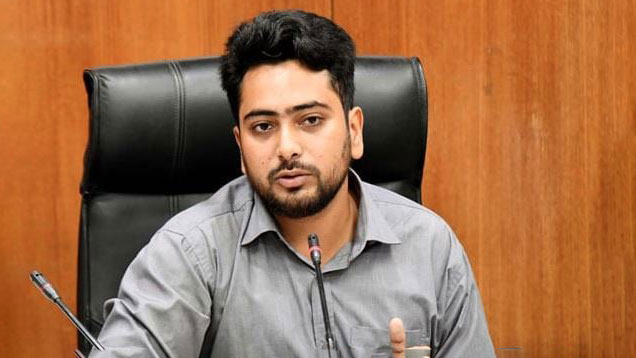
Nahid Islam, Information and Broadcasting Advisor of the Interim Government has strongly criticized BNP Secretary General Mirza Fakhrul Islam Alamgir's statement about neutral government. A former leader of the anti-discrimination student movement described his speech as 'signifying the formation of another 1/11 government'. Nahid said this in a statement posted on his verified Facebook ID on Thursday.
Nahid wrote in the statement, 'Awami fascism arose from the settlement of 1/11. In BNP Secretary General's speech, there are signs of another 1/11 government, parliamentary majority and continuation of knee-jerk foreign policy and no justice for the murders and July murders.'
In an interview given to BBC Bangla yesterday, Mirza Fakhrul questioned the neutrality of the current government. He said, 'If the government observes complete neutrality, then they will remain till the conduct of elections. If not, a neutral government will be needed.'
Regarding the possible change in the interim government, BNP Secretary General said, 'The question of neutrality may arise. Because, here we are noticing that your students are thinking of forming a political party. If there is a representative of the students in this government, then it cannot remain neutral. That is, possible. But if they think that they will elect from (the government), then the political parties will not accept it.'
Criticizing this statement, Nahid also wrote, 'The plan to undermine the students and the leadership of the coup started on August 5. On 5th August, while the students were fighting in the streets, the police firing continued, many of our compromised national leaders were busy planning a new government in the cantonment excluding the people (many of the students also spoke there).'
He said, 'We have been saying since August 3 that we will not accept any kind of military rule or emergency. We are repeatedly asked to go to cantonment but we refuse to go. In the end, Dr. Bangabhaban discussion and negotiation. It was decided to form an interim government headed by Yunus.
The adviser wrote, 'We wanted a national government composed of anti-fascist political parties and civil society. If there was a national government, students might not have needed to come to the government. BNP did not agree to the national government considering that the national government will last for a long time.
But it was after the coup that the need for a national government was greatest in the country. But BNP is talking about the national government after the next election.
Students are the only factor in this government and the existing reality that completely separates the present government from the government of 1/11. BNP discussed minus two a few days ago but now it is proposing another 1/11 government in the name of neutral government to pave the way to power. Such a plan would go against democracy and national interest and the students would never accept it. And I think it is a conspiracy against BNP too.'
Nahid thinks that even though the current government is not a national government, all parties of the movement have a stake in the government and all parties are enjoying various benefits. Before the formation of the government on August 6, the appointment of the Attorney General and the previous IG of Police, who are mainly BNP people. In this way, there are pro-BNP people at various levels from the top to the bottom of the government. Talking about the impartiality of elections, this reality should also be kept in mind.
Commenting on BNP's position against all issues, Nahid wrote in a Facebook post, 'Presidential change, reforms, new constitution, July declaration, BNP has taken a position against all issues. But none of these were party demands of students. But the students have repeatedly moved away from their stand to maintain the country's stability, larger interests and national unity. But this does not mean that we will give any concessions if there is any plan 'anti-democratic and anti-coup'.
The advisor also said, 'Unity between the main parties of India has been possible regarding the Awami League. But in Bangladesh we could not unite about Awami League even after so many murders and crimes. Alas, we will make a state with this 'national unity'! It is easy to weaken Bangladesh because Bangladesh can be divided easily. The great men of this country are ready to be sold at a low price. I don't think the entire BNP accepts this position. Rather, the majority of BNP's workers and supporters want the realization of the desire for a coup. I call upon the patriotic and self-sacrificing leadership of BNP to choose the path of greater unity and solidarity with the students instead of going against the uprising of the students.'

