


Hendrik Brandis would like to make one thing clear: he has no plans to stop in any way in the coming years. “I’m having too much fun with everything here,” he says: “If I wasn’t allowed to do this tomorrow, it would be like my toy train being taken away from me.” The question arose, not least for his investors and partners who wanted to know what would happen next. Brandis is 62 years old and has been leading the fortunes of the venture capitalist Earlybird, which he co-founded, one of the largest and oldest start-up financiers, for almost 30 years Europe’s.
Earlybird became known in the 2000s with investments such as the one in the construction financing broker Interhyp, in which Earlybird increased its investment more than fifty-fold. For example, Earlybird later invested one million euros in the Romanian automation platform Uipath and later raised a good two billion euros with the IPO. Today the company is invested in, for example, rocket manufacturer Isar Aerospace, the fusion start-up Marvel Fusion and the neobank N26.
The venture capitalist has shaped the German start-up landscape over the past three decades. Brandis’ word carries weight in the industry; he pulls a lot of strings behind the scenes, including politically. He has just arranged his business succession – but before that he has one big, final mission.
Money is no longer the main driver
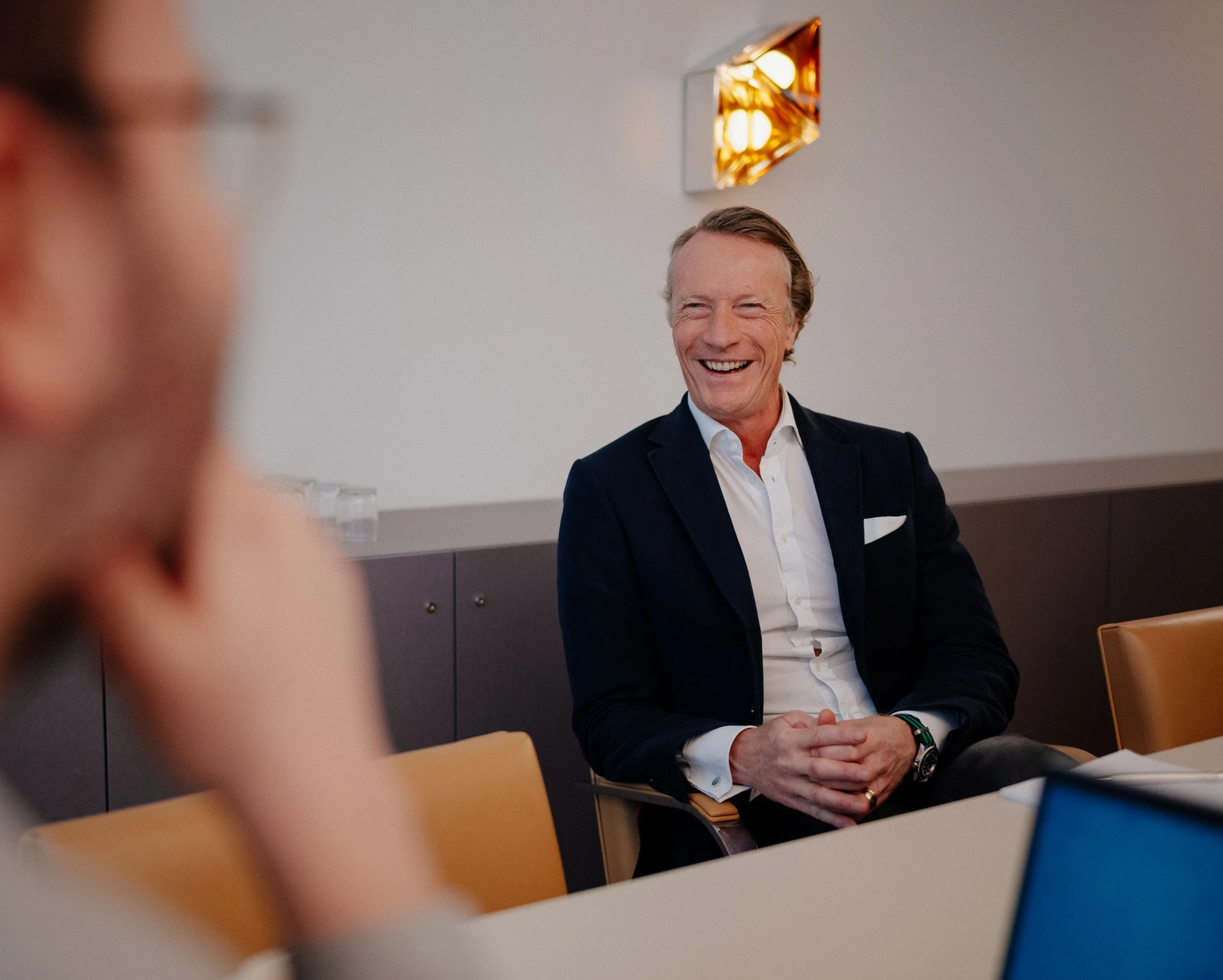
Brandis has invited people to Earlybird’s Munich office, sits at a large conference table and snacks on nuts. He likes to do this in long conversations when he wants to concentrate. And the succession planning of a partner-led venture capitalist is certainly a complex undertaking – and one for which there are still no standards in the still relatively young industry.
Selling the company was out of the question for Brandis. “Of course that would have had the pleasant side effect that we would have gotten money,” says Hamburg-born Brandis in his Hanseatic dialect. But money is no longer his main motivation: “I get heart palpitations when I talk to new, young entrepreneurs about innovations.” He couldn’t imagine giving up his own entrepreneurship and working for someone else. He doesn’t find it “particularly tempting” that his life’s work would be lost in a larger conglomerate.
Brandis is someone who can also shine in the spotlight and tolerate equal partners next to her. At least that’s how his long-time companions describe him. In the venture capital scene, which can sometimes be prone to egomania, this is not a given.
“We have irreversibly let go”
Brandis and his co-founder Christian Nagel have already passed on a large minority of the company to the next generation, with the remaining shares following a firmly agreed schedule over the next nine years: “We have irreversibly let go, it can no longer be reversed.”
The highlight of the deal, which was worked out with lawyers over two years: the company can only ever belong to the active partners and, in fact, cannot be sold. The partners don’t have to spend a lot of money buying each other. The shares are designed in such a way that the proceeds of any sale would flow to the original founders Brandis and Nagel or their heirs. “So there is no incentive to ever sell Earlybird shares,” says Brandis: “The idea that I might be invited to the Christmas party when I’m eighty, and then I’ll no longer own anything, but I can tell you how it all started in 1997, is something I honestly find very attractive.”
“I was in my early 30s and thought I could walk on water”
At that time, a venture capital industry like that in Silicon Valley in Germany was unthinkable. Brandis had just become a partner at management consultancy McKinsey – in less than five years. This is exceptionally fast. “I was in my early 30s and thought I could walk on water,” Brandis says. But he didn’t want to remain a consultant, but instead wanted to start a business himself. Because he had no idea for his own technology company and knew from his consulting work that the young industry needed investors, he founded Earlybird together with colleagues.
But the first few years were extremely difficult; Brandis and his colleagues barely made any money. It takes the team two years to collect its first five million euros – mainly from friends. “That was certainly an important lesson for me personally,” says Brandis. It was only with the new market that Earlybird’s business really took off.
Earlybird is currently investing in the early phase Start-upsthe investor has just raised 360 million euros for a new fund. In this phase, the risk of failure is still particularly high, but large investments can be acquired with very small amounts of money. In this early phase, there is now a lot of private capital available in Europe. However, there is still a large capital gap with the United States in the growth phase – i.e. when start-ups can demonstrate initial success and need larger sums of money to expand.
Large growth capital fund planned
Brandis now wants to work on closing exactly this gap. “In the future, we want to provide larger amounts of support in later phases,” announces Brandis: “That is where we see the biggest bottlenecks in Europe.” Brandis knows that this undertaking will not be easy. Raising external capital is currently challenging for venture capitalists, especially when large sums are involved. But Brandis is “cautiously optimistic” about the growth capital fund. He doesn’t want to reveal any more details.
The time for big leaps in the European tech industry is now. Brandis begins to calculate. He likes to do this and with a certain routine, even if he doesn’t describe himself as a detail person, but rather as someone who likes to think big. The American stock index S&P 500 and its European counterpart Euro Stoxx grew in lockstep until 2010. But in recent years a gap of a factor of three has opened up, which for Brandis reflects Europe’s relative loss of prosperity compared to the USA. However, if you exclude the ten largest companies in terms of market capitalization – above all the large tech companies such as Apple, Alphabet, Meta and Microsoft – from the S&P 500, the greater growth of the American stock market would no longer be present.
The concentration of growth
Brandis’ conclusion: “Economic growth today is concentrated in a few large companies due to technological development.” This is completely different from the time of the German economic miracle, when thousands of German medium-sized companies with 50 or even 500 employees ensured the upswing. However, with a distributed approach you cannot keep up with the ChatGPT developer Open AI. It has just raised $122 billion from investors, around fifteen times as much as the entire German start-up landscape last year.
Today, the German economy actually only needs two companies of this size in order to be able to catch up in terms of growth through new and very complex technologies such as AI. In this context, Brandis speaks of “centacorns”. The name plays on the term “unicorn”, which investors use to describe start-ups with a valuation of over one billion euros. “It must be our ambition to build such hyper-scaling tech companies from Germany,” says Brandis: “We have the candidates.”
Europe is excellently positioned in robotics, nuclear fusion and quantum computing, for example. He is nevertheless aware of the risks of an “extreme concentration of power” on individual tech entrepreneurs – but he believes that they are manageable in the European regulatory framework and “unfortunately there is no alternative”.
“Nowhere in the world is it safer and freer than here in Europe”
Brandis sees momentum in the European tech industry – primarily caused by the policies of American President Donald Trump. “Nowhere in the world is it safer or freer than here in Europe, and more and more people are realizing that,” he says. Talents that would previously have been drawn to America as a land of unlimited opportunities are now increasingly coming to Europe. Brandis sits on the Advisory Board of the TUM School of Management (Technical University of Munich). For two years they discussed programs about how top American researchers could be brought to Munich despite lower salaries: “We didn’t pursue the program because we now have significantly more applications than places.”
Brandis isn’t always right in his predictions, which could be described as an occupational hazard. He once described the Heidelberg AI start-up Aleph Alpha as “probably Open AI’s biggest competitor”. That was extremely optimistic at the time and, looking back, seems almost presumptuous. “I am a structural career optimist,” says the investor. Brandis believes in his investments. This is of course part of the tools of every start-up investor. But Brandis always sounds like genuine enthusiasm for technology and founders, not just the typical industry advertising show.
Especially when it comes to his absolute favorite topic: aerospace. Brandis once studied mechanical engineering and aerospace engineering at TUM, and hardly any other topic makes his eyes light up as much as when he talks about the rockets from the Munich start-up Isar Aerospace.
“I don’t take the risk to bed with me”
But his enthusiasm also brought him one of the worst defeats of his career: Lilium. The Bavarian start-up, founded in 2015, had raised a total of 1.5 billion euros for the development of an electrically powered aircraft until it ran out of money in 2024 before the technically very promising prototypes were finally completed. Brandis invested a lot of time and capital to save Lilium after all. At the last second, he organized a consortium of investors to rescue him. But the money from the Slovakian main investor Marian Bocek never ended up in Bavaria, and today all that remains of Lilium are the patents that its US competitor Archer bought at a bargain price.
Brandis himself says that he can handle the stress of his job well: “I don’t take the risk to bed with me, and I don’t sleep badly either.” His second great passion also helps him: sailing. Brandis has been sailing since he was four years old. Today he is still part of a professional team and even sails at world and European championships. “When I’m traveling with my sailing team, the professional stress is gone within a few hours,” says Brandis: “I come back after a week physically exhausted but mentally renewed.”
He can also cope well with setbacks – like the collapse of the Neuer Markt: “I was asked pityingly on the street: ‘Well, do you still exist?'” In fact, he had to live on his savings at times. His children were still small at the time: “I thought to myself, this will work somehow, and if it doesn’t, I’ll just look for something else.”
As so often happens, things worked out for Brandis, somehow. “There have been many instances in my life where I felt like I was walking into a wall and hitting my nose bloody,” he says. But his life has taught him that a door always opens at some point. That’s a kind of motto for Brandis – also for his big goal today, building a growth fund that makes a real difference for the European tech landscape. So let’s move on with our head against the wall.

