

image source, khamenei.ir
Reading time: 4 minutes
Ali Khamenei was born on April 19, 1939 in a religious family in the northeastern city of Mashhad, Iran. He was the second of eight siblings.
His father, Seyyed Jawad Khamenei, was a locally well-known Shia scholar. Mother Khadija Mirdamadi was also a pious woman.
Ali Khamenei got his initial knowledge about other important aspects of Islam, including Quran education, from his mother in his childhood.
Mr. According to Khamenei’s various memoirs, his mother Khadijah Mirdamadi’s voice in reciting the Qur’an was ‘very good’. He also mentioned that his mother’s role in shaping his character in childhood was ‘very important’.
When Ali Khamenei was four years old, he started attending a local school with his older brother Mohammad. Mr. in his memoirs. Khamenei said that he was afraid of the teacher of the Maktab.
Because that teacher would make the students line up every Saturday and beat them from head to toe.
Ali Khamenei spent his childhood in a world of poverty. Describing poverty, he mentioned in his memoirs that as a child, he and the rest of his family would occasionally go to bed hungry.
In addition, Mr. in childhood for dirty and old clothes. Khamenei was often mocked by his madrassa classmates. Sometimes there was a quarrel with them.
In the memoir Mr. Khamenei noted that as a child he was very fond of a pair of ‘shoes with laces’.
Ali Khamenei was admitted to a local school after his graduation. Although his father, Seyyed Javad Khamenei, was opposed to the Western education system.
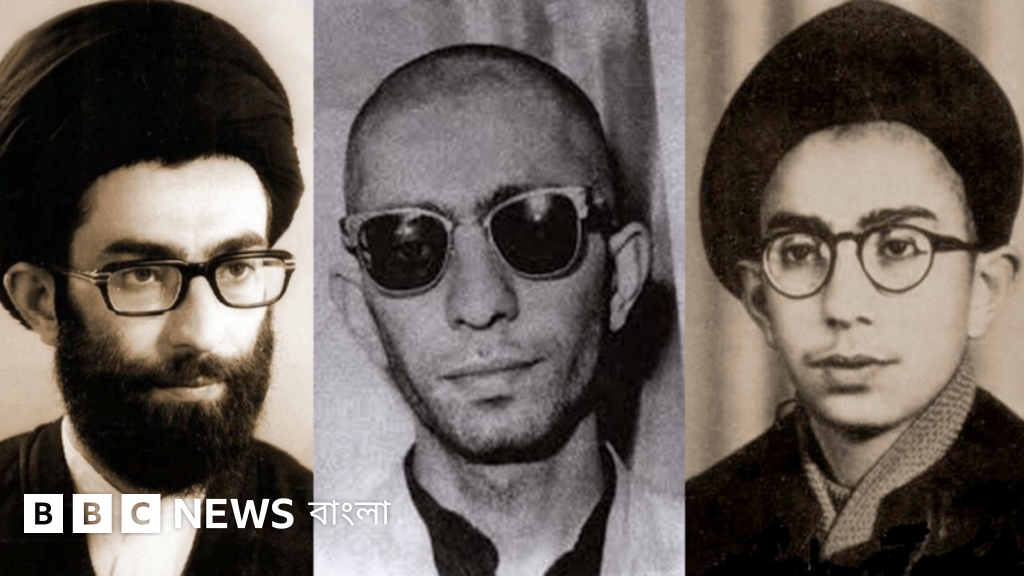
Since childhood, Ali Khamenei had low vision. Due to poor eyesight, he could not see the classroom blackboards and teachers properly.

image source, khamenei.ir
But no one could catch the matter for a long time. As a result, he was described as a ‘very stupid and lazy student’ till third grade.
After being diagnosed with poor eyesight, according to the doctor’s advice, Mr. Khamenei started using glasses.
After that he started showing his brilliant talent in studies and eventually became one of the top students of the school.
However, Ali Khamenei could not be admitted to high school in the face of his father’s opposition. Then he was sent to the holy city of Shia Muslims for religious education.
Ali Khamenei said in his memoirs that he developed a special interest in literature in his youth, especially novels and poetry.
Later he started attending various meetings and poetry gatherings of poets.
His penchant for literature was so great that he had read more than a thousand novels before going to the religious institute in Kome, Mr. said in his memoirs. Khamenei
Among those novels were books by famous authors like Leo Tolstoy, Victor Hugo and Roma Rolla.
In his youth, Ali Khamenei also started writing poetry under the pseudonym ‘Amin’.

image source, khamenei.ir
While being a student Mr. Khamenei attended a meeting in Qom in 1955. There he met Ayatollah Ruhollah Khomeini, under whose leadership the Islamic Republic of Iran was later established.
While studying in Qom, Ali Khamenei began to oppose the then ruler of Iran, Shah Mohammad Reza Pahlavi.
In 1962, he joined Ayatollah Khomeini’s religious movement.
After that young Ali Khamenei gradually Mr. Became a devoted follower of Khomeini. In various memoirs before his death, he mentioned that everything he learned and believed in life was derived from Khomeini’s Islamic ideology.
Ali Khamenei was involved in direct protests against Shah Mohammad Reza Pahlavi and was arrested several times.
Until the revolution, Ali Khamenei’s political activities were mainly centered in the city of Mashhad. Then in 1977, he moved to Tehran with his family.
In December of the same year, Ali Khamenei fled to Sistan and Balchistan, Iran’s largest southeastern province, to avoid arrest.
After the Islamic revolution in Iran in 1979, he returned to Tehran. At that time, Ali Khamenei took charge of the Revolutionary Council.
He later became deputy defense minister and helped organize the Islamic Revolutionary Guard Corps.
The Revolutionary Guard became one of the most powerful institutions in Iran.
In June 1981, he was seriously injured in a bomb attack on a mosque in Tehran. The country’s left-wing rebel group was accused of being involved in the attack. His right hand was paralyzed in this incident.

image source, khamenei.ir
Two months later, the same rebel group assassinated Iranian President Mohammad-Ali Razai.
After Rajaei’s death, Ali Khamenei was elected president of Iran as his successor. He held this official position for eight years.
At that time, he was involved in various disagreements with the then Prime Minister Mir Hossein Mousavi. Because he thought Mousavi was trying to bring additional reforms to the Iranian system.
After Khomeini’s death in June 1989, the Expert Council (a council of religious scholars) elected Ali Khamenei as the new Supreme Leader.
However, he did not achieve the required rank among the Shia clerics or the title of ‘Grand Ayatollah’ as stipulated in the constitution.
Later the Iranian constitution was amended. The amendment stated that the supreme leader “must acquire Islamic scholarship and Ali Khamenei could be elected. He was later elevated overnight from Hojjatul Islam to the rank of Ayatollah.
Another change was made in the Iranian constitution. The office of Prime Minister was abolished and more powers were vested in the President.
During his reign, Ayatollah Ali Khamenei has had six presidents, including the current president Masoud Pezheshkian. Many of whom challenged Khamenei’s authority somewhat but did not challenge the structure of the Islamic Republic.
After serving as Iran’s supreme leader for more than three decades, Ayatollah Ali Khamenei was killed last Saturday in an attack by the United States and Israel.
https://www.bbc.com/bengali/articles/c0lj99p3pw0o?at_medium=RSS&at_campaign=rss

