

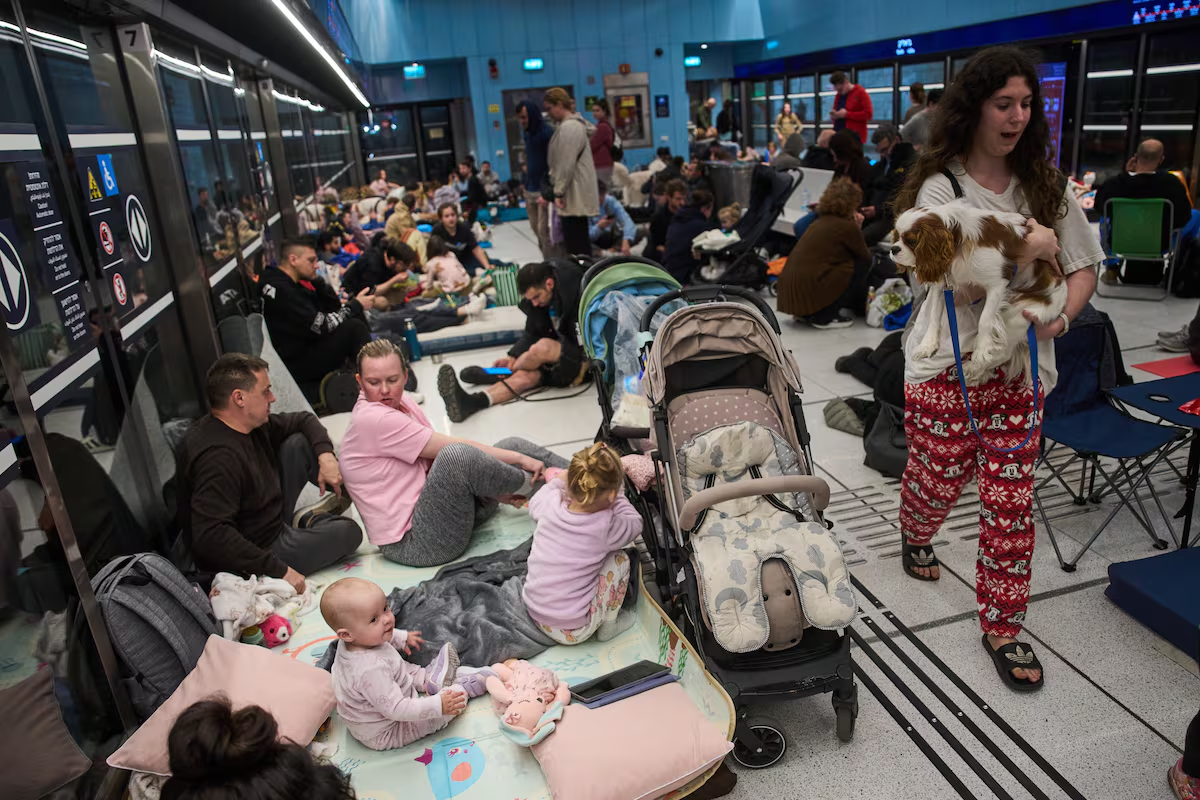
Yosef and Dina quicken their pace. Air raid sirens have begun to sound over Jerusalemwarning of the imminent arrival of an Iranian missile, and the guard of the Museum of Tolerance opens the door and encourages them with a gesture to enter and take shelter in an underground floor. It is difficult for them to run, due to their advanced age, but they have time (usually about 90 seconds) and anti-aircraft defenses usually intercept the projectiles.
In reality, this Israeli couple does not know exactly what is happening early in the morning in the Middle East: they are religious Jews and it is still shabbatthe sacred day on which it is forbidden to turn on electronic devices, such as cell phones, radio or television, and which does not end until sunset. They only intuit – by logic after weeks of massive military preparations by the US and Israel– that Iran has been bombed and that the sirens that have been sounding in waves since the first hour correspond to its response. That’s why, once under cover, they smile without a hint of fear.
“I’m not sure what is happening, but I pray that our pilots return home safely and this ends soon,” says Dina. Her husband celebrates the moment of the bombings: parsha of the weekas each fragment of the Torah that is read during the year is known, has this Saturday an addition that remembers the order to erase the memory of Amalek, the enemy nation of the Israelites that God asked King Saul to exterminate. “And Iran is the current Amalek. It’s not a minor thing, as if France likes what we do more or less. It’s just that they want to put an end to Israel,” he says.
They are two of the few Israelis who have ventured out onto the streets in the middle of the afternoon, when the launches from Iran have given more respite. In the morning, when the sirens began to sound every few minutes, the city looked even more deserted, practically without a single pedestrian or cars other than police patrols. One sound has not changed during the day: the frequent hum of fighters flying overhead.
To the now usual silence of the shabbat (with no public transport and hardly any shops open), the stores that have closed as a precaution have been added. Israel has been in a state of emergency since 08:00 (07:00, in mainland Spain), when he announced his attack on Iran. It has banned public gatherings, closed schools and workplaces, and moved patients to underground hospital facilities. Tomorrow, Sunday, which is the first day of the week here, only stores that sell necessities considered basic will open. Education Minister Yoav Kisch has already announced that schools will remain closed at least until Monday, with distance learning. There will also be no parliamentary activity.
The most religious trust God for protection. The most earthly, to Israel’s anti-missile defense system, one of the most advanced in the world, also supported by that of the largest army (the United States) and other allies, such as Jordan or the United Kingdom. Some Israelis have even taken advantage of the early morning sun to go to the beach in Tel Aviv, before the initial Iranian response, almost two hours later. In fact, in previous war conflicts, the majority of deaths are due to failure to comply with protection regulations or lack of shelter, as they are Bedouins who live in villages that Israel does not officially recognize.
The vast majority of Israelis have well internalized the rules of action: how long it takes for a missile to arrive, how long a drone takes, where the nearest shelter is or what the so-called safe room is, despite serving little protection against a missile launched from Iran.
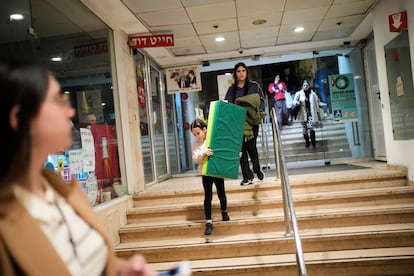
This is exactly what the couple formed by Yonathan and Ilana, aged 38 and 31, respectively, are referring to. They emigrated ten years ago from France to Israel (which automatically grants nationality to anyone who has at least one Jewish grandparent) because, Yonathan explains, it meant “fulfilling a dream” as Jews. So, he adds, they have had time to get used to the mermaid ritual and the comings and goings to the shelters, but it still seems new to them. “We haven’t grown up with that,” he points out. “Yes, it’s scary. You have a bit of a bad time, but nothing that makes us consider returning to France or going to another country.”
Ilana says in an angrier tone: “It’s a little schizophrenic. We have gotten used to it, due to the force of the facts. We are calmer than in (the previous war with Iran) June and than on October 7 (2023, with the Hamas attack).”
The proof, he points out to the baby strollers, is that they have dared to take their children of almost one and two years old for a walk, even though it meant they ended up running to the shelter, carrying them in a hurry to go up the stairs. Although they are religious, they do consult the loud alerts that the authorities send to their cell phones when they identify a launch from Iran, approximately 15 minutes before. Is drop by breaththe principle of Jewish law that allows breaking religious rules to save lives.
The city also leaves scenes that border on surrealism. As if nothing had happened since the morning, three ultra-Orthodox Jews maintain their usual weekly protest and shout “Shabbes, shabbes!” (shabbatin Yiddish) in protest against police or secular Jews driving or using cell phones during the holy day. Two children play soccer with their father in a small square, until a man calls them out from the window for making noise in shabbat. Some even take advantage of the empty streets to run or ride a bicycle. In a building with numerous rental apartments, a group of American Christian tourists climbs the stairs praying: the elevators have been deactivated as a precaution while the sound of alarms fills all the floors.
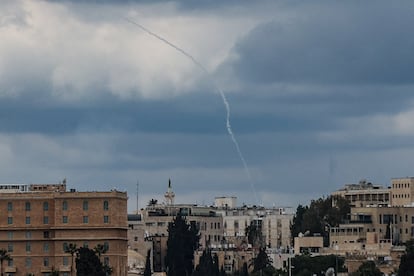
Among the few pedestrians, the majority are religious Jews who walk or go to the synagogue. Three of them reluctantly turn around as they head towards the old walled citadel. “Are you going to the Wailing Wall? It’s closed,” others who come from there warn them. In the absence of cell phones, they learn the news through word of mouth.
In the Mea Shearim neighborhood, the ultra-Orthodox stronghold of Jerusalem, the heavenly outweighs the earthly. The school that appears enabled as a shelter in the official list is closed, but next door men and women (separate and with different entrances) pray outdoors. There are dozens of them, like Shalom, who repeats prayers while swinging his torso back and forth. “It is a time for miracles,” he says of the attack on Iran. “I am only afraid of sinning. And of God, of his judgment, because whoever fears him, does not fear the things of earth.”
They are also seen on the streets some Palestinian day laborers (who have been surprised by the attack) and foreign workers, who usually live in small apartments and spend their free days abroad. This is the case of Ceylonese Indira, 38, and Upeshka, 43. They arrived in the last two years to work as caregivers and Upeshka admits that (after four confrontations with Iran, more than two months of war with Hezbollah and specific missiles from the Houthis of Yemen or Hamas) has already “memorized the practice”, especially to protect the children he cares for. “We come from a country (Sri Lanka) that has been at war for almost 30 years (from 1983 to 2009), so we don’t like this, but it doesn’t change our lives either. What is a shame is that one person makes a decision like that and many others are harmed as a result,” says Indira.
The brothers Jesse (20 years old) and Noah (19) van Halteren are alone in the shelter, even though there is no alarm. It’s not because of fear (you can see it in their body language), but because of laziness and boredom—those are the words they use—as they spend their time doing things. scroll on mobile. They are Dutch, they came as tourists for the fourth time for religious reasons and they planned to fly back this Sunday. “Obviously, our flights have been cancelled,” explains Jesse. “Between what is shabbat and what has happened, we can’t do anything. And the situation is not there to go hiking in the north (border with Lebanon) either,” Noah jokes.
https://elpais.com/internacional/2026-02-28/calles-vacias-y-carreras-a-los-refugios-en-israel-nos-hemos-acostumbrado-es-un-poco-esquizofrenico.html

