

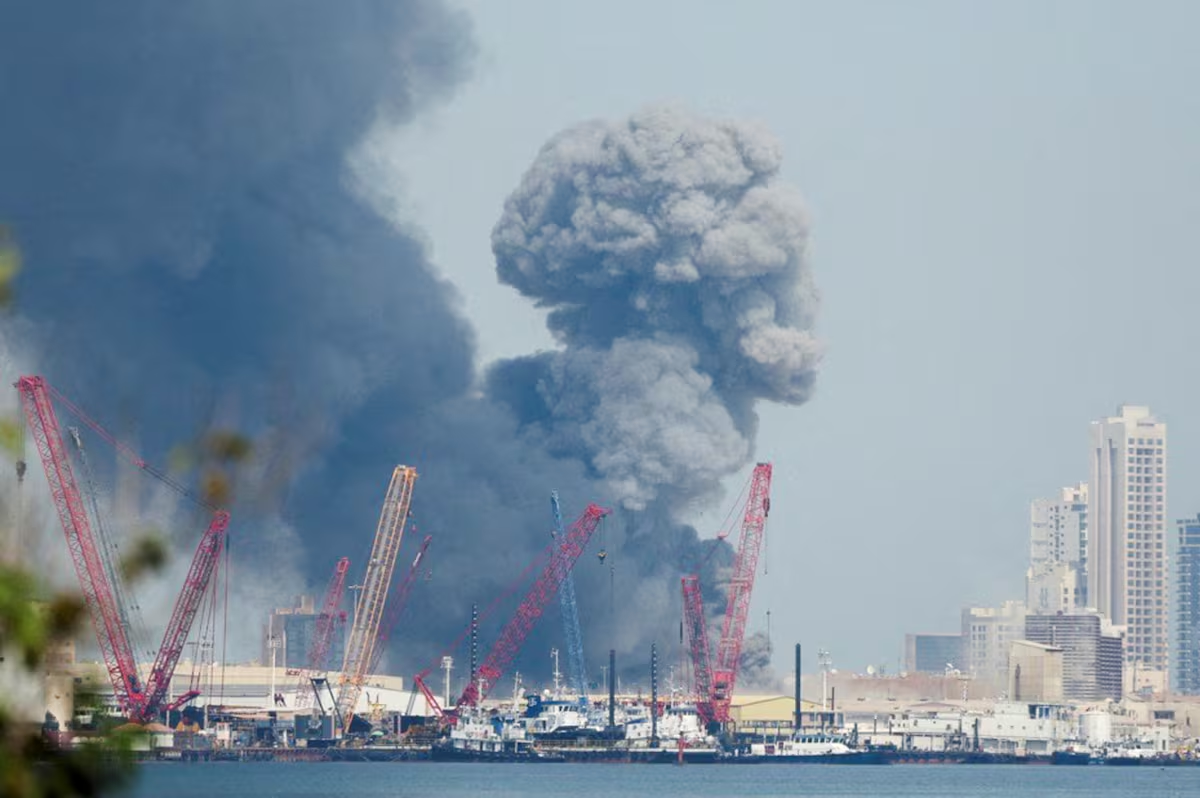
This Saturday, Iran launched bombings against United States military bases in at least seven countries in the region in response to the offensive that the United States and Israel have started with the stated goal of overthrowing the Islamic Republic. Bahrain, Qatar, United Arab Emirates, Kuwait, Saudi Arabia, Jordan and Iraq, in addition to Israel, They have been the object of Iranian hostilities with a balance still uncertain. Several of these governments have announced the successful interception of missiles, although there are also images that demonstrate the impact of projectiles against areas that host US installations in different countries. The Iranian authorities had warned that any attack against their territory would automatically turn both the State of Israel and Washington’s bases in the region into a military target. After the aggression against Iran, Tehran’s anticipated response has plunged the Middle East into a spiral of violence.
The Revolutionary Guard, a parallel army whose task is to protect the Iranian regime, has launched “massive, simultaneous missiles against US military bases throughout West Asia,” according to Iranian state media Press TV. It has also targeted several Israeli areas, causing minor injuries to dozens of people, according to authorities in Israel – a country with empty streets and the continuous sound of sirens. The US and Israeli attacks have wreaked havoc in Iran, killing at least 200 people, according to a Red Crescent statement.
The Farsi news agency states that the response to the US and Israeli offensive includes the US base at Al Ubeid, near Doha (Qatar), the Al Salem air base in Kuwait – where all the missiles have been intercepted – the Al Dhafra air base in the Emirates, and the Fifth Fleet facilities in Jufair, a city in Bahrain where plumes of smoke have been seen rising into the sky. Bahrain’s Interior Ministry has reported attacks on residential buildings in Manama, the capital.
Saudi Arabia has also confirmed attacks in Riyadh and other parts of the country, and the Reuters agency has reported an attack on a US base in Iraqi Kurdistan, according to a security source.
The only country in the Gulf Cooperation Council where no explosions have been reported is Oman, whose government has played a key role in the nuclear negotiations held in recent weeks in Geneva between Iran and the United States. On Friday, hours before the offensive on Iranian territory, the Omani Foreign Minister, Badr Al Busaidi, assured that the agreement was possible. This Saturday, Al Busaidi declared himself “dismayed” at the offensive by the governments of Donald Trump and Benjamin Netanyahu, and urged the White House “not to let itself be dragged even further” into a war “that is not theirs.”
Unlike last June, when Iran launched a specific attack on the Al Ubeid base without major consequences in retaliation for the US offensive against nuclear plants, Iranian forces have projected successive waves of missiles. This has happened in Doha, according to the presenters of Qatari television Al Jazeera, surprised during the live broadcast by the sound of alarms, and witnesses contacted by EL PAÍS.
For now, the impact of the Iranian offensive is unknown. Iranian media echo Arab reports, without detailing which ones, which claim that the Al Ubeid base – the largest of the US bases in the region – and the Jufair base have been hit. Some governments of the attacked countries, which are allies of the United States and have defense systems such as the MIM-104 Patriot, manufactured in the United States, claim that they have intercepted missiles.
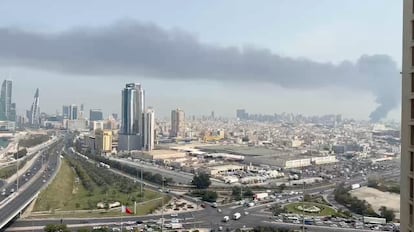
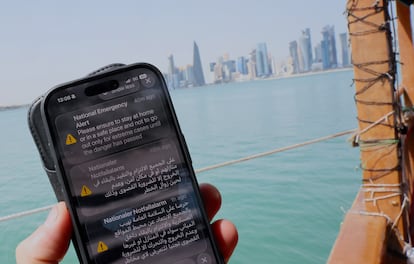
The Qatari Ministry of Defense has assured that the country “has successfully thwarted” a series of attacks, and has indicated that it has done so in accordance “with a previously approved security plan”, which suggests previous preparation for an outbreak like the current one. Doha has put the number of missiles and 12 drones that Iran has launched against its territory at 62. The Qatari Ministry of the Interior has reported that eight people have been injured, one of them seriously. The Jordanian army, for its part, has confirmed the interception of two missiles that it claims were aimed at its territory, where there is also a US presence.
One of these interceptions has caused a death in Abu Dhabi (Emirates) due, apparently, to the collision between the defense systems and the neutralized missiles. In Dubai, an Iranian missile has hit a luxury hotel, according to the BBC, although local authorities have avoided linking the incident to the attacks in Tehran. The Emirati Government has warned that these reprisals represent a “flagrant” violation of national sovereignty and international law,” and that they reserve “the full right to respond to this escalation.”
The authorities in Bahrain, the first to denounce attacks against their territory just hours after the aggression against Iran, They have been described as “treacherous.” Riyadh, for its part, has “strongly” condemned the military action against the Gulf countries, and has warned of “harsh consequences” in the case of a continued violation “of the principles of international law.”
Closed airspace and canceled flights
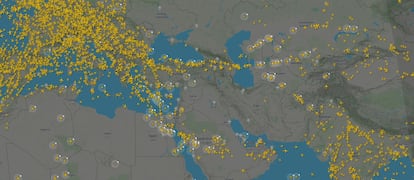
At least eight countries have declared the closure of their airspace, including Iran, Israel, Iraq, Jordan and the Emirates. Several airlines have diverted their usual routes between Europe and Asia, or have suspended part of their flights. Lufthansa, Air France, Iberia, Turkish Airlines, British Airways and Qatar Airlines are among those that have partially or completely canceled their operations in the region.
Middle East Airlines, the Lebanese national company that did not stop flying during the 2024 war between Israel and the Hezbollah militiahas canceled a dozen flights this Saturday, although the Lebanese Government has indicated that the airline continues to operate and that Lebanese airspace remains open.
Last week, The US Embassy in Beirut ordered the evacuation of its non-essential personnelgiven the risk of retaliation by Tehran or pro-Iranian militias. Iran has avoided launching attacks on Lebanon, despite the fact that the United States is present in the area. Hezbollah, one of the allies of the Iranian regime – along with the Houthis of Yemen or the Iraqi militias – that could join the fight against Israel, has issued a statement in which it condemns the offensive on Iran without committing to take up arms.
Tehran warned for months that it would attack US installations in the Middle East, where Washington has some 40,000 troops in 19 permanent or support bases. That statement led governments close to the Trump Administration, such as Türkiye and Qatar, to make efforts to avoid war.
Today, the United States and Israel have declared it, unleashing an escalation “that everyone foresaw,” he laments from Doha by phone. Luciano ZaccaraMiddle East and Gulf political analyst and professor at Georgetown University in Qatar. The researcher, who says he heard at least 60 explosions due to the impact of the defense systems, describes the atrocious fear of the Qataris as a result of the conflict, which leaves the Arab monarchies in a difficult position, somewhere between de-escalation and the exercise of legitimate defense. It is not the only balance they seek. Jordan, Saudi Arabia and the Emirates participated in the defense of Israel during the 12-day war that the Israeli army began last June, at the same time that they govern countries whose citizens are largely opposed to the Israeli offensive in Gaza.
https://elpais.com/internacional/2026-02-28/iran-ataca-bases-militares-de-estados-unidos-en-oriente-proximo.html

