

Europe continues to sharpen its claws in the face of the persistent US tariff threat, but it does not want to be the first to strike. Not even a scratch. From Brussels to London or Copenhagen, the message at the beginning of a key week for the increasingly precarious stability of the international order in force since World War II has been almost univocal: avoid at all costs an “escalation” with the American president, Donald Trump, the greatest agitator on the world stage. Of course, if he persists in his annexationist desires for Greenland and makes its tariff threats a reality to whoever stands in its way, the EU has the “tools” to respond and is willing to do so. Meanwhile, Denmark deployed more troops to the gigantic island on Monday and proposed creating a NATO mission in the Arctic.
The Danish army assured the Reuters agency that a military plane with soldiers from its country will land this Monday night in Kangerlussuaq, in western Greenland. Sources in the Danish Armed Forces described it as “a substantial contribution” to the maneuvers that will be carried out in the coming months on the arctic islandalthough they did not give more details.
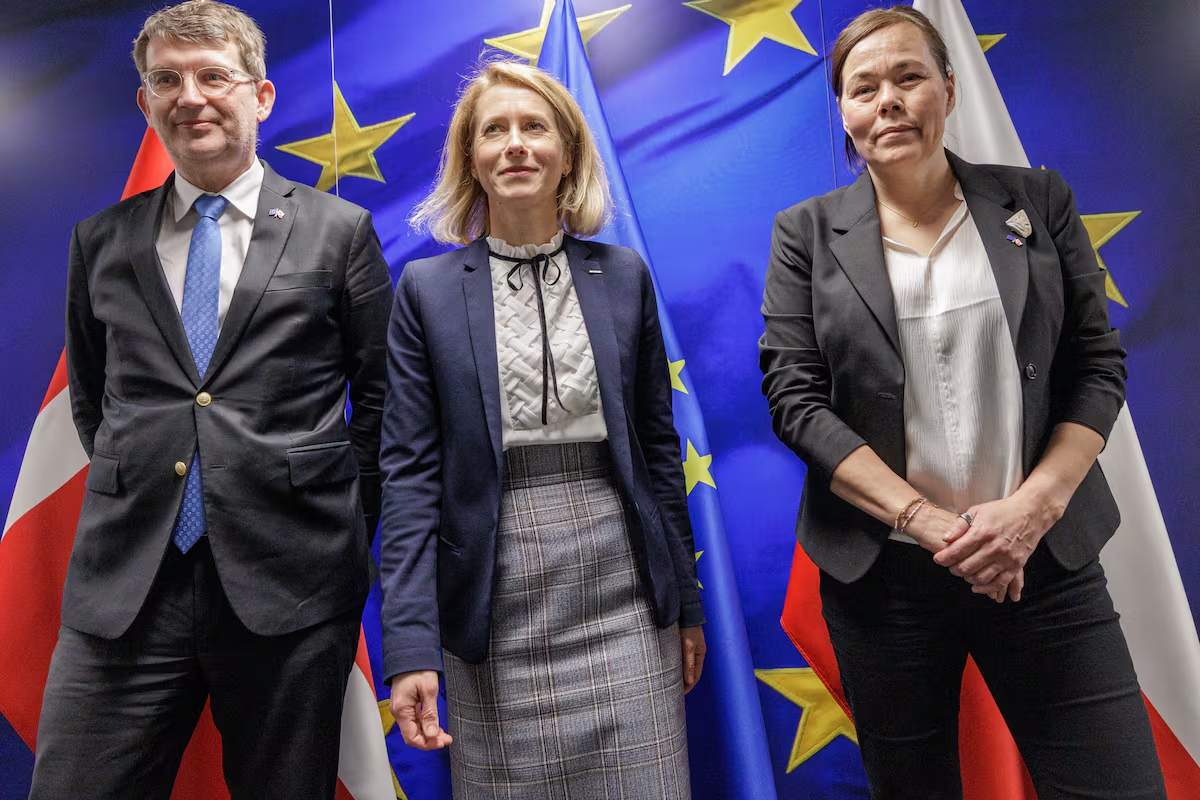
“We have no interest in starting a fight, but we will stand firm. Europe has a set of tools to protect its interests,” he declared. the head of European diplomacy, Kaja Kallasafter meeting in Brussels with the Deputy Prime Minister of Denmark and Minister of Defense, Troels Lund Poulsen, and the Foreign Minister of Greenland, Vivian Motzfeld.
Both have also met, behind closed doors, with NATO Secretary General Mark Rutteto whom they have proposed an Alliance mission in the Arctic. “We have discussed it and we have also proposed it,” Poulsen told Danish media after the meeting. “I hope we can establish a framework to carry it out,” he added. Rutte, very close to Trump and who has been avoiding speaking publicly about the tensions around Greenland for days, has limited himself to stating, in X, that the meeting discussed “how important the Arctic, including Greenland, is for collective security.” “We will continue to work together as allies on these important issues,” he added.
Just met w/ 🇩🇰 @troelslundp & Greenland 🇬🇱 FM Vivian Motzfeldt. We discussed how important the Arctic – including Greenland – is to our collective security & how 🇩🇰 is stepping up investments in key capabilities. We’ll continue to work together as Allies on these important issues pic.twitter.com/0uCNaf8urq
— Mark Rutte (@SecGenNATO) January 19, 2026
“Arctic security is a shared transatlantic interest and an issue that we can discuss with our American allies. But tariff threats are not the solution. Sovereignty is not tradable,” Kallas stressed in his message on social networks.
“Threats of tariffs are not acceptable as a means of managing these issues,” agreed the Commissioner for the Economy, Valdis Dombrovskis, at the beginning of a Eurogroup where several European economic and finance officials agreed to demand “firmness” and “unity” from the bloc before Washington.
“We want to remain firm, as a country and as a continent,” German Chancellor Friedrich Merz also stated in Berlin, until now one of the most cautious leaders in the face of Washington’s threats.
Since Trump made concrete on Saturday his threat to impose tariffs of up to 25% on the eight European countries – six of them EU members, and all NATO allies – that sent a small military contingent to Greenland to “explore” possible broader military maneuvers, Europe has moved quickly to coordinate its response as much as possible.
A reply that does not exclude, as they already requested in a first meeting on Sunday at the level of ambassadors, the activation of the anti-coercion instrument never used until now, but which according to community sources is “ready and on the table”, although still, they emphasize, there are not enough votes in favor of using a measure that some like to equate to a nuclear button. A previous, faster and also almost ready response would be to apply additional tariffs on US imports to products worth 93 billion euros that were agreed to be suspended after the controversial trade agreement with the United States in August, but that could be activated at the beginning of February, the date on which the current tariff freeze expires.
“The EU has tools at its disposal and is prepared to respond if the tariffs it has threatened are applied.” Washington, a community spokesperson stressed this Monday. “We will use those tools as necessary (…) to protect the economic interests of the EU,” he added, although he has assured that, before taking any retaliatory steps, the idea is to seek dialogue to avoid “escalations” that do not benefit any citizen on either side of the Atlantic.
A first possibility to advance this dialogue is the Davos forum where both Trump and several European leaders are expected. The North American Secretary of the Treasury, Scott Bessent, has poured cold water on European expectations upon his arrival in the Swiss city, where he has warned that “everyone should believe the word of the American president,” while describing as “very reckless” the possibility that Europe responds with trade retaliation against Trump. After the Swiss meeting, the Twenty-Seven are convened this Thursday in Brussels for an extraordinary summit that will focus on the Greenland crisis and Trump’s threats, which show no signs of abating.
From London, the Danish Foreign Minister, Lars Lokke Rasmussen, has supported the line of dialogue, but with limits: “There are some clear lines that not even the American president can cross. That is why it is important to send a clear signal to the United States that it must respect the sovereignty and territorial integrity of the countries,” he declared after meeting with his British counterpart, Yvette Cooper. “If we do not respond firmly, we will be sending a signal of weakness,” he warned.
https://elpais.com/internacional/2026-01-19/dinamarca-despliega-mas-tropas-en-groenlandia-y-propone-a-rutte-una-mision-de-la-otan-en-el-artico.html

