

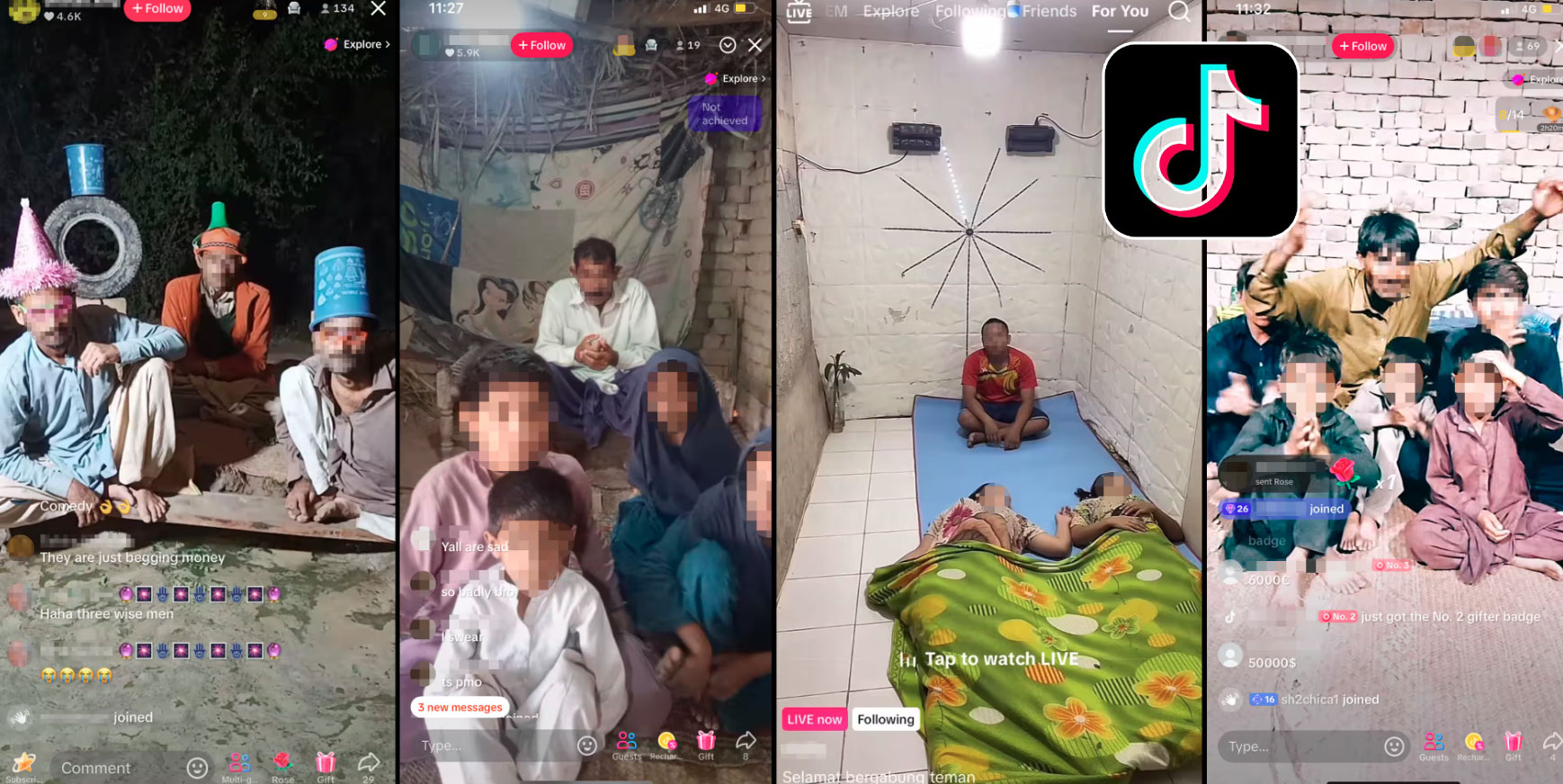
Three children are sitting in front of the camera. They are in a very fragile house in a raw soil house in Afghanistan. One of them looks at the camera and says, 'We are very poor, please help.' Their live stream is being shown in various parts of the world, including Britain, through Tikat Live.
Hours after hours they are seeking the virtual 'gift' of the ticket, which can be converted later to the sense. Once they get a gift, they are happy and clapped. After getting a digital rose on another live stream, a girl is delighted and shouted, 'Thanks, we love you!' The price of this rose was only 5 pennies. However, if it turns cash from a tick, its value may be less than one-third.
Meanwhile, Tiktak claims it has imposed strict restrictions for children begging and other types of begging, and there are strict policies for the live participants. However, investigations of British media abuse have shown that such live streams have become prevalent and thereby are benefiting. That is, commissions and fees are cut from these content. These commissions can be up to 5 percent.
UN Special Representative Olivie de Shooter describes it as a “shocking event” and accuses the tickets and middlemen for 'profit from human suffering'. “It is nothing but digital robbery to make profit from human suffering,” he said. I urge Tiktak to implement their own policies and revisit the rationale for the “commission” (fee). '
Jeffrey de Marco, a digital harmful expert at 'Save the Children', says such habits are serious abuse. It is necessary to take immediate action to ensure that the platforms are no longer directly or indirectly benefited from such content.
According to the area -based analysis, live begging has been seen in countries like Indonesia, Pakistan, Afghanistan, Syria, Egypt and Kenya from January 2021 to April.
Investigation shows that there is live stream from an account almost daily, where regular children are regularly shown. Last February, seven young boys were begging for a digital gift. The next day the other boys arrived at the same place, two adults were sitting next to them. After explaining the observer about the account, the Tikot closed it temporarily within two hours. But no action was taken after the previous report through the In-App Reporting Tool.
Meanwhile, an elderly man sitting in a chair on a live stream was showing a broadcast on the 5 thousand 5 followers account. The account seemed to be operating a third party. However, no information about their identity was found. This account was written in Bio 'poor people' and weeping emoji beside it.
Some live streams have been found to have inferior and sometimes dangerous stunts. They do these stunts in exchange for virtual gifts. Such as hurting themselves, waking up for a long time, covering the ground or sleeping in front of the camera. In a live stream in Indonesia, two little girls are lying on the windowless, white wall studio tiled floor. The live broadcast of a man sleeping on the tiled floor is then broadcast live from the same account.
Another broadcast of Pakistan showed three men sitting in the dark, plastic buckets and party hats on their heads. They were asleep in front of the camera. When they were getting a gift, they woke up and were dancing.
Live feature was launched in August 2021. Through this, content creators can contact the audience directly.
According to the ticket, 5 million people live in 2021, which reached a billion number of users. Visitors can contact the manufacturers by sending direct comments or gifts.
Novita Angrini, a care -in -law, working in the care international charity and Indonesia, said many manufacturers used Tickets live, to show their 'talent' or 'connection with people'. Usually use it, who hold themselves singing, dance, video games, painting or cooking videos. But now it is increasingly being used incorrectly. Especially they, who see it as a 'easy way to make money'. He added that such 'harmful' begging-related videos are increasing very fast. It is a whole new type of absorption.
He also said that behind these live streams, the lack of poverty and digital education is working. In addition, it is not possible to identify whether people are being forced to force them. He also said that in many cases the potential victims refused to exploit themselves and claimed, 'This is a cooperation through which money is being made.'
However, he warned that there is a 'high risk' of exploitation through organized begging networks. Which are under control of income flow and control multiple families for live streams.
Tikot said they had taken drastic action. Among these steps were – deleted accounts identified by Abervar. They say their policy has banned the exploitative begging of live streams, including exploiting begging of children or weak people. A spokesperson for Tickets said, “Any live content, where children want to begged for gifts, do not approve the tick.”
In cases where the exploitative begging or evidence of infant exploitation has been found, they have taken 'strict action'. They closed those live streams and imposed permanent sanctions. They said 'they are helping to' keep our platform safe 'by' stopping four million live streams every month through 'preventive identification and dedicated teams and technologies, “they said. One thousand followers and age should be over 5 years to host a live stream. However, children will be able to come live if they are present with an adult.
The commission and fees they receive are changing, the Tikot said. Live streams do not get the full price of the gift, but they get points called 'Diamond'. This point is determined according to the gift and the popularity and duration of their stream. After the commission and the fee repayment, they usually get half of the original gift, but sometimes only 5 percent. Tiktak claims that the 'App Store Fees and Payment Provider' go to the cost of 5 percent. The ticket has more than 5 digital gifts, one of which, starting from Rose (1 penny), has a Tikot Universe (about 5 pounds).
Tickets had earlier criticized for profit from exploiting content. Especially in 2022 sexual abuse live stream.
In 2021, al -Jazeera said Indonesia's orphanage monasteries were collecting grants through live streams. Children are seen sleeping in these live streams. Tiktak says they have banned such exploitative begging. However, the live stream of the orphanage Ashram did not break their rules.
Although there is a risk related to begging live in Tickets, many charities say it can help people who are in crisis to get help. For example, a family in the Philippines succeeded in collecting grants for their twin baby surgery. However, in many cases it is not clear who is really benefiting from it.
Catherine Turner of Anti-Slavory International says that some children and adults are begging for survival, but others are 'physically or mentally exploited' by the third party. This third party controls income flow.
Tikot wants a government -issued ID to make money through live streams' prizes. But for the audience, there is no way to know whether those who are live in live are actually benefiting. Maya Lahav, a researcher at the Criminology Center in Oxford, said a lot of information is needed to control live streams or surveillance, which is a major challenge. He mentioned that there are moral questions about whether these content should be removed.
However, he added that there is serious concern over human rights violations over third -party intervention and the consent of children or the sick. 'The main question here is when it becomes exploited! This is the right balance of them. '
References: The Guardian

