

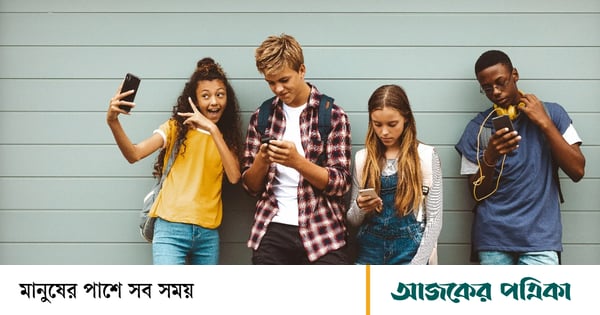
The World Health Organization (WHO) recommends a maximum of two to three hours of leisure time per day for young people. However, teenagers around the world are spending an average of 8 to 10 hours on leisure activities. These activities include watching television, using electronic devices, playing video games, and riding bikes. But having a social media account makes teenagers go through the day more leisurely. The youth of Bangladesh is no exception. These facts are known in the research of a multinational company.
The study was published in the International Journal of Nutrition and Physical Activity on November 29, 2024. The main researcher Dr. James F. It was conducted under the leadership of Salis. He is a Professorial Fellow at the Herbert Wertheim School of Public Health and Human Longevity Sciences at the University of California, San Diego, and at the Australian Catholic University.
Research suggests that for both men and women, having a personal social media account can increase their total idle time. A direct correlation has been found with increased screen time with social media use.
Dr. Sallis says there is a lot of concern about the negative effects of social media. It can also harm physical health. He added, 'These results are alarming, as excessive sedentary time can lead to obesity, diabetes and mental health problems.'
The researchers collected information on leisure-time behavior from 3,982 teenagers aged 11 to 19 years, using accelerometer data (a sensor used to measure body movement and position) and 6,302 participant observations. The study was conducted as part of a project called the International Physical Activity and Environment Network (IPEN) Adolescent Study. The study was conducted on adolescents from 15 geographically and culturally diverse countries.
The study found that the number of household electronic devices, the number of adolescent social media accounts and walking opportunities differed across countries. For example, Indian teenagers had an average of 1.2 electronic devices and 0.5 personal devices in their homes. But in Denmark these numbers were 4.2 and 2.3 respectively. In India and Bangladesh, less than 30 percent of adolescents report having social media accounts, compared to more than 90 percent in high-income countries.
When researchers collected information from parents about neighborhood walking facilities, they found that there are many parks for walking in Australia. But there are no facilities for walking in Nigeria. Parents in Bangladesh and India reported that there are very few parks for walking in their areas. In addition, parents in Brazil, Malaysia, Bangladesh, India and Israel expressed concern about traffic congestion. Parents also expressed concern about crime, particularly in the first three countries.
Studies show that people who spend less leisure time live in more walkable neighborhoods. They also face less traffic and have a better sense of safety from crime. In particular, girls in such neighborhoods spend less leisure time and are more physically active.
Dr. the main author of the study. Ranjit Mohan Anjana says that although the culture, lifestyle and environment of each country are different, the ideas that emerge regarding teenagers' leisure time and physical activity are similar in many countries.
References: News Media Life Sciences

