

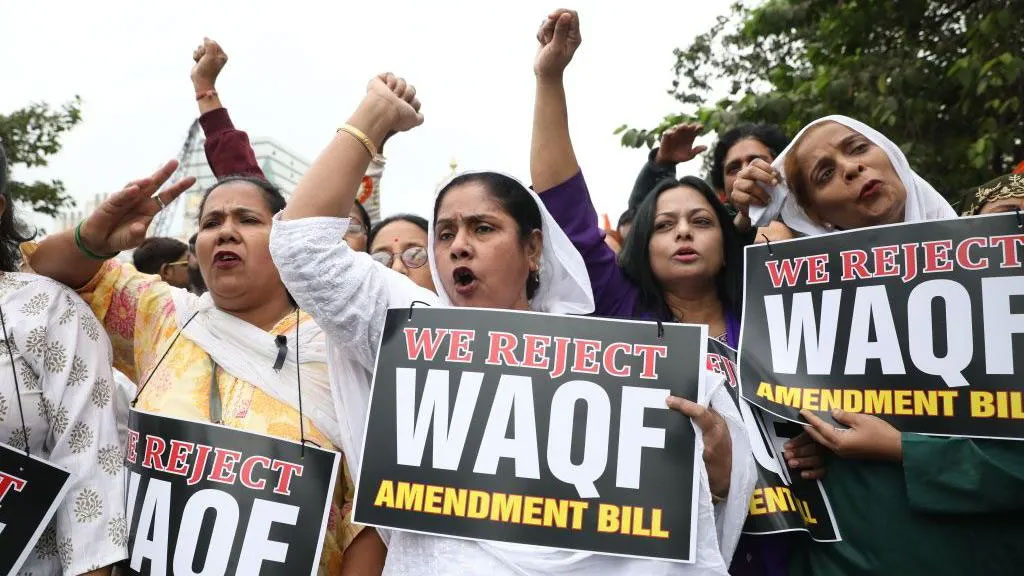
The Waqf Act Amendment Bill in India has spread concerns among the Muslim community. The Modi government says the reform is necessary for corruption and effective management. But Muslim organizations and opposition parties complain that the religious rights of the minorities are underway and efforts to occupy the historical property.
The BBC has made a wide report on this. According to the report, the BJP government has passed a bill in India to change the ownership and management of billions of rupees donated to Muslims for centuries. These properties include mosques, madrasas, shelters and thousands of acres of land. They are known as 'Waqf' and managed the Waqf Board.
In August this year, the existing Waqf Act introduced more than 5 amendments to a new bill. It was later sent to the Joint Committee of Parliament for review. The reports were presented in both rooms of Parliament on February 7 when the opposition party protested strongly. Their complaint, the report has been removed from their different comments or 'Dissent Note'. However, the central government has denied the allegations.
However, the protest could not stop the BJP government. The bill has been passed in the parliament within 24 hours after the bill was passed. To become the law of the bill, it is now just waiting for President Draupadi Murmur.
The BJP government, led by Prime Minister Narendra Modi, says the initiative is to eliminate long corruption and mismanagement in the management of Waqf property and bring reforms according to the demands of the Muslim community. But multiple Muslim organizations and opposition political parties say it is completely politically motivated and is just a new strategy of interfering with the rights of the minorities of India.
What is Waqf?
Waqf is a religious or social welfare gift in Islamic Silsila. Which Muslims do for the welfare of the people. Once a property is determined as a waqf, it cannot be sold, nor can it be used for any other purpose. This means that the property of Waqf is actually dedicated to Allah.
A large part of these property is used as mosques, madrasas, cemeteries and orphanages. Again there are many property, which are empty or occupied.
The history of the Waqf tradition in India is very old. The practice began in the 12th century by the hands of Muslim rulers from Central Asia during the Delhi Sultanate period. Currently, the Waqf property is operated under the Waqf Act, 1. The Act provides for the formation of a state -based Waqf Board, where the government is nominated, Muslim public representatives, Bar Council members, Islamic thinkers and manager of Waqf property.
According to government data, the Waqf boards are one of the largest land owners in India. There are at least 1 lakh 12 thousand 5 waqf property all over the country, which amounted to about 1 lakh 3 thousand acres of land. The total value of these is Rs. 5.2 trillion rupees, which is about US $ 22 billion or £ 9.25 billion.
Waqf Act is urgent to reform
Representatives of the Muslim community are not denying corruption in the Waqf board in India. At times, members of the Waqf Board have been accused of selling the Waqf property by holding the land occupants. However, critics say that a large part of the Waqf property is occupied by individuals, non -governmental organizations and even government institutions – which is important to look at.
The then Congress -led government formed a committee headed by Justice Rajendra Sachar to evaluate the social and economic status of the Muslims of India. The report of the committee also recommended the Waqf reform.
The Sachar Committee shows that the Waqf board's revenue was very low despite the large amount of property. The committee calculated that if the lands were used effectively, it is possible to earn around Rs 12,000 crore every year. However, at present, the estimated annual income is only around Rs 20 crore.
The committee also mentioned that the state of Waqf's maintenance itself has occupied the land in many cases. They also listed hundreds of 'illegal occupation' by various government institutions.
Government data says that at least 5,900 waqf property is currently occupied and more than 3,000 property is included in the court. In addition, there is no information about the current status of more than 1 lakh 3 thousand assets.
The government says the proposed amendments will solve these problems and help implement the recommendations of the Sachar Committee. Parliamentary Affairs Minister Kiren Rizizu told the Times of India that now an elite class of Muslim society controls the property. It is important to balance it through reform.
Then where is the debate
Yet, the proposed changes have been created in the Muslim community around the Muslim community. One of the most controversial issues is the change of ownership. As a result, the future of the historic mosques, Dargahs and the cemetery can be uncertain. This is because a large part of these properties have been used for many generations, but most of them have no written documents. In many cases, it was donated orally or without proof hundreds of years ago.
In the Waqf Act of 9, such property was recognized as 'use -based waqf' or occupation. But this clause has been excluded in the revised new law. The legal recognition of a large number of traditional religious property is at risk.
Professor Mujibur Rahman, author of the book 'Shikwai Hind: The Political Future of Indian Muslims', said that finding the ownership of such ancient religious property is very complicated. Because, from the Mughal period to the British and the administrative structure that has come to the present, the type of document and management has changed again and again.
Professor Mujibur Rahman also said, “The history of personal property can be tracked up to a few generations. But since there is no continuity in the management of the people's property, it is difficult to find the history of them. '
Another concern is that the formal law has changed the formation of the Waqf Board. From now on, the inclusion of non -Muslim members on the board has been made compulsory.
Some say that the legal action of keeping people of all religions on all religious institutions can be generally acceptable – if it makes the process more secular. However, Professor Mujibur believes that the way it is currently trying to implement it is being done in the majority of politics.
In his words, there is an attempt to influence the life of the Muslim community through the Hindu society, not just control over the property of the Muslims through the state.
Change that has been proposed
One of the most important amendments is to register all the property of the Waqf Board to the Deputy Commissioner (District Collector) of the respective districts. The Deputy Commissioner will then recommend the government to the government, whether the property is waqf at the time of the Waqf Board.
According to critics, the power of the Waqf board will be reduced in this process. Asaduddin YC, a Muslim member of the Lok Sabha, alleged that the main purpose of this change is to take away the rights of Muslims.
At present, the state government has to appoint a survey commissioner who identifies Waqf property in the state and make a list. The list was then sent to the state government and a legal notification was issued from the government. If one does not challenge it within a year, then the property is finalized as Waqf.
But with the change of proposed law, many waqf may have to prove the location and ownership of the property. The YC said many have illegally occupied the Waqf property. Now their opportunity will be created to claim that the property is actually their property.
Muslim organizations say that many historical dargahs and mosques will be threatened in this process. According to them, reform needs, but it has to be done to respect the feelings and interests of society.
Professor Mujibur Rahman said the analysis of the disease may be correct, but the medical procedure is wrong.

