

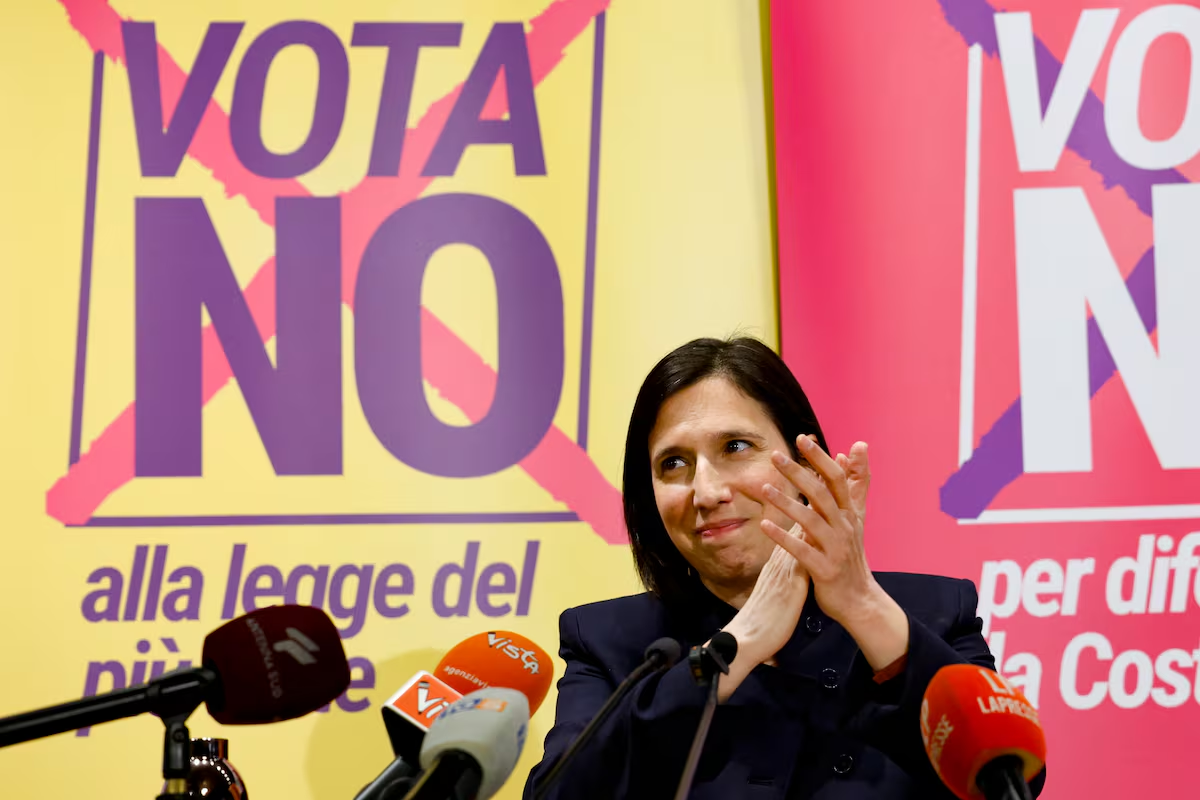
The setback that Giorgia Meloni has suffered in the referendum held in Italy this Sunday and Mondaya consultation for a constitutional reform of the judiciary, has been so clear and unexpected that analysts are trying to find the keys that escape the usual logic of the vote. At least three decisive phenomena have occurred: young people have voted en masse, like the south of the country, and, above all, part of the right-wing electorate has abandoned Meloni and has not gone to the polls or has voted with the opposition, something truly anomalous in Italy, according to experts. Polls indicate that in the Government coalition there has been a vote drain of 23% in the League, 15% in Forza Italia, and 14% in Brothers of Italy (the prime minister’s party).
The motive, many experts and journalists agree, has not been so much a punishment for the Government’s action, but something deeper: a majority of Italians have perceived that the architecture established by the Constitution and the separation of powers were at risk. The fear has weighed that the country would take the first steps towards an authoritarian drift in the style of Donald Trump in the United States or Viktor Orbán in Hungary. Meloni’s close friendship with both leaders has ended up being radioactive for her, especially since the beginning of the Iran war, very unpopular in Italy.
Luciano Fontana, director of the Corriere della Serathe first Italian newspaper, with a conservative line, has said it bluntly. In his opinion, there has been a reaction to any legal change “that could evoke a scenario similar to that of the United States, with an authoritarian use of power, which does not want counterweights and which puts justice under control.” In a meeting with foreign correspondents, Nicola Lupo, professor of parliamentary law at the Luiss Guido Carli University in Rome, pointed out something similar: “There has been a vote in defense of the Constitution, which has brought many young people and people who do not usually go to vote to the polls, because they have been scared by a Trump-style scenario, or rather Orbán or Poland, of control of the judicial power by the Executive.”
The controversial reform of the judiciarywhich changed seven articles of the Constitution, was approved twice in each of the chambers, but since it was not by a two-thirds majority, it required a confirmatory referendum. Without a quorum, the option that obtained one more vote won. An important detail, as has been seen, is that Meloni’s right-wing majority did not agree to change a single comma, not a single amendment. The Italian Constitution dates back to 1947 and has already been revised 21 times. It is not untouchable, but the lack of a broad consensus has weighed on voting.
The scandal of a restaurant with a gangster as a partner
“The opposition has managed to convey the idea that this was a reform of the political class to protect itself from investigations by the judiciary,” summarizes Lorenzo De Sio, director of the Italian Center for Electoral Studies. The vote has also coincided with a scandal that has affected the number two of the Ministry of Justice, Andrea Delmastro, already convicted in the first instance for revealing secrets: he had a restaurant jointly with the daughter of a well-known mafia member from Rome.
Meloni kept Delmastro in his position because he did not want a crisis on the eve of the referendum, but he already fell this Tuesday, forced to resign, as reported by the Italian media shortly before 6:00 p.m. Giusi Bartolozzi, chief of staff of the Ministry of Justice, who entered the campaign like an elephant in a china shop, saying that prosecutors were like “a firing squad,” has also resigned. He has been the symbol of everything that the right has done wrong in this campaign.
The proposed legal changes were somewhat complex, and it was difficult to understand the urgency of such a reform when there are other priorities in Italy (healthcare, education, housing). In this context, distrust towards forms has proven to be very insidious. In the current international framework and given Meloni’s ideological harmony with authoritarian leaders, it has fueled the suspicion that there could be a plan along those same lines behind it. Naturally, it has been the opposition’s attacking argument.
The truth is that some inflammatory statements by Meloni and his followers against the judiciary, no matter how much they consider it to be excessively politicized, have only increased doubts. In addition to Bartolozzi’s controversial statements, the Minister of Justice, Carlo Nordio, defined the judicial associations of the judiciary as a “paramafioso system.” Meloni finished it off by saying that if the reform was not approved, rapists, pedophiles and drug traffickers would fill the streets.
What was voted on was a very technical issue, but important. Basically, it was about separating the careers of judges and prosecutors (who in Italy are those who investigate); divide its current governing body, the Superior Council of the Judiciary (CSM), into two; and elect its members by lottery, to put an end to the organization of judges and prosecutors in ideological currents.
For the opposition and most of the judiciary, it was a maneuver that opened the way to greater future government control over prosecutors. The line to follow has been drawn by Meloni herself: she plans to change the electoral system, so that the coalition with the most votes obtains a prize of seats that guarantees a comfortable majority; and would culminate in institutional reform (the premieredin Italian) to give more powers to the Prime Minister, to the detriment of the President of the Republic. This whole design has fallen apart. Of course now the reform to strengthen the presidency of the Government seems destined to remain in a drawer. But the next battle will be the change of the electoral system.
In this rejection movement, young people have played a notable role: between 18 and 29 years old, 68.4% have voted no, according to a Luiss study. In the next age group, from 30 to 44 years old, the percentage has also been high, 59.8%. It drops between 45 and 54 years old, where the yes vote has won, but then it rises again to similar rates among the oldest. “It has not surprised us, in recent years it is a clear trend, young people are very ideologized and tend to be strongly polarized. There is a strong return of ideology, after a few years in which it seemed that there was no right or left,” explains Elisabetta Mannoni, professor of research methods in social sciences at Luiss University. He believes that this phenomenon is a reaction, in large part, of those who are the main victims of the 2008 crisis, which has led them to become more interested and passionate about politics.
https://elpais.com/internacional/2026-03-24/el-voto-de-los-jovenes-y-el-miedo-a-una-deriva-autoritaria-en-la-linea-de-trump-claves-en-la-derrota-de-meloni.html

