

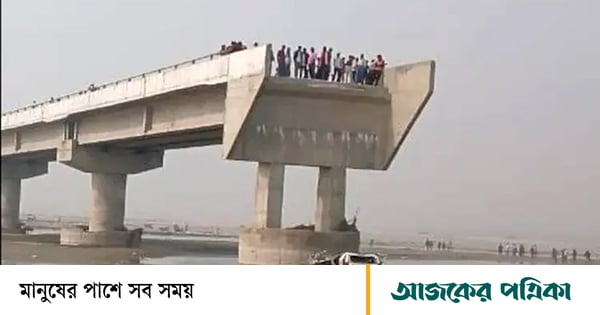
Navigation apps have become an essential companion for road users these days. Other digital platforms like Google and Apple's Maps have made our daily journeys easier for navigating unfamiliar roads. But can digital platforms be legally responsible for any road accident, or is it a widely debated issue recently? The death of three people in a tragic accident in India's Uttar Pradesh on Sunday has fueled this debate anew.
Police are investigating the accident. But they suspect Google Maps set the group on that path. A portion of the bridge collapsed due to flooding earlier this year. Locals knew about this and avoided using the bridge. But the three men outside the area did not know about the matter. There were no signs or warnings of the incomplete condition of the bridge. As a result, the car suffered an accident.
The police have registered a case of murder against four engineers of the Uttar Pradesh road department and an unidentified employee of Google Maps.
A Google spokesperson told the BBC they were cooperating with the investigation.
The tragic accident highlights India's poor road infrastructure. So this raises a question, could navigation apps like Google Maps be responsible for such incidents?
Some people are blaming the app. Because it doesn't show the correct information. Still others argue that this is a major failure of the government. Because they did not take any initiative to secure the place.
Google Maps is the most popular navigation app in India and works with GPS (Global Positioning System), a satellite-based radio navigation system.
In addition, it serves many ride-sharing, e-commerce and food delivery platforms. The app has around 60 million active users and has around 50 million location searches per day. However, the app has often been criticized for not providing accurate directions. As a result, it sometimes leads to fatal accidents.
In 2021, a man's car collided with an embankment in the Indian state of Maharashtra. It is believed that he caused the accident while following the instructions of the app.
Last year, two young doctors died when their car plunged into a river in the state of Kerala. Police said they were following the route shown on the app. Many cautioned that the app should not be over-relied for road information during floods.
Google Maps uses GPS signals from users' apps to detect changes in road traffic. A road is being used by traffic more than once. And a road with less traffic means it is less used. The app also receives updates on traffic jams or road closures from the government and users.
Ashish Nair, founder of mapping platform Potter Maps and a former employee of Google Maps, said Google does not have enough manpower to deal with millions of complaints every day. Google Maps prioritizes complaints related to high traffic or warnings from authorities. A map operator then uses satellite imagery, Google Street View and government notifications to confirm the change and update the map.
Nair also said navigation apps cannot be blamed for accidents. Because their terms of service clearly states that users should exercise their own judgment while driving and the information in the app may differ from actual conditions. Apart from that, platforms like Google manage maps around the world. It is extremely difficult to accurately track the changes that occur on each road.
Compared to other countries, India does not have a robust system for timely reporting of such issues.
Data is a big challenge in India, says Ashish Nair. There is no way to log or add infrastructure changes to a web interface, which can then be used by apps like Google Maps. But countries like Singapore have such a system.
Source: BBC

