

The war of the United States and Israel against Iran flagrantly violates international law. But the same has happened with almost every other war since the adoption in 1945 of the Charter of the United Nations, which prohibits the use of force except in self-defense or, as in the cases of the Korean War (1950-53) and the First Gulf War (1990-91), with the authorization of the Security Council. What distinguishes the current war against Iran is not its illegality, but rather the lack of a clear or achievable objective.
In the United States, officials have oscillated between emphasizing regime change and suggesting that the operation will be limited to the selective destruction of nuclear and ballistic missile facilities, as well as the Iranian Navy. For his part, President Donald Trump has asked for unconditional surrender, insisting that Iran appoint “acceptable” new leadership. But he also stated that The United States has already “won in many ways” in Iran, just not “enough.”
Clearly, Trump wants to avoid a prolonged military conflict, which would erode the support of his isolationist MAGA base. At the same time, it needs to limit the energy crisis: Brent crude oil prices have already risen by 29%, until reaching almost 120 dollars per barrel. The same cannot be said of Israel, which has been attacking Iran’s oil facilities, including fuel tanks in densely populated Tehran, as part of a total war strategy.
The United States also appears to be much more concerned than the Israelis about the impact of the war on its Gulf allies. Unlike Israel and Trump, who want participate in the election of the leader of Iran, The Gulf States recognize the flawed logic underlying the war. They attempted to facilitate a diplomatic solution before the attacks began, not out of sympathy for the Islamic Republic, but because they knew they would be the most affected by Iran’s retaliation. Now, the Iranian attacks on US military bases and the Gulf oil facilities are undermining the image that these countries have achieved with so much effort as a safe haven for international business—something crucial to their efforts to diversify their economies away from oil. If Iran attacks its oil fields, global energy markets would face even greater turmoil.
More generally, the Gulf countries understand that the change of regime It is a long historical process, which war may well not accelerate, and demands for unconditional surrender may prolong the fighting and increase costs. Following the Athenians’ victory over the ancient Persians at the Battle of Salamis (480 BC), they demonstrated the wisdom of not insisting on total submission, a decision that paved the way for an eventual diplomatic agreement.
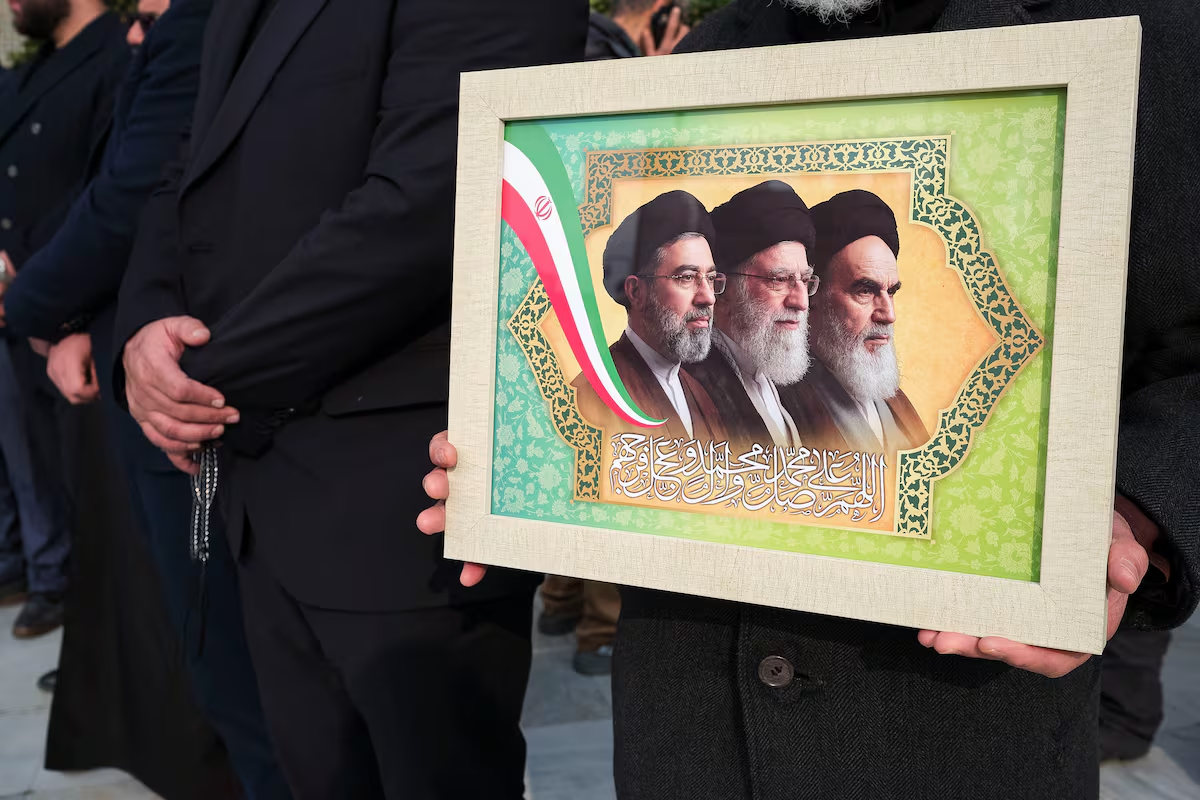
On the contrary, as has been shown historian Ian Kershaw, Allied demands for a total surrender of Nazi Germany may have pushed the regime to continue fighting until the tragic end. Iran today is displaying a similar defiant attitude. Not only has he chosen another radical, Ayatollah Mojtaba Khamenei, as its new supreme leader, but the Islamic Revolutionary Guard Corps has also dismissed President Massoud Pezeshkian’s announcement that Iran would stop attacking the Gulf States.
For the Islamic Republic, this war is existential, which is why it is resorting to all means at its disposal. Beyond its attacks on energy infrastructure, has effectively closed the Strait of Hormuz, the only means of transportation for around 20% of the world’s oil and natural gas (including Iran’s own exports). He has also threatened to expand the conflict beyond the Middle East, targeting a British air base in Cyprus and throwing three missiles over Turkish airspace. Given that Iran possesses some 400 kilos of 60% enriched uranium, nuclear risks are increasing rapidly.
If the Islamic Republic ends up falling, there is little reason to expect an orderly transition to a more moderate government. A descent into chaos, extremism and violence is much more likely. Any radical group that emerges could end up in possession of Iran’s nuclear material—a risk that no international agreement could contain. A nuclear Iran would also trigger a nuclear arms race in the region, with countries like Türkiye and Saudi Arabia rushing to build the bomb.
Even a decisive victory by the United States and Israel would be an undesirable development for the Gulf States, as well as for countries like Egypt and Türkiye. They want Israel as a partner, not as a regional hegemonic power. Crucially, the prospect of outside powers overthrowing regimes they dislike (or supporting popular uprisings) is far from attractive to Arab autocracies.
It is not known at what point in this process the capricious Trump will look for a way out, declaring an ambiguous victory and diverting his attention to other matters. Four key considerations will determine his calculations: energy prices, the stock market, the midterm elections and his upcoming summit with Chinese President Xi Jinping. Without a doubt, he expected to control almost 30% of world oil reserves (those of Venezuela and Iran) for when he met with Xi. Unfortunately, Iran is a much tougher nut to crack than Venezuela, and Trump must temper his unrealistic expectations.
But putting the genie back in the lamp will not be easy, especially because Israeli leaders do not face the same political pressures as Trump. Decades of indoctrination have convinced the Israeli people that the Iranian regime is evil incarnate and must be eradicated. Likewise, Prime Minister Benjamin Netanyahu considers that the “total victory” in Iran – as well as a Gaza and against Hezbollah in Lebanon— forms an integral part of his political legacy, which is currently tainted by broken promises and corruption accusations.
The cost of pursuing this largely impossible goal could prove higher than Netanyahu had anticipated. The growing sense among Americans that Israel has dragged them into a costly war of choice could further erode the already battered image of the country, to the point that alienation poses a real strategic threat. That is the last thing Israel needs at a time when it has positioned itself as the only Middle Eastern state that rejects the very idea of a negotiated settlement, whether on Iran or Palestine.
https://elpais.com/opinion/2026-03-15/el-confuso-desenlace-de-la-guerra-de-iran.html

