

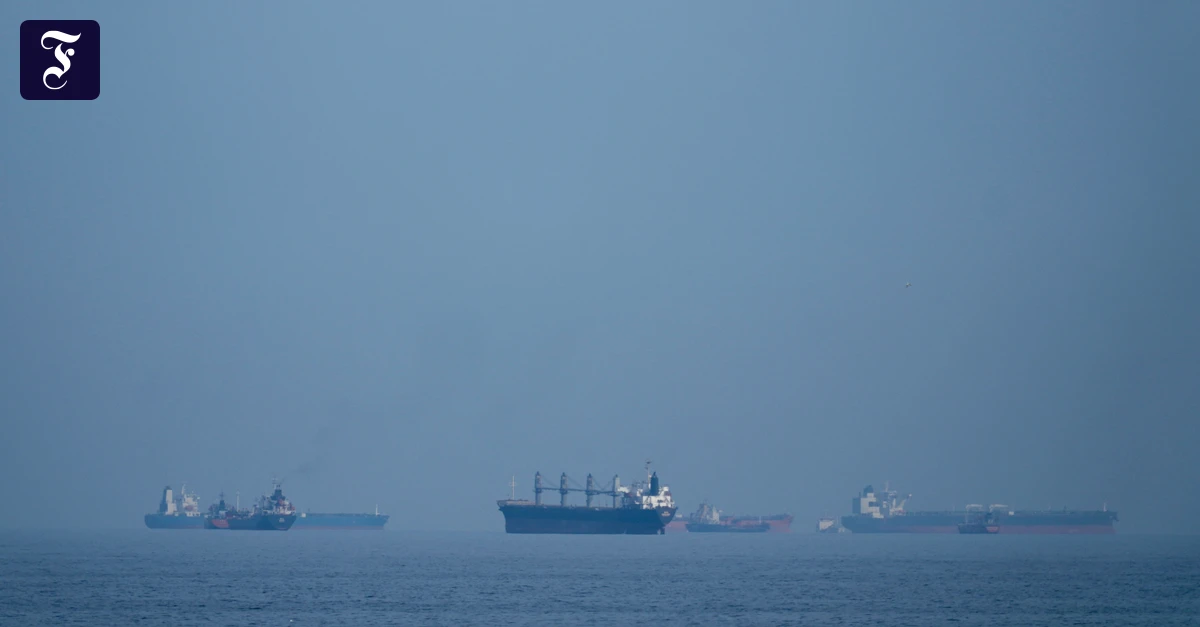
Since the end of February there has been de facto no passage through the Strait of Hormuz. The world is therefore cut off from important oil and gas supplies, and an energy crisis of unprecedented proportions was foreseeable. But since Donald Trump announced on Wednesday night that Iran would grant the “complete, immediate and safe opening” of the waterway for two weeks, there has been cautious optimism among shipowners. The Association of German Shipowners (VDR) speaks of an “important and hopeful signal”.
But in the second sentence of the written statement it becomes clear that little is clear when the US President makes announcements: “Now it is important that political announcements become maritime reality.” The situation remains tense as long as no details are known and security is not guaranteed.
The International Maritime Organization (IMO) said work on a safe passage through the Strait of Hormuz has already begun. “I am working with relevant parties to establish an appropriate mechanism to ensure the safe passage of ships through the Strait of Hormuz,” said IMO President Arsenio Dominguez.
And what about insurance?
Coordinating the removal of thousands of detained ships and their crews from the danger zone will require international coordination and some time, commented the German Shipowners’ Association.
You shouldn’t expect a high pace, warns Jennifer Parker, associate professor at the Defense and Security Institute at the University of Western Australia. “You don’t turn global shipping flows back on in 24 hours. Tanker owners, insurers and crews need to believe that the risk has actually decreased – not just been suspended.” In fact, the suspension of war insurance by the relevant insurance clubs right at the beginning of the Iran War was the main reason why hardly any shipping companies dared to pass through the Strait of Hormuz with cargo worth millions.
The first ships had to turn away
The FAZ learned from shipping circles that the first ships that tried to leave the Gulf on Wednesday were asked to turn away. Passage is still only possible with Iran’s approval and against payment of a toll.
It initially remained unclear how the agreements on a ceasefire and the opening of the Strait of Hormuz should be understood. While Iran spoke of a safe passage in cooperation with its armed forces and within “technical limitations”, Trump announced on social media that the USA would help with the start of traffic and would stay nearby to ensure smooth operations.
“The situation is completely unpredictable,” said a representative of an international shipping company to the FAZ the following morning – they would remain silent for the time being. The mere prospect of Iran continuing to have influence and being able to impose a toll outrages him: “If this were to become a precedent, then international trade would be massively affected.”
In fact, according to the United Nations Convention on the Law of the Sea (UNCLOS), the principle of transit applies to all natural straits. Accordingly, coastal states may not arbitrarily restrict passage or make it dependent on the payment of fees. On this legal basis, the Federal Government is also calling for unhindered shipping traffic in the Strait of Hormuz.
In peacetime, up to 150 ships passed through the 90 nautical mile long strait every day, with the journey time being given as seven to eight hours. It is unclear how many ships could now leave the Persian Gulf within two weeks. It is unlikely that everyone will make it, said a spokesman for Hapag-Lloyd, which is affected by the current blockade with five chartered ships and one of its own. The Association of German Shipowners estimates that a total of 2,000 ships are affected, including more than 50 ships from Germany. The Bloomberg news agency, on the other hand, writes of 800 ships. Tracking data is only available to a limited extent because the tracking systems are sometimes switched off for security reasons.
426 oil tankers, 53 gas transporters
Ships carrying energy make up a large portion of the fleet trapped in the Gulf, according to data from analytics firm Kpler. There are currently 426 tankers transporting crude oil and clean fuels, as well as 34 liquefied petroleum gas (LPG) and 19 liquefied natural gas (LNG) ships. The rest of the ships carry dry goods such as agricultural or metal products. Or containers. The lack of oil and gas on the global market has caused prices in the energy sector to skyrocket, which has a significant impact on the global economy and drives inflation.
A global supply chain problem like the one that arose during the corona pandemic is not expected because merchant shipping across the Atlantic and the Pacific is running smoothly, explained Rolf Habben Jansen, CEO of the Hamburg shipping company Hapag-Lloyd, a few days ago.
However, this does not mean the all-clear for the companies affected (shipping companies as well as their customers and suppliers). Some of the goods stuck in the Persian Gulf may have already become worthless. And that’s not all: In order to be able to meet delivery obligations, companies have now had to source the relevant goods elsewhere, charter additional ships and look for alternative delivery routes, sometimes overland – associated with considerable costs.
For now, the consensus is to wait until the situation becomes clearer. The security situation remains crucial, including the safety of the crew. “Based on our current risk assessment, we continue to refrain from transiting through the strait. At the same time, we are continually and very carefully checking when transit will be possible again,” says Hapag-Lloyd’s written statement.
The tourism group TUI from Hanover is also hoping for suitable options to take the two cruise ships out of the region, which have been stuck in the Persian Gulf since the beginning of the war. There is still a reduced minimum crew on board to ensure the safe operation of the ships. The planned trips to the Mediterranean were canceled. According to current estimates, the relocation of the ships without guests will take four weeks.

