

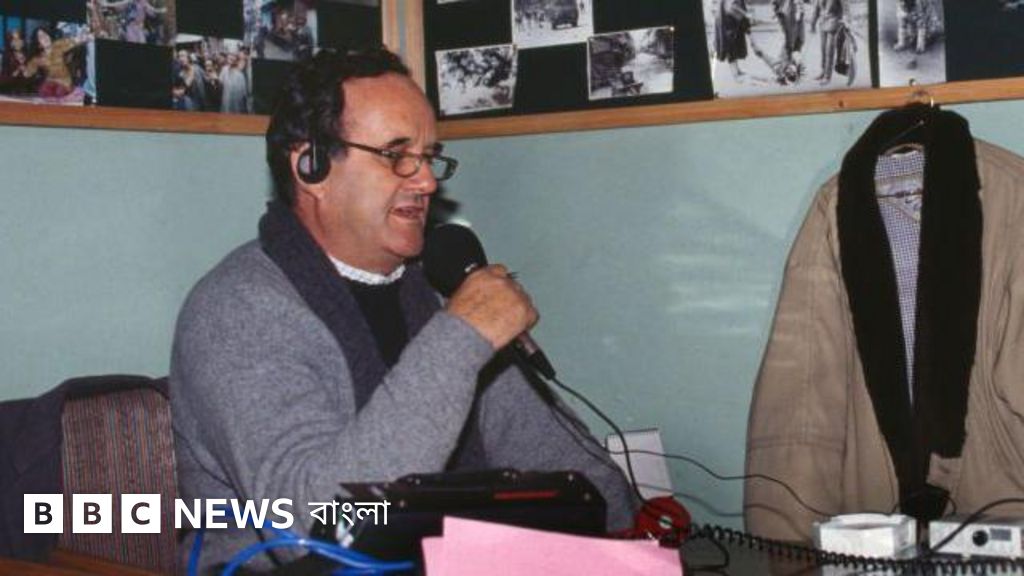
image source, Robert Nickelsberg/Getty Images
BBC’s ‘Voice of India’ famous former senior journalist Sir Mark Tully has passed away. Ninety-year-old Mr. Tali died on Sunday in New Delhi, India, his former colleague Satish Jacob confirmed to the BBC.
Although born in an English family, Mr. Three quarters of Tali’s life was spent in India.
He served as the BBC’s bureau chief in Delhi for over two decades.
In that long time, Bangladesh’s liberation war, Pakistan’s military regime, India’s state of emergency and Sikh rebellion, Indira and Rajiv Gandhi’s assassination, Zulfiqar Ali Bhutto’s execution, Tamil Tigers’ rebellion in Sri Lanka, Soviet invasion in Afghanistan, Mr. Tiles, on which he also publishes reports.
Meanwhile, in 1971, when it became difficult to reveal the true events of the war of independence in the face of the strict control of the Pakistani military, Mark Talley became a familiar name to the people of Bangladesh by regularly publishing news and analysis of the war of liberation on the BBC.
“BBC meant Mark Tally to the people of Bangladesh at that time. Those who had a radio at home then, they would listen to his voice on the radio morning and evening,” researcher and journalist Afsan Chowdhury told BBC Bangla.
The government of the country later awarded Mark Talley the ‘Muktijudda Maitri Sammanna’ for playing an important role in achieving the independence of Bangladesh by publishing news impartially during the liberation war.
The former BBC senior journalist came to Dhaka for the last time in 2012 to receive the award.

image source, Getty Images
Mark Talley in Dhaka to gather news of the Liberation War
BBC journalist Mark Tally came to Dhaka to gather news in the last week of April, a month after the liberation war.
The then military government of Pakistan Mr. Allowed two foreign journalists including Tali to enter Bangladesh.
He was in Bangladesh for about two weeks during that trip in 1971. Then Mark Tali went to Rajshahi by road from Dhaka.
“I was accompanied by Claire Hollingworth, Britain’s Telegraph war correspondent. Our news was of particular importance as we had the opportunity to freely go around and see the situation,” said Mark Tully in an interview given to BBC Bangla in March 2016.
He published a report on the BBC about the horrors of the war that he witnessed while visiting different areas.
“We realized that there was a massive carnage. I saw on both sides of the road from Dhaka to Rajshahi that village after village had been set on fire,” Mr. the tile

image source, Getty Images
How to collect news?
During the Bangladesh War of Independence in 1971, almost all newspapers published in Dhaka were controlled by the Pakistani military.
There was none of what was meant by freedom of the press then. Only the statements sent by the then military government and the news directed by them were printed.
As a result, there was no news of killing and torture by Pakistani forces or standing up to the liberation forces in the local media at that time.
Afsan Chowdhury, a researcher on Liberation War, said that the news about the liberation war was published in Swadhin Bangla Betar Kendra or the Indian media.
“As a result, some western media such as BBC became a place of hope for people to get accurate and impartial news,” said Mr. Chowdhury
During the Bangladesh War of Independence in 1971, the BBC regularly broadcasted news and analysis about the situation in the besieged Bangladesh.
“As a BBC journalist, Mark Tally used to collect the news of the liberation war impartially and his manner of presenting the news was excellent. That’s why his name spread on people’s lips,” Mr. told BBC Bangla. Chowdhury

In April 1971, Mark Talley was allowed to enter Dhaka, but the military government of Pakistan did not allow him to stay for more than two weeks.
“When the Pakistani army reached the border area and they felt they had the situation under control, they allowed us to come in,” Mark Talley told BBC Bengal.
Later, sitting in London, Mark Talley presented various news of the Liberation War to the world including the mass killings of the Pakistani forces.
“I stayed in London most of the time during the war. Then I sat there and wrote analysis and comments on various aspects of the war. Most of the news on which I wrote these came from Calcutta,” said Mr. the tile
“When the refugee crisis started, there was a lot of news coming from them. We had a very good correspondent named Nizamuddin. He was staying inside the country. He was also sending news. He was killed towards the end of the war,” he added.
Apart from that, among the relatives of colleagues and acquaintances who were staying in Bangladesh at that time, Mark Tali said that he used to collect news of the Liberation War.
“I was helped a lot by the colleagues of the BBC Bengali department in London. Many of them had relatives and friends in the country. The colleagues of the Bengali department tried to communicate with them in various ways. That information was useful to me,” said Mr. the tile

image source, Getty Images
How to become a journalist instead of becoming a priest
Mark Talley was born in 1935 in Calcutta, then British India. His father was English, mother Bengali.
He moved to Britain at the age of nine after studying for five years at a boarding school in Darjeeling.
“I went to a public school in England. There were only boys. If I misbehaved with anyone or didn’t study well, the teachers would beat me severely. Then I joined the army for two years, but I didn’t like it at all,” said Mr. the tile
Then he wanted to become a Christian priest.
“I went to Cambridge University, where I studied history and religion. I planned to become a priest, but didn’t finish my studies,” said Mark Tully.
Then Mr. worked in a private company for four years. the tile
“It was an NGO, which mainly worked with the elderly. Then I accidentally saw an advertisement and applied to the BBC,” Mr. told BBC Hindi. the tile
He joined the BBC in 1964 as a general staff member. The following year he returned to New Delhi and started journalism.
“When I came to India, I was a BBC staffer. There wasn’t much work. Later I decided to become a journalist myself,” said Mark Tully.
Within a few years, Mark Tully took over as the BBC’s Delhi bureau chief.
In 1975, he was expelled from the country with 24 hours’ notice after the then Prime Minister Indira Gandhi declared Emergency. After about 18 months he returned to the Delhi Bureau and started working.

image source, Getty Images
In 1992, Mark Talley came under fire from Hindu extremists while collecting news about the demolition of the Babri mosque in Ayodhya, northern India. He was locked in a room for several hours.
Later Tali was saved from that danger with the help of a local Hindu priest.
Mark Tully left the BBC in 1994 due to a dispute with the BBC’s then director-general John Burt in the 1990s. He then started working as a freelance journalist and presenter in Delhi.
He was awarded the Padma Shri in 1992 and the Padma Bhushan in 2005 by the Government of India for his contribution to journalism, a unique event for a foreign national.
Apart from this, in 2002 Mr. Tali gets the title of ‘Knight’. He described the award as ‘an honor for India’.
Apart from journalism, he was also involved in writing. He has also published several books.
Among them, the book ‘No Full Stops in India’ published in 1992 is considered as one of the best books written by Mark Tully.
Earlier, Mark Tully’s first book was published in 1985. ‘Amritsar: Mrs Gandhi’s Last Battle’ was co-authored by his former colleague Satish Jacob.
In the book, they highlight various important facts about the Indian Army’s special operation ‘Operation Blue Star’ in Amritsar’s Golden Temple to suppress the Sikh rebels.
https://www.bbc.com/bengali/articles/c0ker5vmv0go?at_medium=RSS&at_campaign=rss

