

Italy is at the forefront, worldwide, in the creation of superconducting cables to be used for industrial applications and to transmit renewable energy. This is indirectly confirmed by a study just released by Nature, the most important scientific journal in the world, which says that MgB2 technology (magnesium diboride, that of superconducting wires) is the best, from a cost-benefit perspective, for creating infrastructures for the transport, over long distances, of energy and liquid hydrogen. The latter, moreover, allows the superconductor to be cooled, allowing the passage of electrons and eliminating losses and dispersions. The Nature study was carried out by Chinese universities and research institutes as well as by Cambridge University and compared MgB2, which was the best, with the technologies Bscco (copper, calcium, strontium, bismuth oxide) and Ybco (yttrium, barium and copper oxide).
Today there are very few companies in the world capable of producing MgB2 wires: they can be counted on the fingers of one hand, including the USA, South Korea, Japan, China and Italy. The only company, however, which so far can boast a patented superconductor production process suitable for the manufacture of flexible cables (within which the superconductive wires run) for the transmission of energy through industrial processes, is Italian. This is the Ligurian company Asg (which is owned by the Malacalza family) which, not surprisingly, has already supplied this technology to CERN, where numerous cables have been produced and are currently operational that will power the LHC (Large Hadron Collider) particle accelerator, in its upgrade called Hilumi.
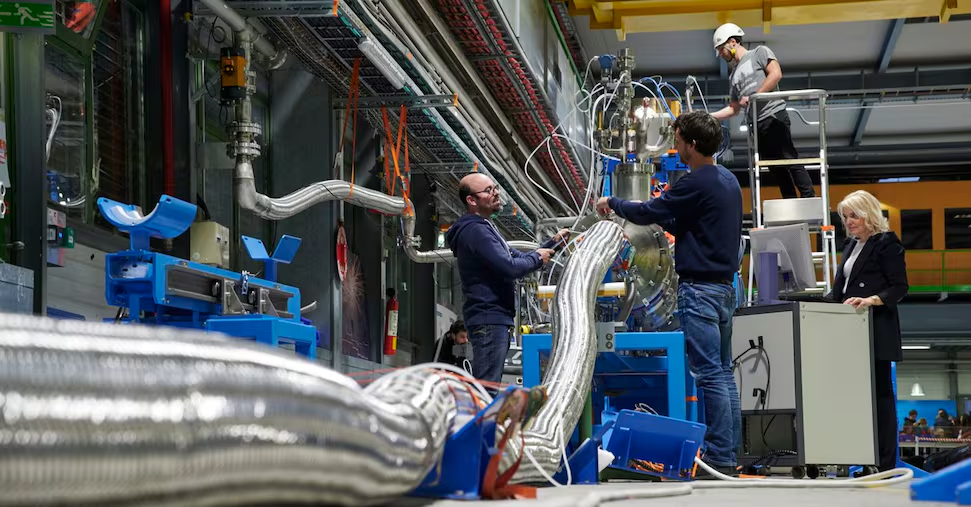
Cable made by Asg of the Malacalza family
But ASG also collaborates with the Infn (National Institute of Nuclear Physics): together they are developing a superconducting cable with a power of 1 gigawatt (potentially capable of transporting, in a few centimeters of diameter, the energy produced by a nuclear power plant), which is currently being tested in the ASG plant in Genoa and is currently being installed in an Infn facility in Salerno.
Antonio Zoccoli, president of the Infn, confirms the leading position that Italy and therefore Europe have in the sector. «Yes – says the physicist – we are ahead. But we are for a very specific reason, because we now have a tradition in this field. Infn and ASG have been working on superconductivity for many years, and the Ligurian company has supplied a third of the magnets to LHC, works with Iter (the project that aims to create clean nuclear energy), on the DTT (Divertor tokamak test, Enea’s Italian energy and fusion project) and so on; all thanks also to this experience he had with us.”
Asg, he continues, «uses a cable while many others use wires; what Asg has done, in particular, is to be able to industrialize this technology. Now, therefore, it is easier to produce a cable that can be used very quickly. We have moved from basic research to industrial research.”

