

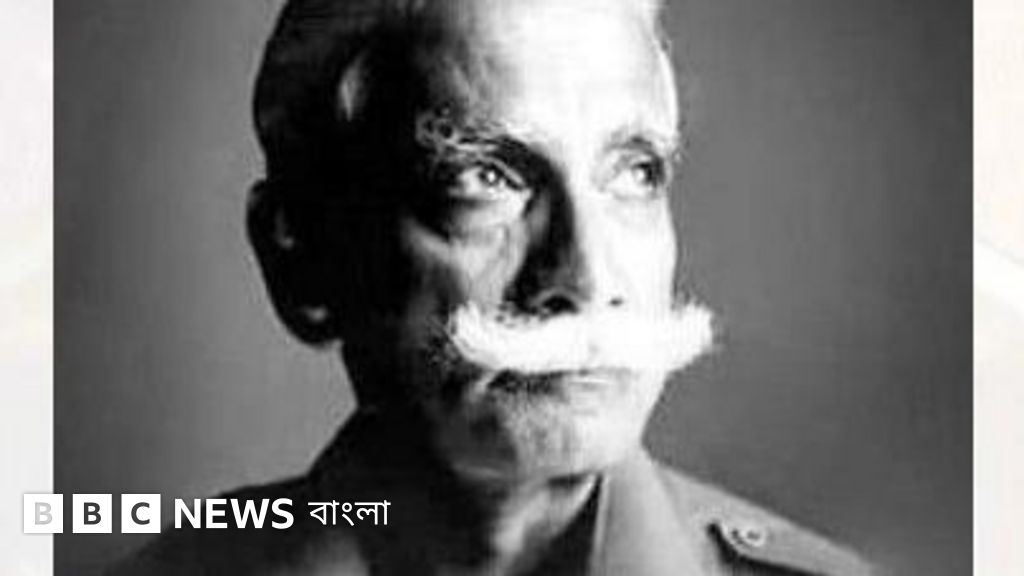
image source, Ottoman Museum
On the night of March 25, 1971, the Pakistani army carried out indiscriminate massacres in Dhaka after attempts at political reconciliation failed. When the news of that military operation called ‘Operation Searchlight’ spread, the Bengalis burst into anger.
The war of liberation began.
At the beginning of this war, the Bengali army isolated resistance and counter-attacks in various areas including Dhaka and Chittagong.
Later in early April, they started to organize, gradually forming the Mukti Bahini.
A former army colonel named Mohammad Ataul Gani Osmani was appointed as the head of that force.
Colonel Osmani, known as ‘Papa Tiger’ to the soldiers, retired from the Pakistan Army three years before the liberation war began. Then he joined politics.
From there, how Colonel Osmani once again returned to the life of military uniform and became the chief commander of the Liberation War, this report highlights that.

image source, Bettmann Archive/Getty Images
Soldier’s Life: British India to Pakistan
Mr. Osmani was born in 1918 in a noble Muslim family in Sunamganj. MAG Osmani was the youngest among three brothers and sisters.
His father Khan Bahadur Mofizur Rahman is said to have been a high-ranking official of the then British government. Mr. due to his father’s job transfer. Osmani spent his childhood in different places of Assam and Sylhet.
After finishing school and college there, he got admission in the famous Aligarh Muslim University in Uttar Pradesh, India. From there in 1938 Mr. received a bachelor’s degree. Osmani.
According to the information of ‘Banglapedia’, the national encyclopedia of Bangladesh, MAG Osmani took part in two government service examinations simultaneously after graduation. One of these belonged to the Indian Civil Service, the other to the Army.
After passing both exams, Mr. Osmani eventually joined the British Indian Army as a commissioned officer.
According to Banglapedia, within a couple of years of joining the service, he was promoted to the rank of Major and appointed a battalion commander in the British Army.
When Damadol spread in the Indian subcontinent during World War II, Mr. The battalion led by Osmani was then sent to fight in Burma.

image source, Ziad Ali
After the war, in 1947, MAG Osmani was recommended for promotion as Lieutenant Colonel by the then British Indian Army.
After the partition of India, he joined the Pakistan Army as a lieutenant colonel. Osmani.
Until 1955, he served in various important positions in the military including Additional Commandant of the then East Pakistan Rifles, General Staff Officer of the Army.
In 1956, he was promoted to colonel. Osmani. For the next ten years he served as Deputy Director of General Staff and Military Operations at Pakistan Army Headquarters.
MAG Osmani retired from Pakistan Army in 1967 with the rank of Colonel.
“Though he retired as a colonel, Osmanir deserved a higher rank than that. Almost all of the non-Bengalis who joined the Pakistan Army with him from the British Army retired with high ranks and even became army chiefs,” writer and researcher Mofidul Haque told BBC Bangla.
“But Bengalis were not promoted in the Pakistan Army in such a way that they could not go to higher ranks. Colonel Osmani was also a victim of that injustice,” said Mr. the right

image source, Getty Images
Joining politics
After retiring from the Pakistan Army, MAG Osmani joined Awami League politics.
Joining the party, he voted as Awami League’s nominated candidate in the 1970 general election. At that time, he was elected a member of the then Pakistan National Council by election from Fenchuganj-Balaganj-Bishwanath area of Sylhet.
Awami League won an absolute majority in that election held in December 1970. But still the then military government of Pakistan did not allow the party to form the government.
On the contrary, on March 1, 1971, the then president of the country, Yahya Khan, announced the indefinite suspension of the National Assembly session.

image source, Songramer Notebook
Army rally in Dhaka
Sheikh Mujibur Rahman called for a non-cooperation movement to protest the postponement of the National Assembly session.
He called for the boycott of all government institutions including educational institutions, offices, courts, banks and stop paying taxes in the then East Pakistan.
On the 7th of March, Sheikh Mujib addressed a large gathering of millions of people at the Race Course Maidan in Dhaka.
There, he once again ordered the closure of all courts, criminal courts and educational institutions of East Pakistan for an indefinite period.
After Sheikh Mujib’s speech, a new dimension was added to the non-cooperation movement. People from different classes and professions continued to express solidarity with that movement.
In continuation of this, a rally of retired Bengali soldiers was held in front of Baitul Mukarram Mosque in Dhaka on 22nd March. MAG Osmani played an important role in organizing it.
Former members and officers of the Army, Navy and Air Force participated in the rally and expressed solidarity with the Non-Cooperation Movement. It is also mentioned in the news of that time that they will fight with arms for the country if necessary.
At the end of the meeting, the ex-servicemen went to the central Shaheed Minar of the Dhaka University area to pay their respects with flowers.
Then everyone recited the oath together to join the war of independence. After the oath, Osmani and some retired senior army officers met Sheikh Mujibur Rahman at Dhanmondi number 32.
A sword was then presented to Sheikh Mujib as a symbol of loyalty, according to newspaper reports.

image source, Getty Images
secret meeting
During the non-cooperation movement Mr. Osmani began secretly contacting Bengali officers of the Pakistan military to mobilize them.
After learning about the matter, Pakistani army officers became worried. Mr. as preparation for war. They feared that Osmani might organize the Bengali army and form a separate army.
The then Governor of East Pakistan Dr. This becomes clear in an autobiographical account of Major General Rao Farman Ali, AM Malik’s military advisor.
Mr. about the situation before March 25, 1971. Ali wrote in his book ‘How Pakistan Got Divided’, “A very alarming situation then arose as the loyalty of the East Pakistani members of the military became suspicious.”
“Current and former (Bengali) army officers under the leadership of Colonel Osmani began to hold frequent meetings. Their aim was to prepare to form a military force to fight on behalf of the Awami League if the problem was not resolved constitutionally,” said Mr. Ali.

image source, LIBERATIONWARMUSEUM BD
Teliapara Battle
Many people including Bengali army, EPR, policemen got angry and started resistance in the incident of 25th March massacre.
Piece by piece war started in different places including Dhaka, Chittagong.
On April 4, 1971, they met in a secret meeting in a bungalow house in Teliapara Cha Bagar, Habiganj, to organize this resistance war that started separately and bring it under a single leadership.
In that meeting, some important strategies were adopted regarding the liberation war, which later came to be known as ‘Teliapara strategy’.
More than two dozen army officers including then Major Ziaur Rahman, Major KM Safiullah, Major Khaled Musharraf, Lt Col MA Rob participated in the meeting led by retired Colonel MAG Osmani.
They unanimously decided, Mr. Osmani will lead the war of liberation as the chief commander.
At the same time, army officials decided to continue the armed war by dividing Bangladesh into four military zones or sectors. Later the number was increased and the entire country was divided into 11 sectors.
Besides, it is known from the documents of the war of independence that it was initially decided in the meeting to form the government of independent Bangladesh as soon as possible and obtain the recognition of the liberation war and to take the necessary assistance including arms and ammunition from India.

Official announcement
A week after the Teliapara meeting, on April 10, the government in exile in Bangladesh, namely the Mujibnagar government, was formed.
Sheikh Mujibur Rahman as President, Syed Nazrul Islam as Vice President and Tajuddin Ahmad as Prime Minister took oath on April 17 at Baidyanathtala in Meherpur.
The interim government officially announced the appointment of Colonel MAG Osmani as the Commander-in-Chief of the Bangladesh Armed Forces and the Liberation Army.
“Colonel Osmani was the most suitable person for that post,” historian Professor Muntasir Mamun told BBC Bengal.
Explaining the matter, Professor Mamun said, “Firstly, he was organizing the Bengali army from the time of non-cooperation movement. Secondly, he was the most senior among the Bengali army officers at that time. He has experience of serving in British and Pakistan Army, he participated in World War II.”
“Also, he was a familiar face to the governments of India and Pakistan as well as Bangladesh and had a different acceptance. All in all, it was decided to appoint him to the post,” said Professor Mamun.

image source, Getty Images
Author and researcher Mofidul Haque was saying the same thing.
“It was a matter of military experience and familiarity, more importantly, he was a representative elected by the people. As such a person was associated with the preparations for the liberation war, his name naturally came to the fore after the start of the war,” said Mr. the right
Mukti Bahini was divided into regular and irregular with the responsibility of commander. Osmani.
The regular forces mainly included Bengali soldiers of the then East Bengal Regiment and East Pakistan Rifles.
They were engaged in fighting according to the traditional rules of the armed forces.
On the other hand, irregular forces, which were known as Ganavahini, were formed by training civilian professionals such as farmers, labourers, jobbers, students and political activists.
Members of the Gana Bahini were sent to conduct guerilla warfare against the enemy inside Bangladesh.
Thus, after gaining independence through a long and bloody struggle, MAG Osmani was promoted to the rank of General of the Armed Forces.

