

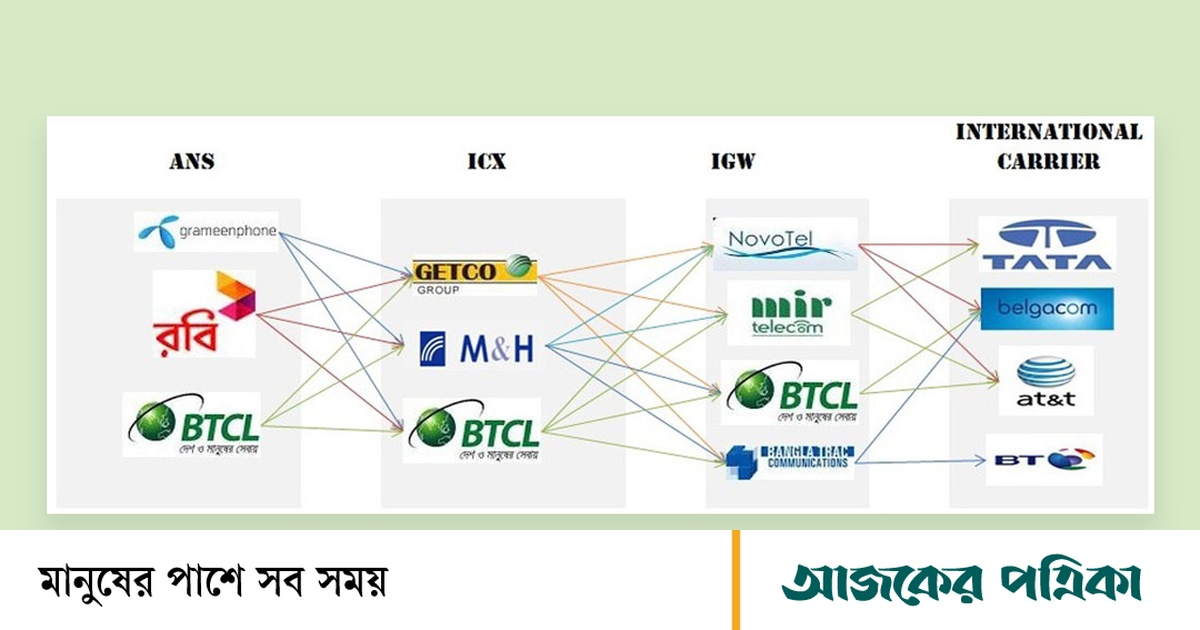
The Interconnection Exchange (ICX) plays a role in connecting the phone call from one operator to another. All internal and international voice traffic in Bangladesh have been transmitted through the ICX for 25 years.
The main function of the ICX is to deliver the calls from abroad through the International Gateways (IGW) to the operator of mobile and other telephones (ANS or Access Network Services). The call through the ICX is under the government's surveillance. This makes it possible to prevent taxation through gray traffic or illegal calls. Even more important is that the security and sovereignty of the state protects through digital surveillance of the ICX.
But after taking over the interim government, the Bangladesh Telecommunications Regulatory Commission (BTRC) has proposed to exclude the ICX in the draft of the Bangladesh Telecommunications Act for 'reorganization of network and business management licenses in the telecom sector'. As a result, the digital security of Bangladesh will be threatened by the entrepreneurs and experts.
Technology expert Ahmed Ur Rahman (Rommel) said that ICX management has been in Bangladesh for a decade and a half. More than 5 voice service providers in the country are operating the Access Network Service (Mobile, PSPN and IPTSP). If each of them establish a separate bilateral connection, it will cost higher than the ICX system.
Rommel, head of the ICX Operation Department of Agni Systems, has been working on ICX management for more than a decade. He said that Bangladesh is lagging behind in internet service in terms of international quality, but voice service is in a good position. Even during the internet shutdown of July-August, various structures related to voice service have been attacked, but services have been confirmed in alternative systems. At that time, SMS and voice traffic doubled as the only communication medium. As a result, the capacity of voice service has been verified in the highest adverse conditions. In such a situation, the ICX will discriminate against the cancellation of interconnection and destroy the market for healthy competition.
In this reality, Rommel expressed skepticism as to whether there was the logic and necessity of voice reform. He said the reform committee did not give any clear explanation behind the 'unnecessary declaration' of the ICX level. But it has been proposed to reform the voice service of different technologies by highlighting the problem of data -based technology.
Rommel 'Head of the ICX Operations Department of Agni Systems in Dhaka on Wednesday, adding the impact of excluding ICX on the draft telecommunications policy, was reformed in the telecom sector: the importance of central interconnection management in voice calls and the real picture of ICX.
He said that although the ICX is blamed for the increase of collateral at the Caldrop or customer level, the reality is different. Rather, the price of local off-net voice call has dropped further due to this level.
The technician believes the amount of illegal VoIP and revenue gap will increase when ICX exploits. He said the government lost a large amount of foreign currency and revenue due to illegal VoIP. ICX acts as an effective 'filter' in preventing illegal VoIPs. This is because, with the ICX, conservation of collateral, revenue sharing and call tracing is ensured, it is easy to identify illegal activities.
Rommel said that only the government benefits through the ICX, there is another misconception that operators are harmed. But the reality is that through this system, the state, operator and customer benefit from the three parties.

However, in the current system, he proposed to stop taking the 2 paise revenue from the ICX from the ICX. Then access network operators will be forced to reduce the collateral at the customer level. This will implement the goal of reducing the BTRC's regulatory burden.
In this regard, Brigadier General Md., CEO of Lifestyle Solution Limited. Khurshid Alam (retd) said, “ICX gets 1 paise at 2 paise of mobile calls. You have to pay two paise BTRC. The license, tax, VAT are gone between these two paisa. We have only one penny. '
The Association of ICX Operators of Bangladesh (AIOB) has accused the draft telecommunications policy-2021 a serious threat to the National interest, employment and security.
The organization says domestic organizations will not be able to survive virtually if the draft telecommunication policy is implemented. The risk of establishing foreign control will be created. Digital sovereignty and national security will hurt. Foreign control of the telecom network will weaken the country's cyber security and the management of important national information will be threatened, which is against the sovereignty of the country.
AIOB Secretary -General Lieutenant Colonel Aminur Rahman said that if the government's new policy is implemented in the name of BTRC license reform, the country's telecom infrastructure, national security, digital sovereignty and employment of thousands of workers will be at risk.

