

Completing the Dakar Rally, no matter how much marketing is added to the whole thing, is an unmistakable sign that a vehicle is robust. Few races better evoke the idea of reliability and durability in motor sport: 8,000 kilometers accumulated in two weeks, with all kinds of obstacles and terrain in between. The hundreds of cars and motorcycles that take the start squeeze each of their screws to the maximum, and statistics indicate that less than half reach the finish line. It is not surprising then that, year after year, China makes its way and increases its footprint in rally rallying now that its motorcycles and cars are beginning to be noticed in Europe, the United States and the rest of the world.
“What’s better than trying things where they break,” summarizes Javi Vega, who competes with a Kove in the original category, the most demanding for motorcycles as it does not have mechanical assistance. “Absolutely everything breaks in the Dakar, from a Chinese machine to an Austrian one. Without a doubt, it is the definitive laboratory for any new brand,” adds the 36-year-old driver in conversation with EL PAÍS.
In 2025, a Chinese supercar from BYD touched 500 km/h and broke the world speed record previously set by Bugatti. And the Chery group’s premium brand, Exeed, has just announced a five-year plan to enter the 24 Hours of Le Mans. At the Dakar, the organization finalizes the landing of several new manufacturers from the Asian giant. “We are talking with several brands, and both motorcycles and cars will soon arrive at one or two teams for the race,” reveals David Castera, director of the rally. “This is no coincidence. I was at the last motorcycle show in Milan and the display of the Chinese was incredible. For the first time in history, more Chinese cars have been sold in France than European cars. This is an unmistakable sign,” says the former French rider.
On four wheels, Chinese factories will enter the competition through the newly launched stock category, a more economical solution that has already attracted brands such as the British Defender. They will most likely do so in 2027 and since last summer they have been testing potential pilots. On two wheels, Kove and Hoto are already among the best, although without much success. Segway and Arctic Leopard are also participating with their electric motorcycles in the Mission 1000 category, dedicated to more sustainable mobility. Although they still have a long way to go in the competition, 24 Chinese drivers took part in the start in 2026, the sixth most represented nationality in the entire rally.
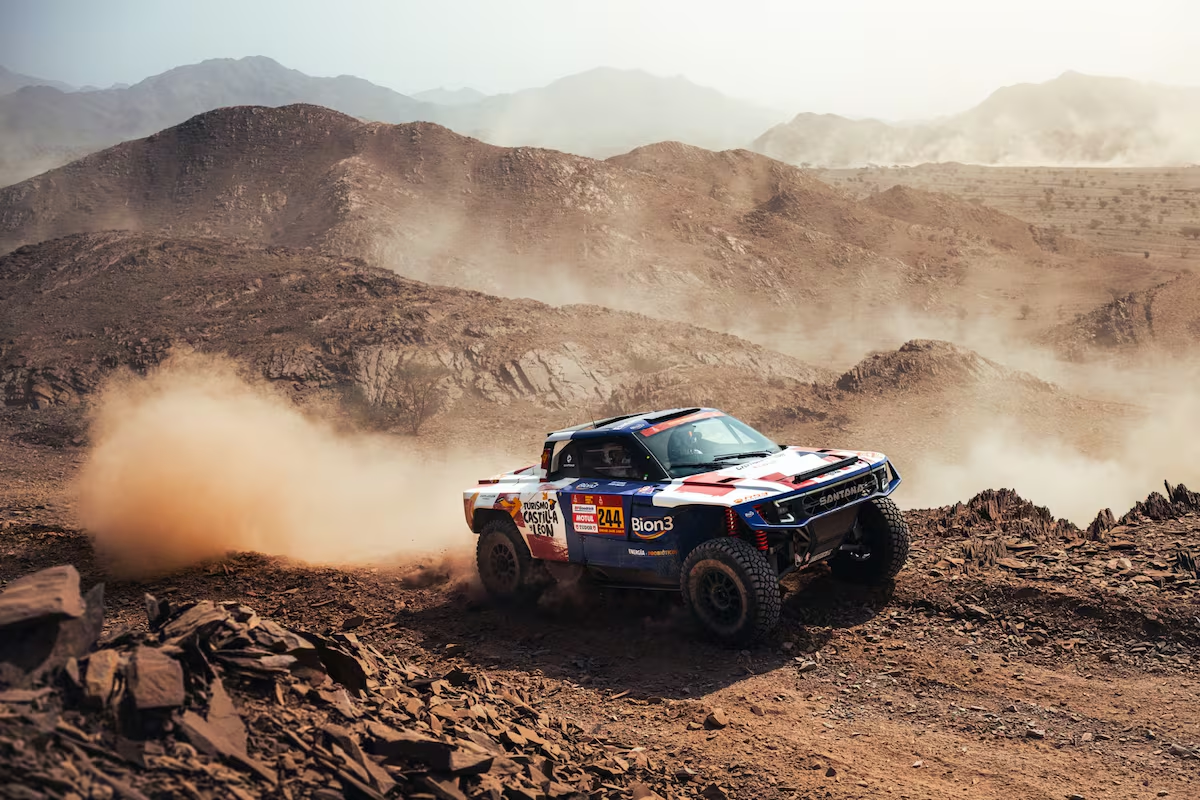
In cars, two elite teams hide behind the sheet metal and paint China’s growing interest in the discipline. Ebro and Santana, Spanish brands recently refloated by the capital of the Asian giant, are launching this year. “The context we are experiencing fosters this situation,” says co-pilot Edu Blanco, CEO of Santana and also a founding partner and former advisor of the Barcelona brand. The executive participates in the race alongside presenter Jesús Calleja representing the Linares company. “The story of Santana is a good example. It started as a joint venture with Land Rover and had to deal with the British. Then with Suzuki and the Japanese. Then with Iveco and the Italians. Now it’s China because they have done their homework well. They have been thinking for 30 years about what the cars of the future are going to be like,” he highlights.
“In competition, Chinese dominance is far away. The European level in both vehicles and suspensions and other components is very high. It is very difficult for them to arrive suddenly. But we must not be fooled. Just as we copy their street car for our market, they are buying our competition cars to learn. It is an exchange of technology and knowledge,” adds Blanco. Santana and Ebro use an adapted South African prototype, the Century, in the Dakar to promote their return to the road.

