

Until last January 3, the day that the United States decapitated chavismo In a lightning action in Venezuela, a rosary of good news accompanied the veteran Luiz Inácio Lula da Silva in the final stretch of his third term as president of Brazil. His firmness and dialogue strategy In the face of Donald Trump’s tariff order, it seemed to work. Mercosur and the European Union finally have reached the trade agreement for which he bet so strongly. The judges punished with jail the coup adventure led by his main rival, the ultra Jair Messias Bolsonaro, to sabotage the extraordinary return to power of the former union leader. The country abandoned the UN Hunger Map. And poverty, inequality and unemployment fell to a minimum historical.
Brazil is gearing up to elect the president, the 27 governors, and renew the entire Chamber of Deputies and part of the Senate in October. The leader of the Workers’ Party, at 80 years old, is the favorite in the polls to win a fourth term against a completely disoriented right.
But Trump’s military attack against neighboring Venezuela brings back the unfortunate memory of previous interference and tutelage, triggers uncertainty and will probably reverberate in the Brazilian elections. For now, the reaction of Brazilian politicians has followed ideological lines. Lula and the left condemn the assault on sovereignty, while the right applauds Washington.
The main unknown of the presidential elections is whether the opposition to Lula will be united around Bolsonarism or divided. The former ultra president, who is serving a long sentence for coup plotting, has designated a pre-candidate to his firstborn, Senator Flávio Bolsonaro, 44 years old.
Bolsonaro Jr. would measure Lula at the polls, who at 80 years old longs to prolong his political life with another re-election. He already governed between 2003 and 2009 and, again, from 2023. Those statements that the return would be for a single term have been buried. The emergency operation due to a cerebral hemorrhageWhat he suffered at the end of 2024 seems forgotten and any fear of ending up like the American Joe Biden has been put to rest.
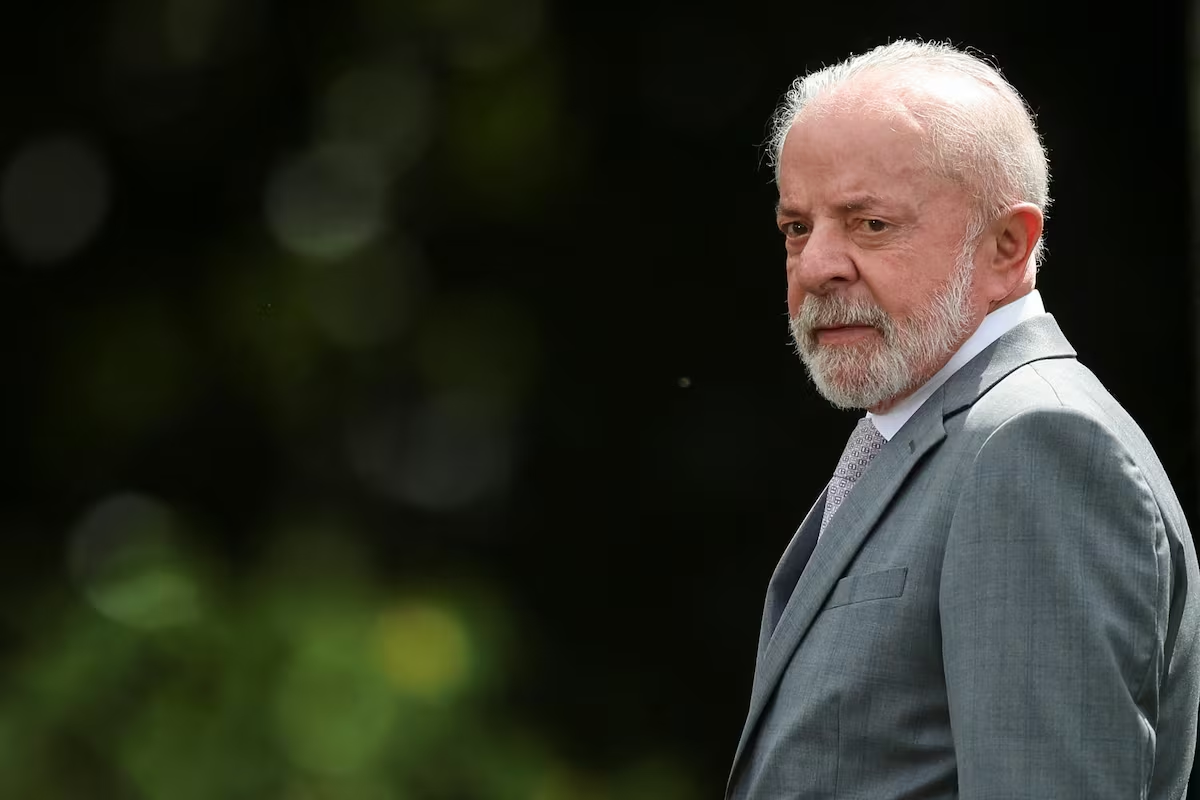
Only an unexpected health problem would remove him from the electoral race. Therefore, he controls his public image with an iron hand, work of your personal photographeralways attentive to showing it active and vigorous. Winning the elections would be the perfect gift for his 81st birthday, on October 27, two days after the second round.
Lula appeared exultant in his Christmas message to his compatriots: “It was a difficult year, with many challenges. But everyone who cheered and played against Brazil ended up losing. The Brazilian people emerged as the great winners,” he proclaimed in a soccer simile. “We had an unprecedented challenge: great rate against Brazil. But we show that we are for dialogue and that we are not fleeing from the struggle.” Days later, she showed off her good physical shape with a video in a swimsuit from a beach in Rio de Janeiro, managed by the Navy, where she spent New Year’s Eve.
Trump backfired with the pressure campaign against Brazil to save Bolsonaro, one of the worst bilateral crises in 200 years between the two most populous democracies in America. Brazilian institutions were not intimidated. “Brazilian democracy won the fight with the superpower,” wrote columnist Celso Rocha de Barros in Folha de S.Paulo. All of this was before the United States intervened in Venezuela to protect a Chavista transition and profit from Venezuelan oil.
Lula skillfully turned US interference in Brazil into instigated by the Bolsonaro clan, on the occasion of wrapping himself in the flag and defending national sovereignty while accusing the Bolsonaros of treason. Thanks to the boomerang effect of Trump’s maneuver, the leftist managed to turn around the odyssey he faced a year ago, when He suffered the unspeakable to govern and his popularity was lower than ever.
The polls of recent months invariably place Lula as the winner of the elections, but they also suggest that it will not be a walk in the park. The race seems close or very close. In these times of extreme volatility, surprises should not be ruled out.
Despite the hostility of Congress, dominated by Bolsonarism and the classic right, Lula has managed to carry out his star promise: the law that eliminates or reduces the income tax to millions of middle class Brazilians, who will have more money to spend. He has also resurrected or expanded the social programs of his first stage in power, although at the cost of an increase in the public deficit (8.1% of GDP) and debt (79%).
Meanwhile, Bolsonaro, recently transferred to a prison from the police station where he was imprisoned and suffering from various health problems, exercises his political power. A waning power, but one that maintains him as the leader of the Brazilian right. On Christmas Day, the former president released a handwritten letter from the hospital in which, in a messianic tone, he handed over to his eldest son. “In this scenario of injustice, (…) I give the most important thing in the life of a father: my own son to the mission of rescuing our Brazil.”
The first polls after the announcement indicate that Flávio Bolsonaro, 44, inherits the bulk of his father’s votes, but Lula remains victorious. There has never been a doubt that Bolsonaro Sr. would nominate the right-wing candidate. The unexpected thing is that he did it so soon. In any case, it is the first time in three decades that at this point it is not completely decided who will face the incumbent president at the polls.
The economic elites and the right uncomfortable with the most reactionary Bolsonarism would prefer to remove the Bolsonaro family and have the candidate be the governor of São Paulo, Tarcísio de Freitas, a former minister and military man 50 years old. The question now is whether Bolsonaro Jr., who presents himself as a moderate version of the patriarch, will manage to consolidate a candidacy that unites the right or if the classic right will launch a governor as an alternative. The mystery will be resolved by April, when the deadline expires.
“If the candidate were Tarcísio (the governor of São Paulo), it is not known what clothes he will wear, whether he will embrace a technocratic discourse or a Bolsonarist discourse,” says Lara Mesquita, a political scientist at the Getúlio Vargas Foundation. He adds that “the center (the great center, a constellation of parties without ideology) is large enough to decide the election.”
The governor of São Paulo is in no hurry. He allows himself to be loved by the moderate right, publicly talks about seeking re-election in Brazil’s economic engine and reaffirms his absolute loyalty to his mentor Bolsonaro. His New Year’s message is most eloquent: dressed in a Canarinha t-shirt, he explains in a graphic and simple way the path to having a good year. “The formula is simple! Happy 2026 = Fora PT.”
With a well-rooted anti-Peterism, Brazilians who reject the president’s work (48%) almost equal those who support him (49%), according to the latest Datafolha.
Lula and the PT (the Workers’ Party) would like the campaign to revolve around the economy to boast of lowering taxes on the people (with the counterpart of raising them on the ultra-rich) and making tax justice their great banner along with the right to more time off with the same salary, social programs and infrastructure works.
But the right, which supported this large tax exemption, prefers to focus the debate on public safety to sell its recipe for a strong hand against organized crime and violence. While right-wing governors (and a majority of Brazilians) celebrate bloody operations such as the one deployed in Rio in November against the Red Command, which ended with more than 120 deathsLula’s Government defends the strategy of economically suffocating organized crime. Its model is the last major operation against the First Capital Command (PCC), which dismantled legal businesses without a single shot with whom he launders the money he earns from drug trafficking.
The Senate will be a key battle. Bolsonarism wants to ensure a sufficient majority in the upper house to, from there, stop the Supreme Court —the subject of renewed criticism for his excesses, now that the chapter on the trial against Bolsonaro has closed—and even dismiss Judge Alexandre de Moraes.
Lula is already in electoral campaign mode. He harangues his compatriots saying that Brazil cannot allow “the fascist, denialist extreme right, responsible for the death of 700,000 people, to govern again thanks to lies spread on the Internet.”
His advanced age will possibly overshadow the campaign, but political scientist Mesquita predicts that it will not have a huge weight for the electorate. Brazilians see their president in shape, many think he is younger than he is. And he cultivates that image while repeating that he feels like a 30-year-old kid and hopes to live to be 120. If he wins again, “he would be a president with less energy and would have to prioritize more,” says the political scientist.
https://elpais.com/america/2026-01-17/brasil-enfila-un-ano-electoral-con-lula-como-favorito-y-la-derecha-desnortada-sin-bolsonaro-padre.html

