

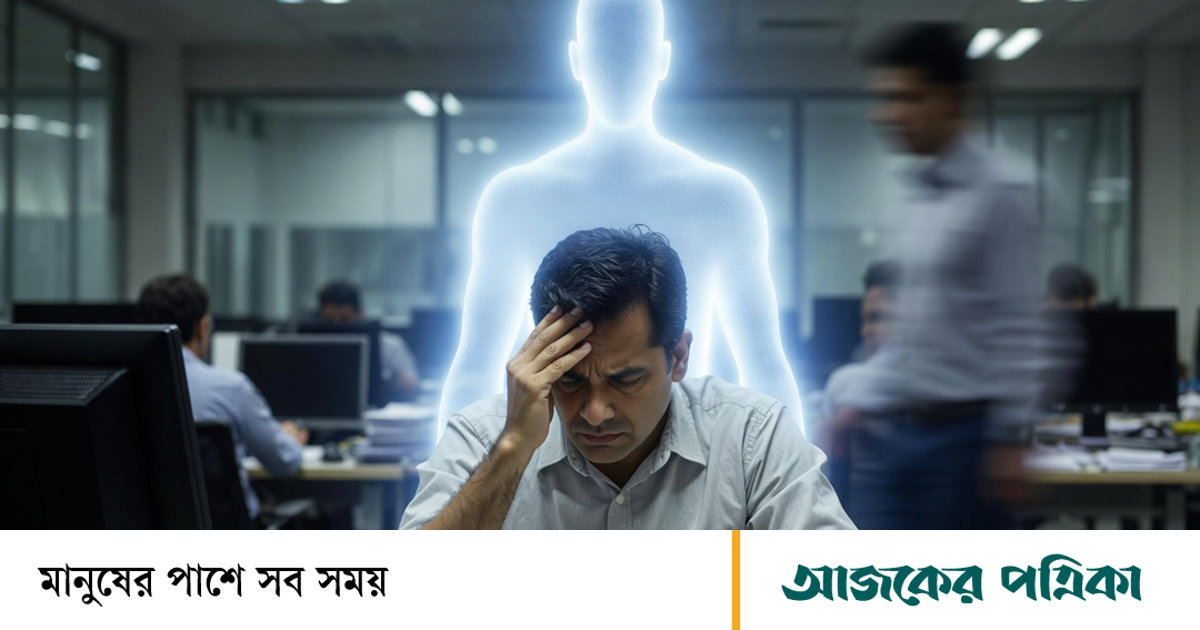
Artificial intelligence or AI has been the most discussed question in the last two years — will this technology take away human jobs? But now, along with that debate, a new concern is emerging. According to experts, AI may not completely take away jobs in the future. However, monitoring and directing employees in a way that can make the work environment more stressful.
Nvidia CEO Jensen Huang recently warned that in the future, workers may face a situation where their AI agents are constantly giving instructions, monitoring work progress and micromanaging them.
“Your AI agents will constantly nag you, micromanage you, and you’ll be busier than ever,” he said in a talk at the Stanford Graduate School of Business.
Although the comment was made in jest, tech experts say it hints at a real fear about the future of the workplace.
Sagar Bishnoi, co-founder of Future Shift Labs, said excessive AI-based notifications and instructions can create ‘alert fatigue’ among workers as a result of over-alerts.
According to him, ‘AI can increase productivity, but additional instructions can turn it into a digital micromanager. If a new AI suggestion or warning is added to each task, workers may lose autonomy and job satisfaction may decrease.’
Currently, AI technology is doing things like writing code, creating meeting summaries, managing schedules, drafting emails and analyzing data. However, organizations are increasingly using these technologies not only as assistants, but also as a means of monitoring employee activities and analyzing productivity.
Paramdeep Singh, co-founder of Shorthills AI, said that while many workers today are comfortable using AI co-pilot, the technology could cause additional stress in the future.
He said, ‘Human managers are tired at the end of the day and wait until the next day. But the AI co-pilot or agent never gets tired.’
According to him, the deeper integration of AI into workplace software will increase real-time monitoring of productivity, continuous evaluation and analysis of employee performance.
He thinks that if the efficiency increases, the mental pressure of the employees may also increase. He also commented that in the future, employees may be required to have a ‘right to disconnect’ or isolation from technological communication outside working hours.
According to Rahul Atri, partner at executive recruitment firm Pro-Age Services, AI-based surveillance may boost productivity in the short term. However, in the long run it can have a negative impact on employee morale.
“Some organizations want to use AI only as a tool to increase efficiency,” he said. And some organizations want to use AI to improve decision-making capabilities.’
According to him, AI will be more dominant in organizations that focus only on getting things done faster and with less manpower. But in organizations that want to use AI to make better decisions, the use of the technology will be more balanced.
Dr. AI expert. Srinivas Padmanavuni said the most beneficial situation for workers would be when AI acts as a ‘co-pilot’, not a ‘backseat driver’.
Meanwhile, Jensen Huang is optimistic about AI. He recently said that the idea that AI will take away jobs on a massive scale is completely nonsensical. According to him, productivity will increase due to AI and organizations will hire more engineers and skilled workers.
On the other hand, OpenAI CEO Sam Altman and Anthropic CEO Dario Amodei have also taken a relatively optimistic stance recently. Earlier they expressed the fear of losing a large number of jobs due to AI, but now they say that new employment opportunities will also be created with the spread of technology.
But in reality layoffs continue in the tech sector. Companies like Meta, Amazon and LinkedIn have laid off workers as part of AI-based restructuring. Recently, software development platform GitLab also announced about 14 percent layoffs.
According to Paramdeep Singh, both sides of the jobs debate may ultimately be partially right.
“In the short term, AI will automate many jobs and many will lose their jobs,” he said. But in the long run, new jobs will be created. For this, employees need to acquire new skills and become adept at using AI.’
But the big question of the future is not just whether there will be jobs or not. Instead, workers will work in an environment where AI monitors and controls their every move. And maintaining this balance may be one of the biggest challenges of the future.

