

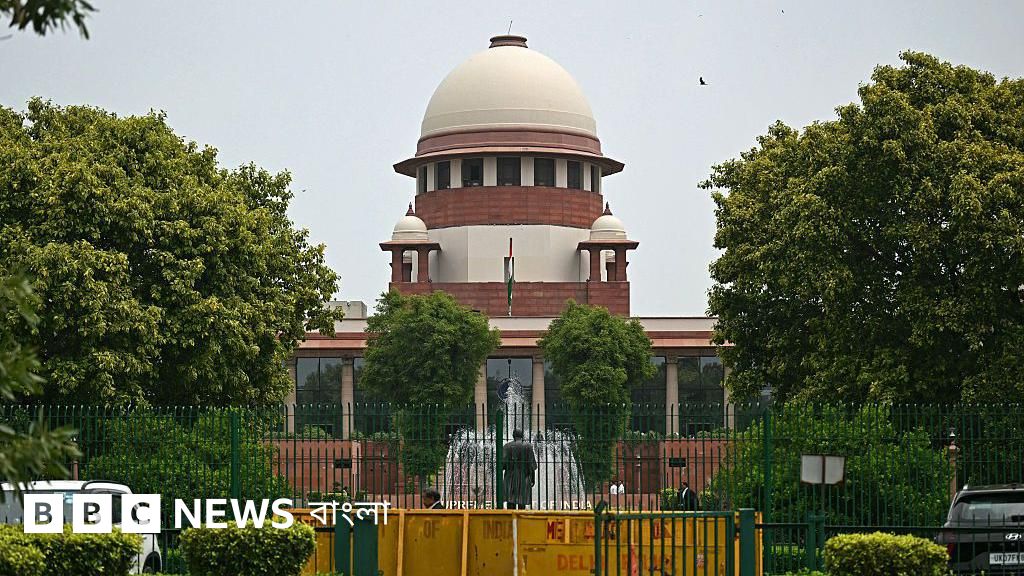
image source, MONEY SHARMA/AFP via Getty Images
The Supreme Court of India, in a ruling on Wednesday, May 27, has declared the Special Intensive Revision or SIR process for the Electoral Roll or Electoral Roll fully valid. However, the Supreme Court also said that the Election Commission only has the power to consider citizenship, not to determine it.
This judgment on the validity of SIR applies to all states including Bihar and West Bengal where the SIR process is ongoing. But the ‘logical discrepancy’ case in West Bengal is unique.
On the question of citizenship, a bench of Chief Justice Surya Kant and Justice Jaimalya Bagchir said that citizenship is a consideration for inclusion in the voter list and the Election Commission can take it into consideration. However, it has been reported that the Election Commission does not have the power to determine whether a person is a citizen or not.
A bench of Chief Justice Surya Kant and Justice Jayamalya Bagchir said the SIR is crucial in ensuring a constitutionally transparent and free election process.
On the question of the role of the Election Commission, the Supreme Court said that the SIR process is entirely within the purview of the Election Commission of India and it is within their rights and powers to carry out the task of particularly intensive revision of the voter list.
However, the Supreme Court said that not being in the voter list does not mean that the person is not a citizen.
Last year, the Election Commission of India conducted a special revision of the voter list for the first time in Bihar. Some organizations such as the Association of Democratic Reforms and the National Federation of Indian Women then filed a petition in the Supreme Court questioning the legal validity of the process.
At that time, however, the Supreme Court of India did not grant any stay in this process, so the Election Commission did not have any difficulty in conducting the SIR process.
After Bihar, this process was also carried out in several states like West Bengal, Kerala and Tamil Nadu. It may be noted that in all these states the SIR was launched before the assembly elections.

image source, Santosh Kumar/Hindustan Times via Getty Images
What is the reaction in political circles?
The Supreme Court’s verdict has drawn mixed reactions from the ruling party and the opposition. However, while both sides have welcomed it in their own way, some questions have been raised by the member parties of the India Alliance, including the Congress.
Union Law Minister and BJP leader Arjun Ram Meghwal said, “When the SIR was discussed in Parliament, the Supreme Court of India basically accepted what the ruling party said. We thank the Election Commission for conducting the SIR process impartially.”
“Rahul Gandhi tried to malign the Election Commission, but he should respect constitutional institutions,” he said.
BJP leader Sudhanshu Trivedi also lashed out at the Congress from a press conference. According to him, this judgment is a befitting reply against the Congress’s ‘slander’.
Trinamool MP Kalyan Banerjee fought on behalf of the former West Bengal government in several cases against the SIR and the Election Commission. He said, “There is no dispute that the Supreme Court has declared the SIR constitutionally valid.”
“But the court has made it clear that the Election Commission has no right to declare people who have been excluded from the list as citizens,” he said, welcoming the court’s decision.
But he added, “The case of logical discrepancy in the case of West Bengal, that case is still pending. Today’s judgment was not about that case of West Bengal.”
On the other hand, Congress MP Imran Masood said, “SIR was never illegal. The question is not whether SIR is legal or illegal. But how can the election process be considered fair by excluding a large number of people?”
Rajya Sabha member Manoj Jha of RJD, a member of India Alliance, gave a similar response. He said, “We thought that many people in West Bengal are still out of the voter list. We asked for inclusion, not exclusion.”
“Welcome the Supreme Court judgement,” he said, adding that “the constitution makers may not have thought that the electoral process would be completed by keeping so many people out of the electoral roll.”
“There is no question whether the Election Commission has the right to process the SIR or not. But we will approach the court again with some other questions,” said Mr. Jha
However, anti-SIR activist Yogendra Yadav indirectly criticized this verdict. He said, “The real news is not that SIR is valid, the real news is that this time the voters will no longer elect the government, this time the BJP government will decide who will be a voter and who will not be.”

image source, Arvind Yadav/Hindustan Times via Getty Images
What did the Supreme Court say about ‘citizenship’?
A very important part of this case was the question of determining citizenship. As a result of the SIR, the question of citizenship arose in the minds of many people who were excluded from the electoral roll.
Although the court had earlier said that non-appearance in the voter list does not mean loss of citizenship, applicants can return to the voter list through the tribunal.
In Wednesday’s judgment, the court opined that the Commission can only verify citizenship for this limited purpose of whether a person’s name should be included in the electoral roll.
According to the court, such verification by the Election Commission cannot be considered as determination of citizenship. If a person’s name is omitted from the electoral roll, it does not automatically mean that he is not a citizen of the country.
The court said, “Since this decision of the Commission is confined to electoral purposes only, it cannot be treated as conclusive on the question of citizenship. Therefore, any action to remove the name from the electoral roll on this reasoning would be dependent on the outcome of the judicial decision of the competent authority.”
In other words, it has been made clear that by exercising the power of the Election Commission, the Election Commission can decide not to place the name of such a person in the electoral list if there is any doubt about the citizenship.
But the Supreme Court has not empowered the Election Commission to decide whether the person is really a citizen or not.
The Court has made it clear that only the ‘concerned authority’ can take a decision on suspected persons and the Election Commission should inform the authorities if such suspicions arise.

image source, Samir Jana/Hindustan Times via Getty Images
Any questions answered?
Today’s judgment of the Supreme Court was basically tied to three questions, those three questions are,
- First, whether the Election Commission has the power to conduct a process like SIR or not
- Second, whether the information being examined under the SIR is based on a legitimate objective, and if so, whether the steps taken by the Election Commission are proportionate to the attainment of that objective.
- Third, whether the SIR proceedings undertaken by the Election Commission violate the Representation of the People Act, 1950.
What the court said, to put it simply, is that the commission has the right to take such corrective action as it decides.
The court also said that the SIR in no way overrides the ‘Representation of People’s Act’ and related regulations, rather it reinforces the powers given to the Election Commission by the Constitution within the specific statutory boundaries set by the Act.
Finally, the bench opined, “It cannot be said that the Election Commission exercised its powers outside of its share.”

image source, Arun Kumar/ The India Today Group via Getty Images
And what did the court say?
The court said that the purpose of SIR is to create favorable conditions for the constitutional purpose of ensuring fair and transparent elections in the country.
Validating the reasons recorded by the commission, the judgment said, “More than four decades have passed since the last intensive revision process, massive additions and subtractions in the past years, rapid urbanization and displacement of people from one place to another, these factors have led to the possibility of repetition of names and errors in the voter list. This process is intended to correct those deviations.”
But the method taken to meet these objectives is appropriate?
In response to this question, the Court observed, “The reasonableness of the procedure should be judged by the success of its implementation.”
“Procedures which may at first appear discriminatory may be made constitutionally valid by fair execution.”
“The actions taken bear a reasonable relation to the objectives set as goals.” The court added, “They are clearly not excessive and are accompanied by sufficient procedural safeguards to prevent arbitrary exclusion.”
That is, the court did not find any error in the procedures adopted by the Election Commission in the SIR process.
The petitioners who challenged the process argued that the citizenship of voters whose names are already included in the electoral roll should be guaranteed and that this innocence cannot be challenged except in accordance with the procedure laid down by law.
The petitioners also alleged that the Election Commission had violated the rules and excluded the names of many people without reason.
However, the court rejected all these arguments of the petitioners.
https://www.bbc.com/bengali/articles/cz725v2yw1yo?at_medium=RSS&at_campaign=rss

