

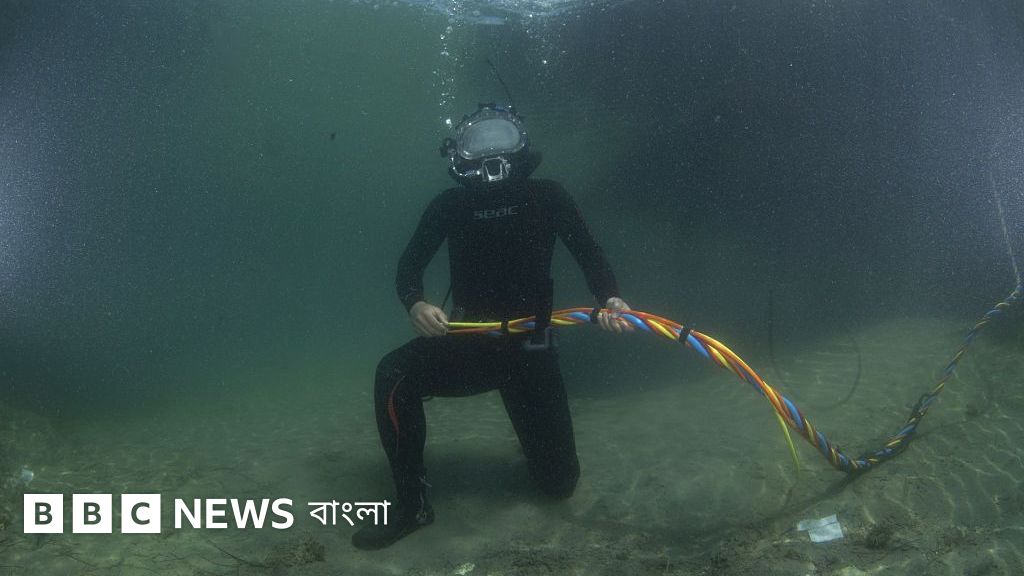
image source, Lokman Ilhan/Anadolu via Getty Images
Iran’s media and the country’s hard-line political circles now portray the Strait of Hormuz not only as an important energy transit route, but also as a strategic route for global Internet communications.
They believe Iran’s new pressure tool is hidden in international data cables that pass under the waters of the Strait of Hormuz.
The talks come at a time when tensions are rising between Iran, the US and the Gulf states following the recent military standoff over the Strait of Hormuz.
According to the Iranian media and hard-line political circles, Iran can monitor or supervise the submarine cables passing under the Strait of Hormuz.
That is, it can try to establish control over the safety and use of these cables. They may even charge a fee for use.
Although Iran faces many legal and technical hurdles to actually take such a step, the talks demonstrate that the country is considering not just oil tankers, but critical digital infrastructure as a means of building strategic pressure.

image source, Stocktrek / Getty Images
New issues in the Strait of Hormuz dispute?
For decades, the Strait of Hormuz has been considered an important part of global energy security. Because, about one-fifth of the world’s oil transported by sea travels through this narrow waterway.
Fars News Agency, a media outlet close to Iran’s Islamic Revolutionary Guard Corps (IRGC), brought forward the idea of using undersea internet cables as a potential tool of pressure in a report published on May 8. These only play an important role in communication and exchange of financial information between Europe, Middle East and Asia.
According to telecommunications service provider Tata Communications, several major cable networks pass through the Strait of Hormuz, including Falcon, GBI and TGN-Gulf. These facilitate data exchange between the Gulf region, Europe and Asia.
In particular, the TGN-Gulf cable connects Oman, the United Arab Emirates, Qatar, Bahrain and Saudi Arabia to the global communications network.
Fars News Agency also emphasized that big technology companies like Google, Meta, Microsoft are now more than ever dependent on these cables.
According to them, the international financial transaction network SWIFT also depends on this infrastructure passing under the Strait of Hormuz.

image source, NurPhoto via Getty Images
“If oil was the world’s most important fuel in the 20th century, then data has taken its place in the 21st century,” the report said, noting that Iran’s location on the Strait of Hormuz has geographic influence on important data transport routes as well as oil transport routes.
Mashreq News, another media outlet close to IRGC, is also saying the same thing. They described submarine cables as “Iran’s silent weapon”.
They claim that this infrastructure could pose a major risk to US CENTCOM and its allies.
The talks come at a time when Iranian officials have repeatedly said Tehran is reviewing its regional security strategy. Earlier, they have been repeatedly alleging that some Gulf countries have supported US military activities.
Digital infrastructure and economic pressures have also gained prominence in the “new equation” surrounding the Strait of Hormuz in recent months.
Iranian parliamentarian Eshan Ghazizadeh Hashemi told the country’s state news agency IRNA on May 2 that lawmakers were preparing a new “action plan.”
He said, if any work is to be done with submarine data cables in the Strait of Hormuz and the surrounding waterways, the permission of the Iranian government must be obtained first.
This will include where the cables will be routed, how they will be laid, how they will be operated or repaired, or whether they will be rerouted later.
Besides, Iran may have to pay service charges for these works, he said.

image source, Chip Hires via Getty Images
Why submarine cables?
According to a report published by the Reuters news agency in late April, about 99 percent of international Internet traffic is transported through submarine cables.
Telegeography, a telecommunications infrastructure research firm, said AEE-One, Falcon and Gulf Bridge International Network cables passed through the Strait of Hormuz.
As a result, a major problem in that area could affect the Internet, banking operations and business networks of the entire Middle East.
Citing various international estimates, Fars news agency wrote, financial transactions worth trillions of dollars are completed around the world every day through this undersea cable network.
The media also said that a disruption to these networks could cause economic losses of “several billions or hundreds of billions of dollars” within days. And that’s why it’s not just a technical issue; Rather, it is also involved with national security and geopolitics.

image source, FARS
What exactly is being said to do?
Iran’s hard-line media and people close to the government have not directly talked about cutting or seizing submarine cables. Instead, the focus of their discussion was toll collection, digital control and regulation of cable usage.
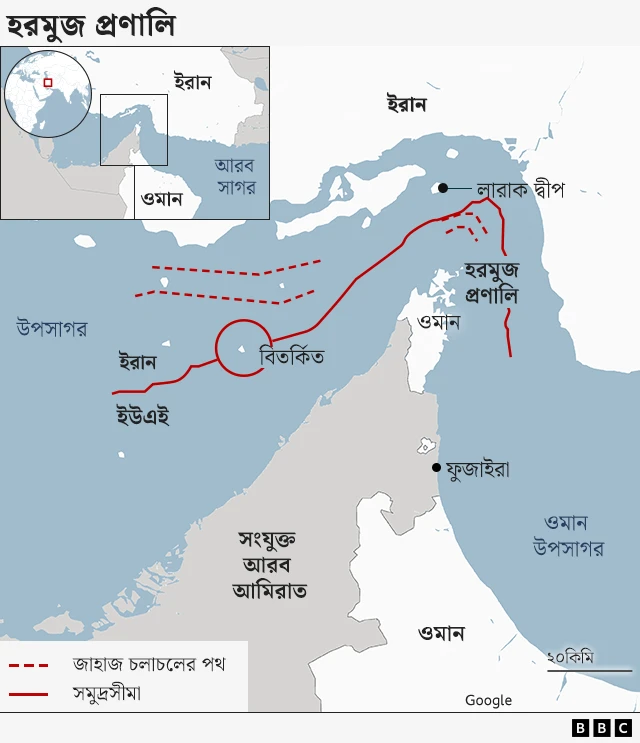
According to them, one part of the Strait of Hormuz is in Iranian waters and the other part is under the control of Oman. Tehran can therefore exercise legal and sovereign control over the seabed infrastructure that passes through this route.
Echoing the statement of an Iranian member of parliament, Fars news agency mentioned some possible steps. These include requiring permits for the laying of submarine cables, setting fees for the movement of cables, and increasing Iran’s role in repairing and maintaining cables.
According to them, through this, Iran can also earn money.
Submarine cables are usually made up of multiple fiber optic cables, which are protected by layers of steel, insulation and polyethylene.
It protects cables from stress, corrosion or external damage.
Repairing undersea submarine cables is expensive and time-consuming, Fars news agency said.
Reuters and telecom analysts had earlier reported the same.
The media also wrote that repairing cables in conflict zones is particularly difficult. Because operating a repair vessel there requires permits, safe sea lanes and stable conditions.
The report also said that foreign technology companies using these cables must work in accordance with Iran’s rules.
Fars claims that these proposals are “realistic” and that the Strait of Hormuz should be developed not only as an energy transit route, but as part of Iran’s digital and economic powerhouse.
According to them, it will also implement Iran’s larger strategy. Because this will create an opportunity to create influence and pressure in various alternative ways beyond the conventional military power of the country.
Does Iran really have such legal powers?
IRGC-affiliated media outlets mainly emphasize Iran’s own interpretation of the UN Convention on the Law of the Sea. They claim that the narrowest part of the Strait of Hormuz lies almost entirely within the territorial waters of Iran and Oman.
They argue that the right of international shipping through the Strait of Hormuz does not mean that littoral countries lose their own control or sovereignty.
But under international law of the sea, Iran’s claim to establish such extensive control over global communications infrastructure or data flows may not be easily accepted.
That is, the interpretation that Iran could unilaterally impose unlimited controls on the entire movement of data may not be supported by international law.
In addition, major powers such as the United States and European countries are unlikely to accept Iran’s attempts to impose unilateral control or fees on the global Internet infrastructure.
There are some real limitations in this regard. Subsea cables like ships are not always easy to monitor. In addition, these cables are operated under complex international agreements between governments and private organizations. As a result, deliberately interfering with it could create a massive international backlash.
However, the way Iran has previously exerted pressure or taken a tough stance on shipping in the Strait of Hormuz, it can be assumed that Tehran may want to use the control of submarine cables as a pressure tactic without waiting for full legal recognition.

image source, Anadolu via Getty Images
Why is this discussion coming forward now?
Timing is important here. The talks come at a time when Iran is rolling out new pressure tactics around the Strait of Hormuz. At the same time, they are repeatedly complaining against the US that Washington is creating a kind of blockade situation around Hormuz.
Not only maritime threats, but also economic, cyber and technological issues are gaining importance in Iran’s political rhetoric in recent times.
At the same time, hardliners have raised warnings against the United Arab Emirates and Bahrain.
They allege that these countries are cooperating with the military activities of the United States and Israel.
On May 8, Iran’s Foreign Ministry spokesman Ismail Baghai posted a vague warning on social media Xe Arabic.
There he writes, “When you see the sharp teeth of a lion, never think that the lion is laughing.”
In such a situation, this discussion of digital infrastructure sends a message that Iran has a wider range of strategic pressures at its disposal beyond oil tankers.

image source, Getty Images
How realistic is this idea?
Iran could face major technical and political hurdles if it tries to control or tax international internet traffic. Such a move could further isolate the country, especially at a time when Iran’s economy is already under pressure.
There are also risks for Iran itself. Because, the economies of Persian Gulf countries are deeply connected with each other. As a result, a major disruption to the submarine cable infrastructure could also affect Iran’s regional communications and trade.
However, according to analysts, it is important to discuss the idea openly.
By linking critical digital infrastructure to strategic calculations around the Strait of Hormuz, Iranian hardliners may be trying to send a message that future tensions will not be limited to sea lanes or oil tankers; It can also spread to the cyber world and global communication networks.
However, it was seen from this discussion that it is not possible to compete directly with the military power of the United States, so Iran is thinking of how to apply pressure and build resistance in alternative ways. That is, Tehran is now looking for ways to create strategic influence without direct war.

