

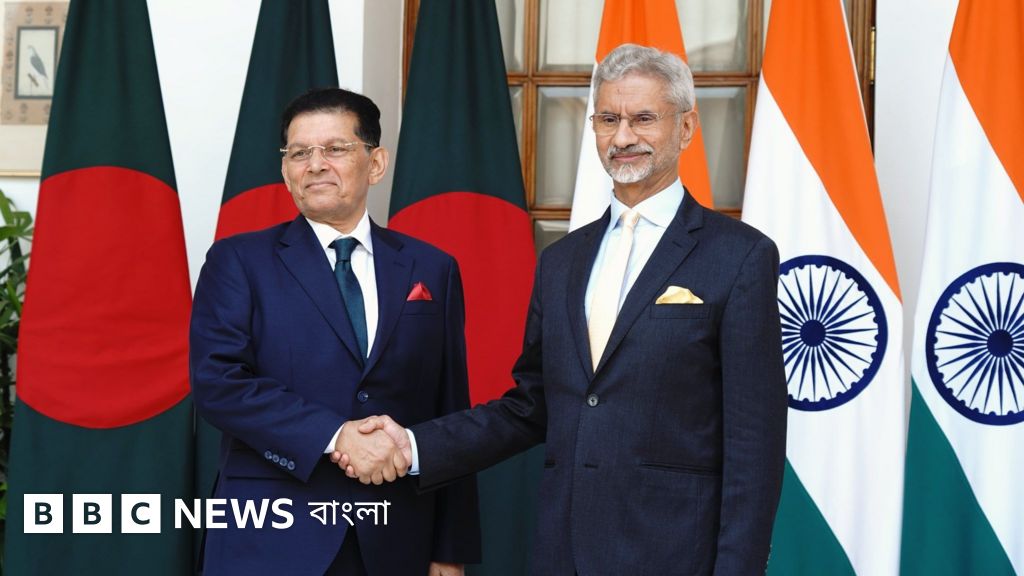
image source, Dr S Jaishankar/X
After a long uneasy phase in India-Bangladesh bilateral relations, an elected political government has come to power in Dhaka – and a key minister from that government is visiting Delhi for the first time.
Bangladesh Foreign Minister Dr. Khalilur Rahman’s ongoing visit to India is taking place in this backdrop – and India is also giving due importance to his visit.
After arriving in Delhi on Tuesday (April 7) afternoon, Dr. Rahman met India’s National Security Advisor Ajit Doval in a private meeting. The two also had dinner together.
After this day (Wednesday, April 8) he is scheduled to have consecutive meetings with Indian External Affairs Minister S Jaishankar, Commerce Minister Piyush Goyal and Petroleum Minister Hardeep Singh Puri.
Initiating talks on renewing the Ganga Treaty, reinstatement of trade concessions withdrawn in the last one-and-a-half years and additional pipeline supply to Bangladesh under the existing agreement – all these issues are expected to be discussed in the meetings.

image source, Dr S Jaishankar/X
However, India’s Ministry of External Affairs has not issued any statement or handout regarding the visit of the Bangladeshi foreign minister – so it is not very clear what is India’s ‘official position’ on the visit.
However, right after the visit tomorrow (April 9) Dr. Rahman and Dr. The BBC has learned that Jaishankar was to board an Air Mauritius commercial flight from Delhi to attend an international conference together.
In diplomacy, it is quite rare for foreign ministers of two countries to travel together on such a long-haul or long-haul flight, and because of that, it is understood that both governments are giving each other enough importance, ‘trying to understand’ each other.
Meanwhile, Dr. Delhi. Rahman’s traveling companion, Bangladesh Prime Minister’s Foreign Affairs Adviser Humayun Kabir, is visiting India’s ruling BJP headquarters in Delhi on Wednesday.
The head of the party’s foreign branch at the BJP office, Dr. It is also known that he will meet and exchange views with Vijay Chauthaiwal.

image source, Getty Images
How much will the resh of ‘Delhi na Dhaka’?
The August 2024 mass uprising that ended sixteen years of Awami League rule in Dhaka certainly had an anti-India dimension.
Prime Minister Sheikh Hasina has sold the interests of the country to India, this complaint was constantly heard in the mouths of the protestors.
At that time slogans were raised on the streets of Bangladesh ‘Delhi na Dhaka, Dhaka Dhaka!’ A boycott of Indian goods was called for, and the cultural center of the Indian embassy in Dhaka was also burnt.
As a countermeasure, India has also effectively suspended its visa program to Bangladesh, withdrawing one trade facility after another, and canceling scheduled cricket tours.
Even if there is some transition from that situation, there are doubts whether the situation will ever be the same again.
It may be difficult for both governments to completely ignore the amount of hatred and attacks that have been seen among a section of the people of the two countries.
Because both the ruling parties of the two countries also have domestic political obligations, the main slogan of the BNP government’s foreign policy is ‘Bangladesh First’.
However, from a recent thought of the Indian government, it seems that an attempt is being made by Delhi to counter the narrative that many people in Bangladesh say that the Muslim minority in India is extremely oppressed.
Prime Minister Narendra Modi’s office is actively considering whether to send one of the country’s respected Muslim intellectuals as India’s High Commissioner to Dhaka, BBC Bengal has learnt.
A retired politician or a retired diplomat is also being considered for this post. A former minister and editor was also considered, but he himself said he was not willing to go for the post.
If this proposal is implemented, it will be a very rare event for India – there is no precedent for India to have a ‘political appointment’ as an ambassador to any capital other than London or Washington.
If finally someone like that is sent as ambassador to Dhaka – it may not be much more than ‘tokenism’, but at least it will send the message that India respects the views of a large number of people in Bangladesh!

image source, Getty Images
‘Nothing will happen if the West Bengal elections are not settled’
Sriradha Dutta, a professor at OP Jindal Global University and an expert in international relations, feels that Delhi is well aware of the fact that an anti-India sentiment runs strong in Bangladesh – but she is not sure how much it is given importance in the implementation of India’s foreign policy.
A major reason for this could be that during the long rule of Awami League, most of India’s interests were protected regardless of what the common people of Bangladesh thought about Delhi.
In fact, when Sheikh Hasina’s government extended all the help to India, then Delhi did not need to think so much about what the common people of the country were thinking.
“There is nothing wrong with India seeking friendship with the people of Bangladesh – but there has always been, and always will be, some anti-India sentiment.”
“Delhi has established relations with Dhaka by accepting this, that opposition has not hindered it.”
“But with the change in the political situation in Bangladesh since August 2024, India has to make it clear that they are also giving importance and addressing that opposition,” Sriradha Dutta told the BBC.
However, he believes that even if there is a change in the attitude of Delhi, if the assembly elections in West Bengal and Assam are not completed, it will not be reflected in reality.
Since the BJP strongly wants to win the West Bengal elections and not allowing the state to become ‘West Bangladesh’ is a major political tool for their campaign, it is unlikely that India’s ruling party will make any visible change in its radical anti-Bangladesh political narrative right away.
Counting of votes after polls in West Bengal and Assam on May 4 – Sriradha Dutt therefore believes that any change in Delhi’s policy towards Bangladesh will happen after that.

image source, Getty Images
‘The urge to keep the relationship normal is a big factor’
Pinakaranjan Chakraborty, the former ambassador of India in Dhaka, wants to look at the whole matter from a different perspective.
He was telling the BBC, “The strong anti-India sentiment in Bangladesh is nothing new.”
“But I wonder when the question is raised whether India understands it? Hey, why wouldn’t we – there’s no rocket science in it that we’d find it difficult to understand!”
According to this former top diplomat of India, the political forces in Bangladesh capitalizing on anti-India politics are questioning whether India as a hegemonic power is ignoring the public opinion of Bangladesh.
Mr. Chakraborty argues that since Bangladesh’s independence, a large section of its population has turned against India – but that has not stopped relations between Delhi and Dhaka. Despite its ups and downs, the relationship never stagnated.
Mr. Chakraborty believes that now that the two countries have many interests and are dependent on each other in the economic and commercial sectors – that reality will take the relationship forward.
“Just as there is anti-India among a section in Bangladesh, so there is anti-Bangladesh among a class in India. It also fluctuates in intensity from time to time.”
“But for so long, trade, connectivity, communication has not stopped. I believe that the governments of both countries take their stand publicly. Both want to keep the relationship normal because they have their interests in it,” said Mr. Chakraborty.

image source, Getty Images
Awami League factor will cause discomfort?
A major point of uneasiness in India-Bangladesh relations recently has been the Awami League, the political party in Bangladesh with which Delhi has a very close and almost historic relationship.
Almost all the political forces currently active in Bangladesh are labeling Sheikh Hasina’s tenure as ‘fascist’ – and the fact that the ousted Sheikh Hasina has taken refuge in India adds to the complexity.
Meanwhile, it is clear that India is not responding to Dhaka’s request to hand over Sheikh Hasina, who has been sentenced to death in a Bangladeshi court.
Soumen Roy, a former ambassador of India and Bangladesh watcher, however, thinks that no matter how good India’s relationship with Awami League is, it will not be an obstacle in the way of building new relations.
“Just as there are no permanent friends in diplomacy, there are no permanent enemies.”
“We had a friendship with the Awami League, we got the benefits of that. Now that BNP is in power – we would like to build a friendly relationship with them, because we have invested a lot in Bangladesh – that cannot be thrown away.” Soumen Roy was telling the BBC.
Many observers in Delhi believe that Tariq Rahman’s BNP government will surely demand Sheikh Hasina’s handover to India due to internal obligations – but they will not be particularly pushy about it.
India too would definitely want the matter not to be made too much of a fuss.
Dr. Humayun Kabir, the foreign advisor of the Bangladesh Prime Minister who is visiting Delhi, is meeting with the party’s foreign wing in an official meeting at the BJP office in Delhi today, but it is against this background.
So far India’s ruling party, the BJP, used to hold such open meetings only with the Awami League – but now the BNP has taken that place.

