

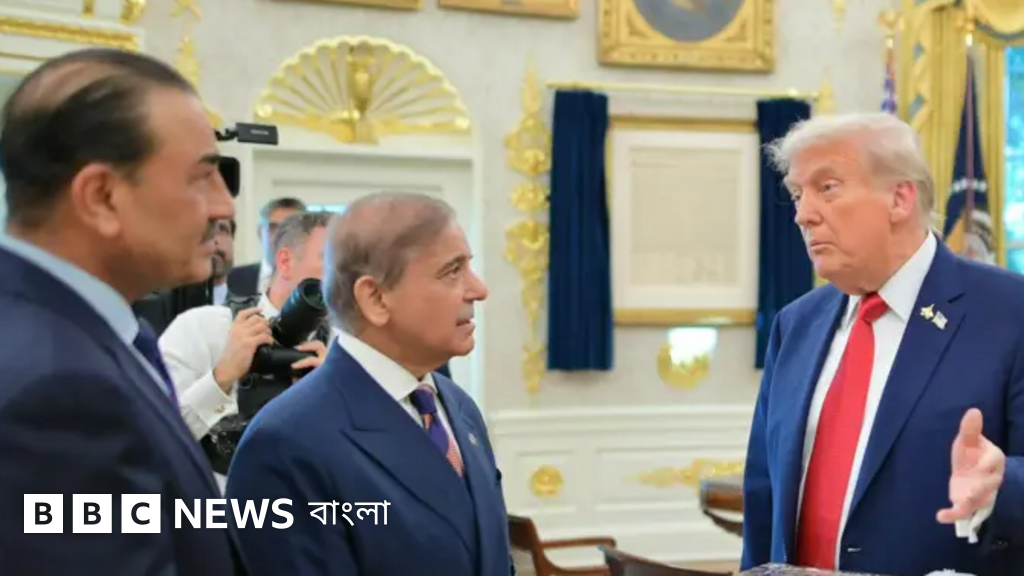
image source, Office of the Prime Minister of Pakistan
Reading time: 5 minutes
On the one hand, while there are conflicting reports on talks between the US and Iran, Pakistan’s name is emerging as a possible mediator.
US President Donald Trump has given Iran 48 hours to open the Strait of Hormuz. He then said that if Iran does not comply with the conditions, the US will “wipe out” the country’s power plants.
The US President made the threat on his social media platform ‘Truth Social’ at 5:30 a.m. Pakistan time last Sunday.
But just hours before the deadline, President Trump announced on Monday that he was suspending all attacks on Iran.
He said there had been “very positive, productive and constructive discussions” between the US and Iran on de-escalation.
However, Iran’s foreign ministry has denied any talks between Tehran and Washington.
Iran’s foreign ministry described Trump’s remarks as an attempt to lower fuel prices and delay their military plans.
“There have been no discussions with the United States,” said Mohammad Bagher Ghalibaf, speaker of the Iranian parliament.
He wrote on social media X that ‘fake news’ is being used to ‘influence’ financial and oil markets.
However, a senior Iranian official told CBS News, the BBC’s US partner, that “we have received some proposals or points from the US through intermediaries, and they are currently being reviewed.”
Despite Iran’s outright denials, not only are talks now rumored, but there are also reports that Iran’s neighbor Pakistan is playing the role of mediator and has even offered to hold talks in the country’s capital, Islamabad.

image source, Office of the Prime Minister of Pakistan
Name of Pakistan as Mediator
Citing reports from the British newspaper Financial Times and the American digital news website Axios, BBC correspondent Bernd Debsman Jr. said from the White House that Pakistan is going to appear as a mediator in possible talks to resolve the conflict that arose after the attack on Iran by the United States and Israel.
The BBC’s Washington correspondent Daniel Bush also wrote that “the talks between the US and Iran are likely to be held in Pakistan and the US will be represented by Vice President JD Vance.”
The BBC’s security correspondent Frank Gardner also mentioned Pakistan by name in various reports.
According to him, a US report said that talks were held between the parties last Sunday. That discussion also included Donald Trump’s preferred emissaries, Steve Wittkoff and Jared Kushner.
According to Frank Gardner, ‘Another, more reliable report – Egypt, Türkiye and Pakistan were involved as mediators in the talks.’
Meanwhile, Pakistani foreign ministry spokesman Tahir Hussain Andrabi told the BBC’s Carrie Davis, “Islamabad is always ready to host talks if the parties want. Pakistan has consistently supported dialogue and diplomacy to maintain peace and stability in the region.”

image source, Reuters
However, Pakistan’s Foreign Office spokesperson also said that they would neither confirm nor deny talks with any party.
Meanwhile, the US television channel CNN, citing sources, claimed that the US had sent a list of its expectations containing 15 points to Iran through Pakistan.
However, it is not yet clear whether Iran has agreed to any of these proposals.
CNN also claimed that Pakistan’s intelligence chief, Lt. Gen. Asim Malik, is among the officials who are in contact with Witkoff and Kushner.
Although it has not been officially confirmed by the US or Iran, Pakistan’s role does not come as a surprise to many in Washington.
Besides Iran, Pakistan also has close ties with the Trump administration.
Pakistan Army Chief Asim Munir met Trump in June and September last year. Asim Munir was accompanied by Pakistan Prime Minister Shahbaz Sharif during the September visit.
Pakistan nominated Trump for the Nobel Peace Prize in June and October for his mediation efforts during the India-Pakistan dispute.
The move has increased sympathy for Asim Munir in the eyes of many members of the Trump administration.

image source, Anadolu via Getty Images
“It is not uncommon for Pakistan to emerge as a potential mediator between the United States and Iran,” wrote American foreign policy expert Michael Kugelman on X (formerly Twitter).
He said that there have been several high-level meetings between Pakistan and Iran in the past year and that “the US administration also likes Pakistan”.
According to Michael Kugelman, “Trump says that Asim Munir understands Iran better than most people. It is also worth noting that Pakistan represents Iran’s diplomatic interests in the United States.”
Former Pakistani diplomat Shamshad Ahmed believes that if Pakistan is given the role of a mediator, it could be because Pakistan nominated US President Donald Trump for the Nobel Peace Prize.
Speaking to BBC correspondent Umair Mahmood, he said, “If this happens (ie if Pakistan plays the role of mediator), then it will be a good opportunity for the country to play a positive role.”
But according to Shamshad Ahmed, “it is not possible to make any preconceived notions about Trump’s intentions.”
But if Pakistan plays the role of a mediator, how acceptable will it be to Iran?
In response to this question, Shamshad Ahmed said, “Iranians will trust Pakistan more than any Arab country.”
It may be noted here that Iran’s third Supreme Leader Mojtaba Khamenei said in a written statement on the occasion of Nowruz that “Pakistan was a ‘special favorite’ country of his father Ali Khamenei.”
Politician and former human rights minister Shireen Mazari welcomes Pakistan’s potential role in the talks, but has doubts and concerns about how Israel and Donald Trump will react.
In a post on X, he said, “Who can guarantee the behavior of an unruly country like Israel? And who can guarantee that Trump will stick to a peace deal?”

image source, Getty Images
Communication between top officials of Iran and Pakistan
Amid conflicting reports of talks between the US and Iran and reports about Pakistan’s possible role, senior Pakistani and Iranian officials have been in touch with each other.
The words ‘negotiation and diplomacy’ are prominent in the official statement issued after this communication.
Pakistan Prime Minister Shahbaz Sharif spoke to Iranian President Masoud Pezheshkian on telephone on Monday.
He wrote in his X post, “As a neighboring and brotherly country, I stand in solidarity with the brave Iranian people on behalf of Pakistan. I offer my sincere condolences for the loss of life in the war and wish the injured a speedy recovery.”
In the statement, the Pakistani prime minister also said that in his conversation with the Iranian president, “a consensus was reached on de-escalation, dialogue and maintaining diplomacy”.
Shahbaz Sharif mentioned in his post that Pakistan will play its constructive role for regional peace.
After that, Deputy Prime Minister and Foreign Minister Mohammad Ishaq Dar spoke to Iran’s Foreign Minister Abbas Araghchi on the phone.
A statement issued by Pakistan’s foreign ministry said the two leaders discussed the recent regional situation and Mohammad Ishaq Dar “stressed the importance of dialogue and diplomacy to promote peace, security and stability”.
https://www.bbc.com/bengali/articles/c78l92678ywo?at_medium=RSS&at_campaign=rss

