

image source, Getty Images
Reading time: 6 minutes
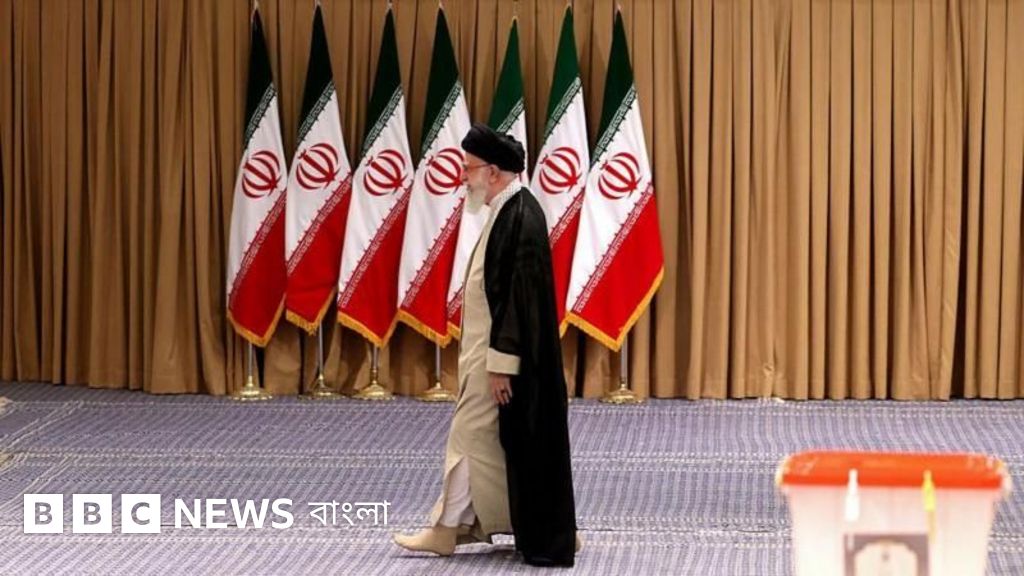
Iran’s supreme leader Ayatollah Seyed Ali Khamenei, who was killed in US and Israeli strikes, was the country’s most powerful man.
After the 1979 Islamic Revolution, the post of Supreme Leader was created in the Iranian constitution. It was headed by Ayatollah Khomeini, who was appointed as the first supreme leader on December 13, 1979.
Ayatollah Khomeini served this duty for nine years and six months.
After his death in 1989, Ayatollah Ali Khamenei was elected as the country’s second supreme leader. He held this position for 36 years and six months until his death on February 28, 2026.
Who holds the power until the new supreme leader is elected?
According to Article 111 of Iran’s constitution, a three-member council temporarily assumes leadership from the Supreme Leader’s death until a new Supreme Leader is appointed.
The members of this council are the president of the country, the head of the judiciary and a jurist from the Guardian Council, who are nominated by a body called the ‘Expediency Council’.
However, the power of this three-member council is limited.
The cases in which the approval of three-fourths of the members of the ‘Explanatory Council’ is required to carry out their decisions include––
1. Determining the general policies of the state
2. Promulgation of referendum decree
3. Declaration of war or peace
4. Impeach the President
5. Appointment and dismissal of the Chief of Joint Staff, Commander-in-Chief of the Revolutionary Guards or top military and law enforcement commanders.
Even if the supreme leader is temporarily unable to perform duties due to illness or accident, this council performs the same duties.

image source, Getty Images
Election of Supreme Leaders Council and Supreme Leader
Iran is the most powerful Shia-majority country in the world, and according to the country’s constitution, only an ‘ayatullah’—the Shia religious leader—can be supreme leader.
But Ali Khamenei was not Ayatollah when he was elected. The law was changed to bring him to this position.
In Iran, the ‘Supreme Leaders Council’, consisting of 88 clerics, elects the supreme leader. Every eight years, billions of Iranian citizens elect members of this council. The last election was held in 2016.
However, to become a member of the supreme leader’s council, the Guardian Council’s approval is required first. The members of this council are directly or indirectly nominated by the current Supreme Leader.
It is clear that the Supreme Leader wields influence over both the Guardian Council and the Supreme Leaders Council. Over the past three decades, Ayatollah Ali Khamenei ensured a conservative majority in these organizations.
Currently, the chairman of this council is Mohammad Ali Mohidi Kermani, and Hashem Hosseini Bushehri and Ali Reza Urfi are serving as deputy-chairmen.
According to the rules, the presence of at least two-thirds of the members (59 people) is necessary for the Parishad meeting to be valid.
The election of a new supreme leader requires the support of two-thirds of the members present. That is, if only 59 members are present, then the new Supreme Leader can be elected if he gets 40 votes.

image source, Getty Images
Commission for Eligibility of Prospective Candidates
A commission of the Supreme Leaders Council is responsible for reviewing the qualifications of potential candidates who may be considered suitable as Supreme Leaders.
Important members of this commission include Ahmad Hosseini Khorasani, a member of the Guardian Council of Jurisprudence; Guardian Council members Ali Reza Urfi and Mohammad Reza Madrasi Yazdi; Hashem Hosseini Bushehri, First Vice-President of the Council of Supreme Leaders; Ayatollah Khamenei’s former representative in Europe, Mohsen Mohammadi Araki; Isfahan’s Friday imam and three-time councilor Abulhasan Mahdavi; and Hassan Amoli, the Friday imam of Ardabil.
How long does the election take?
There is no fixed deadline for the election of a new supreme leader. Since a three-member interim council has been formed, there will not be a power vacuum, at least on paper.
However, after the death of Ayatollah Ruhollah Khomeini, the founder of the Islamic Republic, it can be seen from the events that happened – in such a situation, the council of the supreme leader made a relatively quick decision in the election of the successor.
Khomeini died shortly after 10:00 p.m. on June 4, 1989, and the Supreme Leaders Council convened a meeting the next morning to determine his successor within hours.

image source, Getty Images
The importance of the position of supreme leader
According to Article 57 of the Constitution of Iran, “The government of the Islamic Republic of Iran is divided into three branches: the Legislature, the Judiciary and the Administration. These three bodies are governed by the leadership of the Ummah and the guardianship of the State according to the various provisions of the Constitution”.
Although Iranian politics is multidimensional, the supreme leader’s position has been at the center of public opinion and political activity since day one due to concerns about national security and the existence of an Islamic revolution.
Although the constitution allows for monitoring and expression of the leader, the supreme leader is considered a symbol of the Islamic revolution and opposing him is considered taking a stand against the revolution.
According to Article 91 of the Iranian Constitution, six of the 12 members of the Guardian Council are nominated by the Supreme Leader, and according to Article 157 he appoints the Chief Justice.
Article 110 empowers him to formulate the general policies of the state in consultation with the Expediency Council, as well as to supervise the entire administration.
The leader has the power to call a referendum.
He appoints the heads of all Iranian forces, especially the Revolutionary Guards, and has sole authority to declare war.
After the presidential election, the appointment letter of the winner is also issued by the supreme leader.
He also has the power to remove the President—but only if the Chief Justice finds the President guilty of an offense or Parliament disqualifies the President under Article 89.
In case of disagreement between different branches of the state, the leader is consulted.
The Guardian Council is, however, consulted on the interpretation of the Constitution.
The Supreme Leader is the chief appointee of the state broadcaster.
He also has the power to pardon those convicted by the judiciary. Besides, he can delegate some of his powers to someone else if he wants.
According to Article 60 of the Constitution, the President exercises executive powers with the assistance of his ministers—except for those executive powers that the Constitution reserves for the Supreme Leader. In practice, the Supreme Leader delegates the power of the Supreme Commander of the Armed Forces to the President.

image source, Getty Images
The Supreme Leader and the Iranian Armed Forces
Iran’s armed forces include the Revolutionary Guards—its ground, naval and air wings—and the Quds Force. Besides, conventional military forces or ‘Army of Iran’ are also part of the country’s military power.
He is the supreme leader of all these forces and has the power to appoint their commanders.
There are believed to be more than one crore volunteers known as ‘Basis’ in Iran. Ayatollah Khomeini announced the establishment of this force, whose purpose was to ‘protect the Islamic revolution’. The official name is ‘Basis Organization for the Oppressed’.
It was initially an independent organization, but was later incorporated as part of the Revolutionary Guard. Its head is also appointed by the supreme leader. Basij’s administrative staff work on government salaries, but ordinary volunteers work without remuneration.

image source, Reuters
Who can be the successor after Ayatollah Ali Khamenei?
After the death of Ali Khamenei, the most important question is who will be his successor?
Ali Khamenei did not develop the mass popular support of his predecessor, Imam Khomeini, but he did have the support of key commanders in Iran’s Revolutionary Guards.
As a result, the Revolutionary Guard leadership may have influence in the election of the new Supreme Leader—a realistic possibility.
During Khamenei’s lifetime, two people were considered by many to be particularly important to him – his son, Mojtaba Khamenei, and the head of the judiciary, Ebrahim Raisi. Among them, Ebrahim Raisi died in a helicopter crash in 2024.
https://www.bbc.com/bengali/articles/c9wn7dxq88xo?at_medium=RSS&at_campaign=rss

