

Parth Shankar Saha
After waking up at dawn, the first thing he does is no longer checking his phone. Instead, he takes a few pills from a small white bottle kept on the table. He is only 24, yet this routine entered his life in December last year. The young man from the capital’s northeastern area is now afraid to reveal his identity even to friends and relatives. Just a few months ago, he was the liveliest member of a group of five friends.
When his weight began dropping unusually and weakness increased, he became suspicious. On friends’ advice, he took an HIV test, the virus that causes AIDS. The report came back positive. Later, he learned the infection had spread through a needle used while taking injectable drugs with friends.
He now receives regular ART treatment at a hospital in the capital. The treatment continues and his health has improved somewhat, but the mental pressure does not go away. He says, “I did not know sharing a needle was such a big risk. If I had known, I would never have done it.”
This is not a lone story. Rather, it is a real reflection of the growing HIV infections among young people in Bangladesh.
According to data from the Directorate General of Health Services National AIDS and STD Control Programme, 1,891 people in Bangladesh were infected with HIV in 2025, from December 2024 to November 2025. During the same period, 219 people died of AIDS.
Another story
Another young man lives in the capital’s southeastern area. In November last year, he also learned that he is HIV positive. Doctors believe he was infected through sexual activity with multiple same sex partners.
He currently receives regular treatment and counselling services from the ART Centre at Bangladesh Medical University.
He says, “Whenever people talk about us, they only raise questions of morality, but very few talk about safety.”
The experiences of these two young men show that HIV is no longer limited to any particular group. It is gradually entering the lives of young people, often without their knowledge.
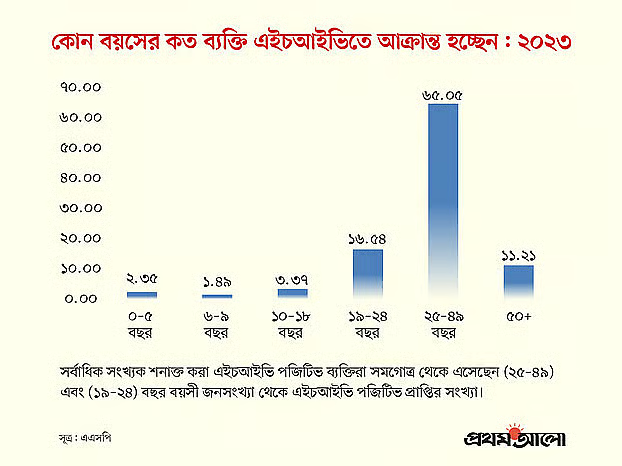
Government figures show that last year, 2025, the rate of HIV detection among unmarried people rose by more than 10 percent. The rate of HIV detection among unmarried adolescents and young adults is increasing day by day.
Public health experts, physicians, and specialists say HIV transmission is rising among young people due to curiosity, misconceptions about sex, lack of awareness, and poor understanding of protective methods. They believe this trend can be reduced through wide ranging awareness programmes on the disease, broader sex education in schools, and an overall rise in public awareness.
What the numbers indicate
According to the Directorate General of Health Services, 42 percent of newly identified HIV cases in 2025 were unmarried young men and women. The share was 31.5 percent in 2024. In other words, within just one year, the infection rate among young people increased significantly.
The situation outside the capital is also worrying. In Jashore, more than 50 people were infected with HIV in 2025. Jashore Civil Surgeon Md Masud Rana told Prothom Alo that the number of school and college students among the infected is relatively high.
He said, “Awareness is low among students of this age, but curiosity is high. That curiosity leads to risky behaviour.” He added that the number of young gay men among these students is also notable.
Why risk is increasing
Public health experts say several factors are working together behind the rise of HIV infections among young people. One is the use of injectable drugs. When the same needle is used by multiple people, infection spreads quickly through blood. Another is risky sexual behaviour, such as not using condoms, having multiple partners, or not knowing a partner’s health status. Silence around sexual health is also believed to contribute to the rise. This is because families and educational institutions do not openly discuss sex and sexual health.
Saima Khan, Country Director of UNAIDS Bangladesh, told Prothom Alo that the infections among unmarried people can generally be assumed to involve those aged around 25. At this age, many seek excitement and want to enjoy life. From that desire, they often engage in reckless sexual behaviour without thinking. In most cases, they do not know the risks. This lack of knowledge stems from a lack of awareness. She said the main reason HIV is spreading among young people is precisely the lack of awareness.
Russell Ahmed, a pseudonym, works for an NGO providing physical health support and counselling for people diagnosed with HIV. He said many boys and girls at a young age do not understand the harm in many cases. Another issue is that there is a social taboo around the protective steps that should be taken. For example, many people become uncomfortable even hearing the word condom. He said these taboos must be broken, and people need a basic understanding of these issues.
Treatment exists, but delay is dangerous
HIV cannot be cured. However, Professor Nazrul Islam, a leading virologist in the country, said that with regular medication an HIV infected person can live a normal life, and the risk of transmitting the virus to others drops significantly. He told Prothom Alo that if HIV infected women and men take medicines regularly, they can lead an almost normal life.
Even so, the reality is that many young people do not get tested for a long time even after becoming infected. Some also delay starting treatment due to social fear and shame.
The young man from Badda says, “I now take my medicines regularly, but I want no one else to make the same mistake as me.”
Sociologists and psychologists believe that interest and curiosity about sex at a young age have always existed, but now it is being expressed in different ways. Social changes are happening very fast, and rapid technological growth plays a role. Social bonds are loosening. New people are arriving in cities alongside fast urbanisation. Technology has also expanded social media massively, and all of this is influencing values, said psychology professor Helal Uddin Ahmed. He told Prothom Alo that technology has increased young people’s access, making it almost barrier free. At the same time, this group lacks awareness and lacks accurate understanding of sexuality.
Attention needed on education and programmes
Professor Nazrul Islam said the rise of HIV among adolescents and young adults is worrying. He said this age group is at risk. To reduce that risk, attention must be paid to how much reproductive health education is being provided at the school level. Multiple organisations are working to prevent HIV transmission. He said it is the responsibility of the government’s health ministry to monitor how effective that work is, and to follow up through observation and oversight.

