

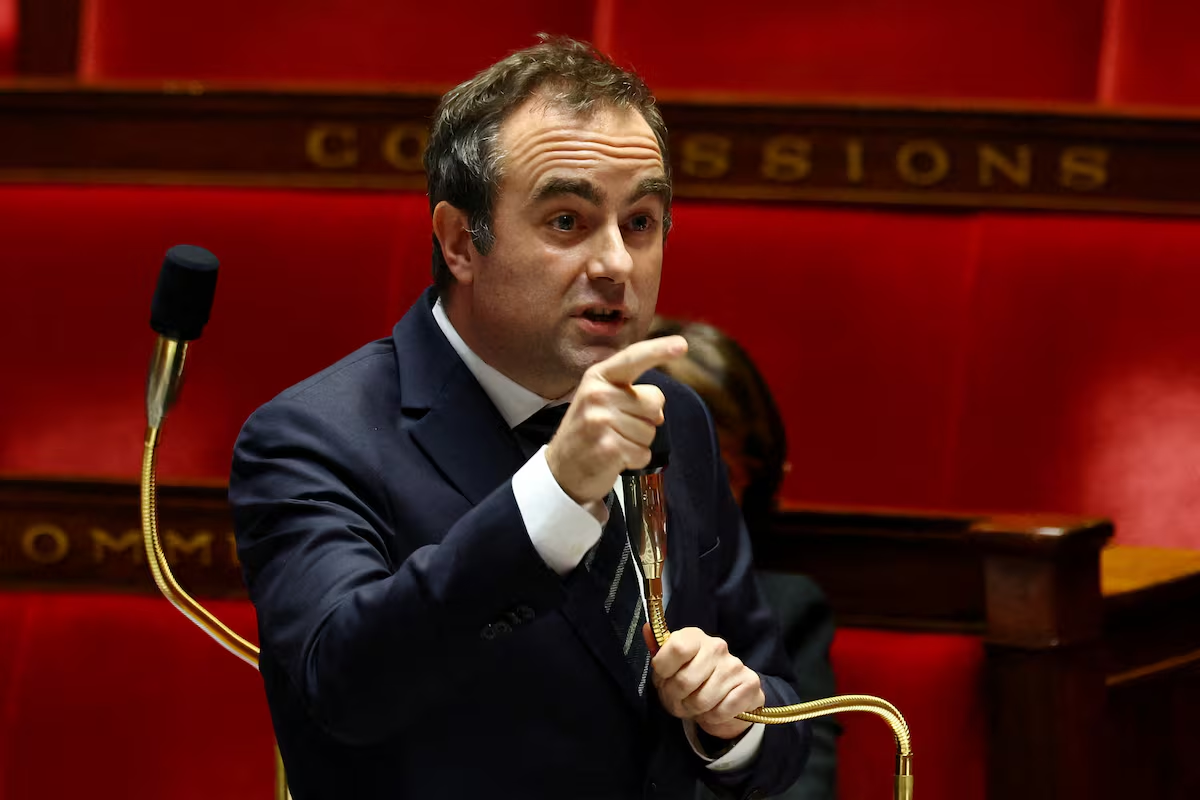
The French Prime Minister, Sébastien Lecornuhis second career began well (the first lasted 27 days). The head of the Government, faithful collaborator of the president Emmanuel Macronshowed signs of political empathy, negotiating ability and a certain complicity with the socialists, who avoided overthrowing his Executive and raised the trophy of suspending the reform of the controversial pension law before Christmas. Lecornu promised to agree on the budget law in the National Assembly, to negotiate, to agree. But, as time has passed, time has run out. And also good intentions. The Executive must now resort to the ordinances that allow the accounts to be carried out or to article 49.3 of the Constitution, to do so by decree. Just what he promised not to do.
Given the lack of a sufficient parliamentary majority and the systematic opposition of the two ideological extremes of the hemicycle, the left of La Francia Insumisa and the extreme right of the National Regroupment (RN)the prime minister announced this Friday night new social measures to convince undecided parties. “It was not a fundamental divergence, but a cynical and deliberate strategy,” he said regarding the opposition of the opposition formations. Lecornu, however, did not explain what method he will use to approve the accounts.
The legal shortcut to bypass Parliament to approve the budget It would inevitably provoke a motion of censure, which would threaten the fall of the Government, unless it includes modifications to the project that appease the socialist deputies. And that is what Lecornu was quick to do in his speech, in which he announced that the State accounts will include an increase of 50 euros per month on average in the activity bonus, an income supplement intended for workers with modest salaries, for “more than three million households.” There will also be “no tax increase for households” in the future budget, he promised, ensuring that the tax deduction for retirees will be maintained and that the income tax scale will be reindexed according to inflation.
Doubts
Lecornu’s speech has not cleared up the doubts that hang over the continuity of the Government. In recent days, the Elysée and the Executive have threatened the parties with a dissolution of the National Assembly and new legislative elections if an agreement is not reached. That extreme, which would force elections to be held at the same time as the municipal elections in March, remains up in the air after Lecornu did not clarify the method he plans to use.
The 2026 budgets could not be approved at the end of last year, when it should have been done. The Executive chose in mid-December to resort to a special law to achieve a kind of budget extension, but insisting that it wanted to try the debate again in January. It has not been possible. Now he can only go back on his promise not to resort to article 49.3, or use the route of ordinances for the first time in the history of the Fifth Republic. This second option would allow him to provide the country with a budget, even if the prime minister were overthrown by a vote of no confidence. That is the main difference with respect to the decree.
The option of ordinances requires that Parliament has not ruled on the budget within a period of 60 days, a time that has already been largely exceeded. A simple regulatory act would be enough to approve the budget, as provided for in article 47 of the Constitution. This would definitively replace the special law adopted in December to avoid chaos.
Lecornu stressed in his speech that one of the essential conditions for this year’s public accounts is that the deficit does not exceed 5% of GDP in order to fulfill the commitment made with its European partners to reduce it to a maximum of 3% in 2029. In 2025, the first anticipations suggest that the deficit was 5.4% of GDP, after in 2024 it had shot up to 5.8%
At the end of his speech without indicating whether he would have his budget approved through article 49.3 or by ordinances, Sébastien Lecornu expressed his “true disappointment”, his “sadness” and his “concern” at the blockage carried out, according to him, by the opposition in Parliament. “I wanted to take a new approach. I’m not giving up on that.”
The underlying problem is that many of the parties are already thinking about the 2027 Presidential Elections and consider this legislature amortized. And the decisions they make in the coming days in the National Assembly will already have a more electoral than legislative character.
https://elpais.com/internacional/2026-01-16/lecornu-renuncia-a-su-compromiso-de-consensuar-los-presupuestos-de-francia-para-evitar-la-caida-de-su-gobierno.html

